
Andere Kunden interessierten sich auch für
 Matrix Methods for Advanced Structural Analysis121,99 €
 Dynamic Analysis of Structures234,99 €
 Applied Thermodynamics in Unit Operations127,99 €
 Computational Techniques of Rotor Dynamics with the Finite Element Method85,99 €
 Theories and Analyses of Beams and Axisymmetric Circular Plates45,99 €
 Earth Pressure and Earth-Retaining Structures60,99 €
 Aircraft Design Concepts49,99 €


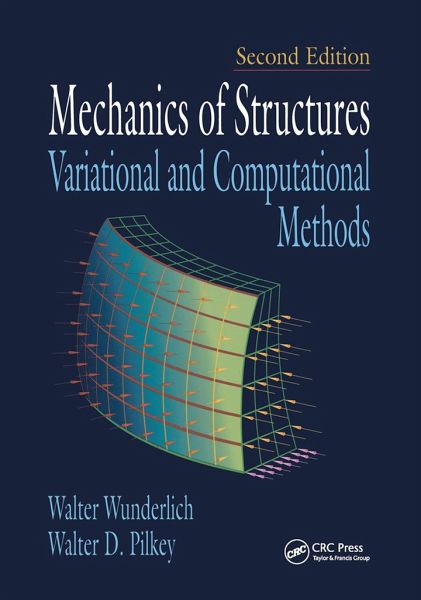
Resoundingly popular in its first edition, the second edition of Mechanics of Structures: Variational and Computational Methods promises to be even more so, with broader coverage, expanded discussions, and a streamlined presentation.
The authors begin by describing the behavior of deformable solids through the differential equations for the strength of materials and the theory of elasticity. They next introduce variational principles, including mixed or generalized principles, and derive integral forms of the governing equations. Discussions then move to computational methods, including the finite element method, and these are developed to solve the differential and integral equations.
New in the second edition:
A one-dimensional introduction to the finite element method, complete with illustrations of numerical mesh refinement
Expansion of the use of Galerkin's method.
Discussion of recent developments in the theory of bending and torsion of thin-walled beams.
An appendix summarizing the fundamental equations in differential and variational form
Completely new treatment of stability, including detailed examples
Discussion of the principal values of geometric properties and stresses
Additional exercises
As a textbook or as a reference, Mechanics of Structures builds a unified, variational foundation for structure mechanics, which in turn forms the basis for the computational solid mechanics so essential to modern engineering.
The authors begin by describing the behavior of deformable solids through the differential equations for the strength of materials and the theory of elasticity. They next introduce variational principles, including mixed or generalized principles, and derive integral forms of the governing equations. Discussions then move to computational methods, including the finite element method, and these are developed to solve the differential and integral equations.
New in the second edition:
A one-dimensional introduction to the finite element method, complete with illustrations of numerical mesh refinement
Expansion of the use of Galerkin's method.
Discussion of recent developments in the theory of bending and torsion of thin-walled beams.
An appendix summarizing the fundamental equations in differential and variational form
Completely new treatment of stability, including detailed examples
Discussion of the principal values of geometric properties and stresses
Additional exercises
As a textbook or as a reference, Mechanics of Structures builds a unified, variational foundation for structure mechanics, which in turn forms the basis for the computational solid mechanics so essential to modern engineering.
"[This book] represents clear progress in this recent custom of popularizing structural mechanics ... . The book includes several important and deep topics that are often neglected in other works of the same kind. It shows a great effort towards completeness. It collects all classical variational principles of continuum mechanics ... . ... [T]he merit of the book resides in its colossal attempt to recombine three branches of the theory of elasticity (foundations, structures, numerical methods), which tend to diverge."
- Meccanica, Vol. 39, 2004
- Meccanica, Vol. 39, 2004