Torben Halkier
Mechanisms in Blood Coagulation, Fibrinolysis and the Complement System
Torben Halkier
Mechanisms in Blood Coagulation, Fibrinolysis and the Complement System
- Broschiertes Buch
- Merkliste
- Auf die Merkliste
- Bewerten Bewerten
- Teilen
- Produkt teilen
- Produkterinnerung
- Produkterinnerung
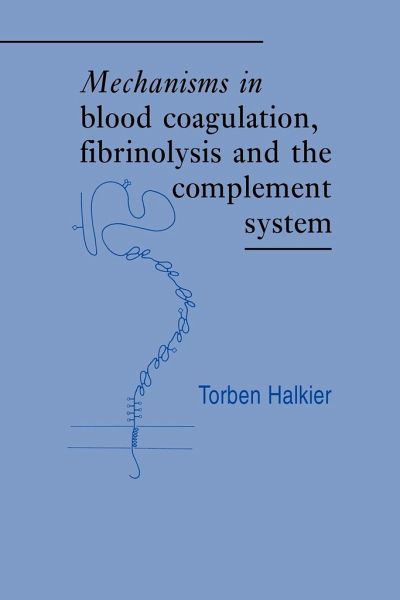
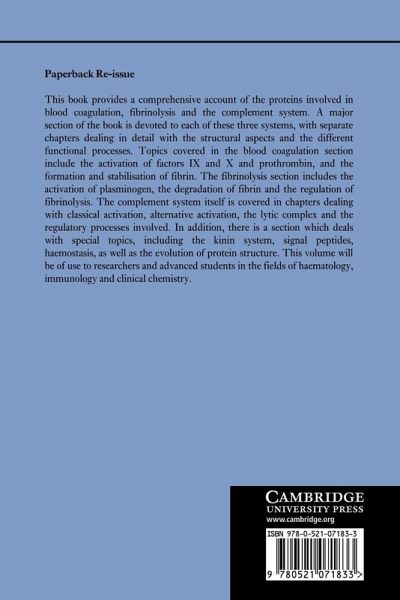
This book presents a thorough explanation and analysis of our current understanding of the proteins and enzymes involved.
Andere Kunden interessierten sich auch für
Torben HalkierMechanisms in Blood Coagulation, Fibrinolysis and the Complement System145,99 €
Signal Transduction in the Cardiovascular System in Health and Disease151,99 €
RotherThe Complement System153,99 €
Janos Szebeni (ed.)The Complement System153,99 €
Structural Biology of the Complement System76,99 €
Structural Biology of the Complement System303,99 €
Leonard WarrenBound Carbohydrates in Nature62,99 €-
-
-
This book presents a thorough explanation and analysis of our current understanding of the proteins and enzymes involved.
Produktdetails
- Produktdetails
- Verlag: Cambridge University Press
- Seitenzahl: 484
- Erscheinungstermin: 6. Mai 2008
- Englisch
- Abmessung: 234mm x 156mm x 26mm
- Gewicht: 728g
- ISBN-13: 9780521071833
- ISBN-10: 0521071836
- Artikelnr.: 24722224
- Herstellerkennzeichnung
- Libri GmbH
- Europaallee 1
- 36244 Bad Hersfeld
- gpsr@libri.de
- Verlag: Cambridge University Press
- Seitenzahl: 484
- Erscheinungstermin: 6. Mai 2008
- Englisch
- Abmessung: 234mm x 156mm x 26mm
- Gewicht: 728g
- ISBN-13: 9780521071833
- ISBN-10: 0521071836
- Artikelnr.: 24722224
- Herstellerkennzeichnung
- Libri GmbH
- Europaallee 1
- 36244 Bad Hersfeld
- gpsr@libri.de
Foreword
Introduction
Part I. Blood Coagulation: 1. The coagulation process: an introduction
2. Contact activation
3. Activation of factor IX
4. Activation of factor X in the intrinsic pathway
5. Activation of prothrombin
6. Activations in the extrinsic pathway
7. Formation and stabilisation of fibrin
8. Regulation of blood coagulation
Part II. Fibrinolysis: 9. Complements of the fibrinolytic system
10. Mechanisms of fibrinolysis
Part III. The Complement System: 11. Overview of the complement system
12. Classical activation of the complement system
13. Alternative activation of the complement system
14. The lytic complex (MAC)
15. Regulation processes in the complement system
16. Anaphylatoxin inactivator
17. Complement reactors
Part IV. Special Topics: 18. The kinin system
19. Glycosylation
20. Signal peptides
21. Modification of amino-acid residues
22. Coagulation-active surfaces in vivo
23. The binding of proteins to coagulation-active surfaces
24. Haemostasis
25. Integrins
26. Serpins
27. Some evolutionary considerations
Appendix
References
Index.
Introduction
Part I. Blood Coagulation: 1. The coagulation process: an introduction
2. Contact activation
3. Activation of factor IX
4. Activation of factor X in the intrinsic pathway
5. Activation of prothrombin
6. Activations in the extrinsic pathway
7. Formation and stabilisation of fibrin
8. Regulation of blood coagulation
Part II. Fibrinolysis: 9. Complements of the fibrinolytic system
10. Mechanisms of fibrinolysis
Part III. The Complement System: 11. Overview of the complement system
12. Classical activation of the complement system
13. Alternative activation of the complement system
14. The lytic complex (MAC)
15. Regulation processes in the complement system
16. Anaphylatoxin inactivator
17. Complement reactors
Part IV. Special Topics: 18. The kinin system
19. Glycosylation
20. Signal peptides
21. Modification of amino-acid residues
22. Coagulation-active surfaces in vivo
23. The binding of proteins to coagulation-active surfaces
24. Haemostasis
25. Integrins
26. Serpins
27. Some evolutionary considerations
Appendix
References
Index.
Foreword
Introduction
Part I. Blood Coagulation: 1. The coagulation process: an introduction
2. Contact activation
3. Activation of factor IX
4. Activation of factor X in the intrinsic pathway
5. Activation of prothrombin
6. Activations in the extrinsic pathway
7. Formation and stabilisation of fibrin
8. Regulation of blood coagulation
Part II. Fibrinolysis: 9. Complements of the fibrinolytic system
10. Mechanisms of fibrinolysis
Part III. The Complement System: 11. Overview of the complement system
12. Classical activation of the complement system
13. Alternative activation of the complement system
14. The lytic complex (MAC)
15. Regulation processes in the complement system
16. Anaphylatoxin inactivator
17. Complement reactors
Part IV. Special Topics: 18. The kinin system
19. Glycosylation
20. Signal peptides
21. Modification of amino-acid residues
22. Coagulation-active surfaces in vivo
23. The binding of proteins to coagulation-active surfaces
24. Haemostasis
25. Integrins
26. Serpins
27. Some evolutionary considerations
Appendix
References
Index.
Introduction
Part I. Blood Coagulation: 1. The coagulation process: an introduction
2. Contact activation
3. Activation of factor IX
4. Activation of factor X in the intrinsic pathway
5. Activation of prothrombin
6. Activations in the extrinsic pathway
7. Formation and stabilisation of fibrin
8. Regulation of blood coagulation
Part II. Fibrinolysis: 9. Complements of the fibrinolytic system
10. Mechanisms of fibrinolysis
Part III. The Complement System: 11. Overview of the complement system
12. Classical activation of the complement system
13. Alternative activation of the complement system
14. The lytic complex (MAC)
15. Regulation processes in the complement system
16. Anaphylatoxin inactivator
17. Complement reactors
Part IV. Special Topics: 18. The kinin system
19. Glycosylation
20. Signal peptides
21. Modification of amino-acid residues
22. Coagulation-active surfaces in vivo
23. The binding of proteins to coagulation-active surfaces
24. Haemostasis
25. Integrins
26. Serpins
27. Some evolutionary considerations
Appendix
References
Index.