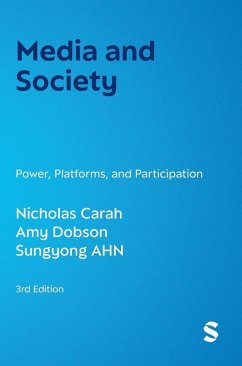
An urgent and compelling introduction that explores the relationship between meaning and power in an age of participatory culture, social media and digital platforms.
An urgent and compelling introduction that explores the relationship between meaning and power in an age of participatory culture, social media and digital platforms.
Nicholas Carah is Director of the Centre for Digital Cultures & Societies and Professor in the School of Communication and Arts at The University of Queensland. He is also an Associate Investigator in the ARC Centre of Excellence for Automated Decision-Making and Society and leads the UQ node of the Australian Internet Observatory. Nicholas is a UQ Teaching Fellow (2018 2019) and has been awarded the Faculty of Humanities and Social Sciences Award for Teaching Excellence (2019) and The University of Queensland Award for Teaching Excellence (2020). Nicholas research has been published in Media, Culture & Society, Cultural Studies, Social Media & Society, New Media & Society, Television & New Media, Convergence, Consumption, Markets & Culture and Mobile Media & Communication. He is the author of Brand Machines, Sensory Media and Calculative Culture (2016), Media and Society: Production, Content and Participation (2015) and Pop Brands: Branding, Popular Music and Young People (2010). He is the co-editor of Digital Intimate Publics and Social Media (2018) and Conflict in my Outlook (2022).
Inhaltsangabe
Chapter 1: Media, Meaning and Power Chapter 2: The Industrial Production of Meaning Making Chapter 3: Platform Media Chapter 4: Social Media, Short Video Streaming and Logistics Chapter 5: Making and Managing Audiences Chapter 6: Participatory and Algorithmic Culture Chapter 7: Algorithmic Imaginaries Chapter 8: Representation Chapter 9: Digital Identities and Intimacies Chapter 10: Creator Cultures Chapter 11: Advertising and Promotional Cultures Chapter 12: News and Strategic Communication Chapter 13: Media Workers Chapter 14: Automation, Representation and Power
Introduction Chapter 1: Meaning, Representation and Power Chapter 2: Representation Chapter 3: The Industrial Production of Meaning Chapter 4: Power and Media Production Chapter 5: Global Networks Chapter 6: Platform Media Chapter 7: Social Media, Streaming and Logistics Chapter 8: Participatory and Algorithmic Culture Chapter 9: Making and Managing Audiences Chapter 10: Producing and Negotiating Identities Chapter 11: News and Strategic Communication Chapter 12: Brand Culture Chapter 13: Media and Communication Professionals Chapter 14: Managing Participation
Chapter 1: Media, Meaning and Power Chapter 2: The Industrial Production of Meaning Making Chapter 3: Platform Media Chapter 4: Social Media, Short Video Streaming and Logistics Chapter 5: Making and Managing Audiences Chapter 6: Participatory and Algorithmic Culture Chapter 7: Algorithmic Imaginaries Chapter 8: Representation Chapter 9: Digital Identities and Intimacies Chapter 10: Creator Cultures Chapter 11: Advertising and Promotional Cultures Chapter 12: News and Strategic Communication Chapter 13: Media Workers Chapter 14: Automation, Representation and Power
Introduction Chapter 1: Meaning, Representation and Power Chapter 2: Representation Chapter 3: The Industrial Production of Meaning Chapter 4: Power and Media Production Chapter 5: Global Networks Chapter 6: Platform Media Chapter 7: Social Media, Streaming and Logistics Chapter 8: Participatory and Algorithmic Culture Chapter 9: Making and Managing Audiences Chapter 10: Producing and Negotiating Identities Chapter 11: News and Strategic Communication Chapter 12: Brand Culture Chapter 13: Media and Communication Professionals Chapter 14: Managing Participation
Rezensionen
Nicholas Carah has provided a crucial and brilliantly written text for our time: a clear-eyed and comprehensive approach to the operation of media power in the era of digital capitalism. Finally, we have a rich resource that does justice to the profound transformations wrought by the media that permeate our social world. Mark Andrejevic
Es gelten unsere Allgemeinen Geschäftsbedingungen: www.buecher.de/agb
Impressum
www.buecher.de ist ein Internetauftritt der buecher.de internetstores GmbH
Geschäftsführung: Monica Sawhney | Roland Kölbl | Günter Hilger
Sitz der Gesellschaft: Batheyer Straße 115 - 117, 58099 Hagen
Postanschrift: Bürgermeister-Wegele-Str. 12, 86167 Augsburg
Amtsgericht Hagen HRB 13257
Steuernummer: 321/5800/1497
USt-IdNr: DE450055826