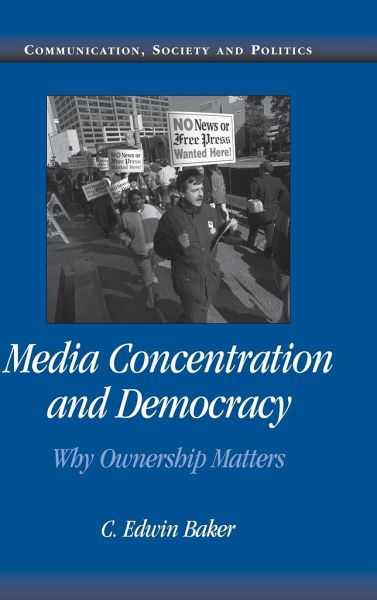
Firmly rooting its argument in democratic and economic theory, the book argues that a more democratic distribution of communicative power within the public sphere and a structure that provides safeguards against abuse of media power provide two of three primary arguments for ownership dispersal. It also shows that dispersal is likely to result in more owners who will reasonably pursue socially valuable journalistic or creative objectives rather than a socially dysfunctional focus on the 'bottom line'. The middle chapters answer those agents, including the Federal Communication Commission, who…mehr
Firmly rooting its argument in democratic and economic theory, the book argues that a more democratic distribution of communicative power within the public sphere and a structure that provides safeguards against abuse of media power provide two of three primary arguments for ownership dispersal. It also shows that dispersal is likely to result in more owners who will reasonably pursue socially valuable journalistic or creative objectives rather than a socially dysfunctional focus on the 'bottom line'. The middle chapters answer those agents, including the Federal Communication Commission, who favor 'deregulation' and who argue that existing or foreseeable ownership concentration is not a problem. The final chapter evaluates the constitutionality and desirability of various policy responses to concentration, including strict limits on media mergers.
C. Edwin Baker is the Nicholas F. Gallicchio Professor of Law at the University of Pennsylvania Law School and has been on the faculty at Penn since 1981. He also taught at NYU, Chicago, Cornell, Texas, Oregon, and Toledo law schools and at Harvard's Kennedy School of Government, and he was a staff attorney for the ACLU. He is the author of three earlier books: Media, Markets, and Democracy (Cambridge University Press, 2002), which won the 2002 McGannon Communications Policy Research Award; Advertising and a Democratic Press (1994); and Human Liberty and Freedom of Speech (1989). He has written more than fifty academic articles about free speech, equality, property, law and economics, jurisprudence, and the mass media, in addition to occasional popular commentary.
Inhaltsangabe
1. Democracy at the crossroads: why ownership matters 2. Not a real problem: many owners, many sources 3. Not a real problem: the market or the net will provide 4. First amendment guarantee of free press - an objection to regulation? 5. Solutions and responses.
1. Democracy at the crossroads: why ownership matters 2. Not a real problem: many owners, many sources 3. Not a real problem: the market or the net will provide 4. First amendment guarantee of free press - an objection to regulation? 5. Solutions and responses.
Es gelten unsere Allgemeinen Geschäftsbedingungen: www.buecher.de/agb
Impressum
www.buecher.de ist ein Internetauftritt der buecher.de internetstores GmbH
Geschäftsführung: Monica Sawhney | Roland Kölbl | Günter Hilger
Sitz der Gesellschaft: Batheyer Straße 115 - 117, 58099 Hagen
Postanschrift: Bürgermeister-Wegele-Str. 12, 86167 Augsburg
Amtsgericht Hagen HRB 13257
Steuernummer: 321/5800/1497
USt-IdNr: DE450055826