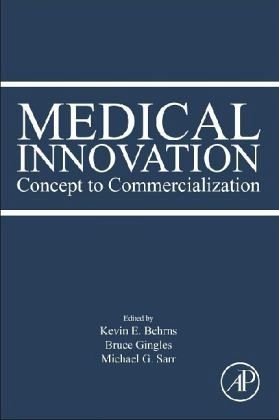
Medical Innovation: Concept to Commercialization is a practical, step-by-step approach on how to move a novel concept through development to realize a commercially successful product. Real-world experience cases and knowledgeable contributors provide lessons that cover the practices of diverse organizations and multiple products. This important reference will help improve success and avoid innovation failure for translational researchers, entrepreneurs, medical school educators, biomedical engineering students and faculty, and aspiring physicians.
Medical Innovation: Concept to Commercialization is a practical, step-by-step approach on how to move a novel concept through development to realize a commercially successful product. Real-world experience cases and knowledgeable contributors provide lessons that cover the practices of diverse organizations and multiple products. This important reference will help improve success and avoid innovation failure for translational researchers, entrepreneurs, medical school educators, biomedical engineering students and faculty, and aspiring physicians.
Die Herstellerinformationen sind derzeit nicht verfügbar.
Autorenporträt
Behrns has more than 20 years of experience as a highly accomplished educator, researcher, physician and administrator. He currently oversees the educational, research, clinical and service activities of SLU's nationally ranked School of Medicine. The CEO of SLUCare, the University's physician practice, reports to Behrns, who also serves as a key liaison with SSM Health, which owns and operates SSM Health Saint Louis University Hospital.
After earning a bachelor's degree in biology from Indiana University, Bruce Gingles joined Cook Medical in in 1979, when relocated to Los Angeles to be the company's first sales representative for the newly formed Critical Care division. He moved to Northern California (Mountain View) in 1984 as regional manager, and to Bloomington, Indiana, in 1991 as director of sales and marketing. Mr. Gingles was promoted to global business leader and vice president in 1999. He now represents Cook in the areas of translational research, commercial regulation and technology assessment. The ethical foundation of commercial relationships and translational algorithms are personal interests. Mr. Gingles serves on the external advisory committee for the Indiana University and UCSF (devices) CTSIs. He has been invited to discuss translational research and medical device innovation at more than 30 CME/CLE-accredited programs in the Asia, Europe and the United States.
Inhaltsangabe
1. Preface 2. Introduction: The role of innovation in improving health outcomes 3. Patent law basics: Strategies for entrepreneurs and start up enterprises 4. Business law basics for new businesses 5. Navigating federal regulation and FDA 6. The role of university technology transfer 7. Can innovation occur in a rural setting 8. Licensing medical devices to manufacturers 9. Understanding health industry venture capital 10. An introduction to the national Institutes of Health SBIR/STTR programs 11. Avoiding common mistakes 12. Medical device clinical trials 13. Managing institutional barriers to physician entrepreneurship 14. Conflict of interest and the "pharmaphobia" narrative 15. Accelerating physician entrepreneurship: Perspective of a recently graduated medical student 16. Accelerating physician entrepreneurship: Perspective of a trainee entrepreneur 17. Preparing America's entrepreneurial workforce: Reinventing the medical curriculum 18. A Dean's Perspective on Entrepreneurship in the University 19. An Editor's perspective on publishing entrepreneurial submissions 20. The role of foundations and professional medical societies in fostering medical innovation 21. Lessons from a serial entrepreneur 22. The CFO as the customer in the process of market adoption in the operating room 23. Technology adoption: Appealing to hospital and health system value analysis 24. Technology adoption: Appealing to payers and capturing economic value 25. Expanding the entrepreneurial workforce 26. Epilogue
1. Preface 2. Introduction: The role of innovation in improving health outcomes 3. Patent law basics: Strategies for entrepreneurs and start up enterprises 4. Business law basics for new businesses 5. Navigating federal regulation and FDA 6. The role of university technology transfer 7. Can innovation occur in a rural setting 8. Licensing medical devices to manufacturers 9. Understanding health industry venture capital 10. An introduction to the national Institutes of Health SBIR/STTR programs 11. Avoiding common mistakes 12. Medical device clinical trials 13. Managing institutional barriers to physician entrepreneurship 14. Conflict of interest and the "pharmaphobia" narrative 15. Accelerating physician entrepreneurship: Perspective of a recently graduated medical student 16. Accelerating physician entrepreneurship: Perspective of a trainee entrepreneur 17. Preparing America's entrepreneurial workforce: Reinventing the medical curriculum 18. A Dean's Perspective on Entrepreneurship in the University 19. An Editor's perspective on publishing entrepreneurial submissions 20. The role of foundations and professional medical societies in fostering medical innovation 21. Lessons from a serial entrepreneur 22. The CFO as the customer in the process of market adoption in the operating room 23. Technology adoption: Appealing to hospital and health system value analysis 24. Technology adoption: Appealing to payers and capturing economic value 25. Expanding the entrepreneurial workforce 26. Epilogue
Es gelten unsere Allgemeinen Geschäftsbedingungen: www.buecher.de/agb
Impressum
www.buecher.de ist ein Internetauftritt der buecher.de internetstores GmbH
Geschäftsführung: Monica Sawhney | Roland Kölbl | Günter Hilger
Sitz der Gesellschaft: Batheyer Straße 115 - 117, 58099 Hagen
Postanschrift: Bürgermeister-Wegele-Str. 12, 86167 Augsburg
Amtsgericht Hagen HRB 13257
Steuernummer: 321/5800/1497
USt-IdNr: DE450055826