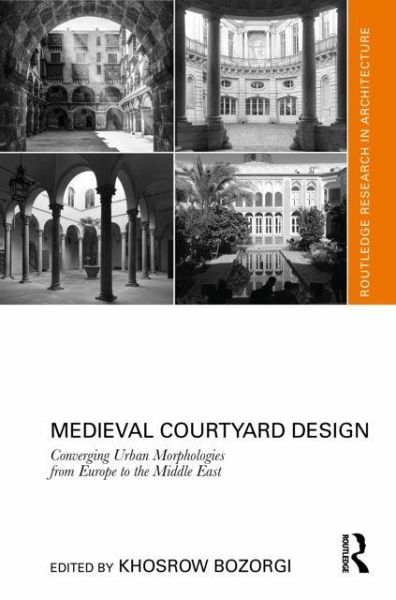
This groundbreaking study examines courtyard architecture across Paris, Florence, Siena, Granada, and Yazd to reveal how the deliberate creation of emptiness-the "bounded void"-functions as architecture's primary generative principle. Moving beyond conventional object-based analysis, the book demonstrates that architecture's essence lies not in built form but in calibrated absence. Through rigorous comparative analysis, readers discover how courtyards operate as environmental mediators, social organizers, and cosmological instruments across diverse cultures. The study reveals striking…mehr
This groundbreaking study examines courtyard architecture across Paris, Florence, Siena, Granada, and Yazd to reveal how the deliberate creation of emptiness-the "bounded void"-functions as architecture's primary generative principle. Moving beyond conventional object-based analysis, the book demonstrates that architecture's essence lies not in built form but in calibrated absence. Through rigorous comparative analysis, readers discover how courtyards operate as environmental mediators, social organizers, and cosmological instruments across diverse cultures. The study reveals striking morphological convergences that emerge through parallel evolution rather than stylistic diffusion. Drawing on spatial cognition research, urban morphology, and phenomenological analysis, the book establishes void-focused methodology as a new theoretical framework. This paradigm shift from analyzing solid to void transforms our understanding of both historical and contemporary spatial practice, uncovering universal principles that transcend geographic and temporal boundaries. Essential for architectural theorists questioning disciplinary orthodoxies, historians seeking alternatives to period-style categorization, and researchers investigating architecture's cognitive dimensions. The work provides both radical historiographical revision and practical insights for contemporary designers who engage with density, sustainability, and social space.
Khosrow Bozorgi is an endowed professor of architecture at the University of Oklahoma's Gibbs College of Architecture. He earned his undergraduate degree from the National University of Iran (1975) and Master's and Ph.D. degrees from the University of Pennsylvania (1980s), specializing in design theory and architectural history. Dr. Bozorgi founded OU's Ph.D. Program in Planning, Design, and Construction and established the Center for Middle Eastern Architecture and Culture. His research examines architectural and urban morphology across the Middle East, North Africa, and Europe. With 40 years of experience at leading American and French firms, he has contributed to major projects across three continents. A Presidential Professor and Graham Foundation grant recipient, his scholarship includes "The Philadelphia House" (2023), exploring how architects blend design principles with local American traditions.
Inhaltsangabe
SECTION ONE: Introduction and Foundation Chapter I: The Courtyard as Adaptable Concept (Khosrow Bozorgi) Chapter II: Convergent Evolution in Courtyard Architecture: A Cross-Cultural Analysis (Khosrow Bozorgi) SECTION TWO: From Cross-Cultural Precedents to Archetypal Urban Formation Chapter III: Paris Courtyards: Definitions and Diversity (Peter Soppelsa) Chapter IV: The Courtyards in Florentine Domestic Architecture of the Medieval and Renaissance Periods (Gianluca Belli, Chapter V: The Courtyard in the Middle Ages Civil Architecture in Siena (Fabio Gabbrielli and Michele Pellegrini, translated by Khosrow Bozorgi) Chapter VI: Granada's Architectural Legacy: A Study of Historic Courtyards and the Alhambra ( Juan Manuel Barrios Rozúa) Chapter VII: Yazd's Spatial Hierarchies: Courtyard Typology and the Genesis of Urban Form (Khosrow Bozorgi) SECTION THREE: Synthesis and Conclusion Chapter VIII: Patterns of Spatial Consonance: Courtyard Architecture as a Collective Language (Khosrow Bozorgi)
SECTION ONE: Introduction and Foundation Chapter I: The Courtyard as Adaptable Concept (Khosrow Bozorgi) Chapter II: Convergent Evolution in Courtyard Architecture: A Cross-Cultural Analysis (Khosrow Bozorgi) SECTION TWO: From Cross-Cultural Precedents to Archetypal Urban Formation Chapter III: Paris Courtyards: Definitions and Diversity (Peter Soppelsa) Chapter IV: The Courtyards in Florentine Domestic Architecture of the Medieval and Renaissance Periods (Gianluca Belli, Chapter V: The Courtyard in the Middle Ages Civil Architecture in Siena (Fabio Gabbrielli and Michele Pellegrini, translated by Khosrow Bozorgi) Chapter VI: Granada's Architectural Legacy: A Study of Historic Courtyards and the Alhambra ( Juan Manuel Barrios Rozúa) Chapter VII: Yazd's Spatial Hierarchies: Courtyard Typology and the Genesis of Urban Form (Khosrow Bozorgi) SECTION THREE: Synthesis and Conclusion Chapter VIII: Patterns of Spatial Consonance: Courtyard Architecture as a Collective Language (Khosrow Bozorgi)
Es gelten unsere Allgemeinen Geschäftsbedingungen: www.buecher.de/agb
Impressum
www.buecher.de ist ein Internetauftritt der buecher.de internetstores GmbH
Geschäftsführung: Monica Sawhney | Roland Kölbl | Günter Hilger
Sitz der Gesellschaft: Batheyer Straße 115 - 117, 58099 Hagen
Postanschrift: Bürgermeister-Wegele-Str. 12, 86167 Augsburg
Amtsgericht Hagen HRB 13257
Steuernummer: 321/5800/1497
USt-IdNr: DE450055826