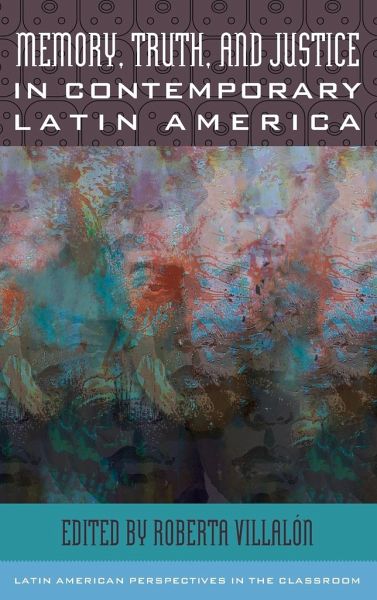
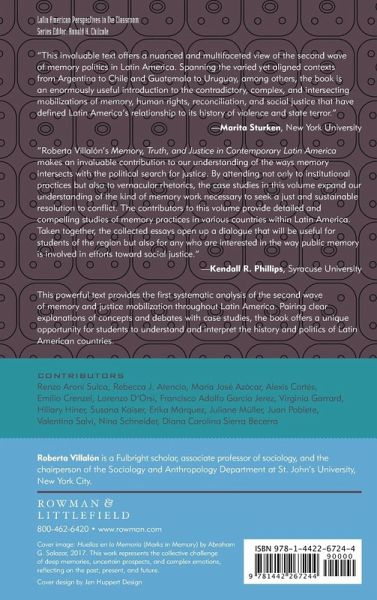
This powerful text provides the first systematic analysis of the second wave of memory and justice mobilization throughout Latin America. Pairing clear explanations of concepts and debates with case studies, the book offers a unique opportunity for students to understand and interpret the history and politics of Latin American countries.
This powerful text provides the first systematic analysis of the second wave of memory and justice mobilization throughout Latin America. Pairing clear explanations of concepts and debates with case studies, the book offers a unique opportunity for students to understand and interpret the history and politics of Latin American countries.
Roberta Villalón is a Fulbright scholar, associate professor of sociology, and the chairperson of the Sociology and Anthropology Department at St. John's University, New York City.
Inhaltsangabe
Introduction Roberta Villalón Part I: Framing Collective Memory: Counter-Hegemonic and Master Narratives Introduction to Part I Roberta Villalón Chapter 1: Genesis, Uses, and Significations of the Nunca Más Report in Argentina Emilio Crenzel Chapter 2: "We're All Victims": Changes in the Narrative of "National Reconciliation" in Argentina Valentina Salvi, translated by Luis Alberto Hernández Chapter 3: Irreconcilable Differences: Political Culture and Gender Violence during the Chilean Transition to Democracy Hillary Hiner and María José Azócar Part II: Defining Historical Periods, Blame, and Reparation Introduction to Part II Roberta Villalón Chapter 4: The Memory of the National and the National as Memory Juan Poblete Chapter 5: Between Two Pasts: Dictatorships and the Politics of Memory in Bolivia Francisco Adolfo García Jerez and Juliane Müller, translated by Margot Olavarria Chapter 6: Colombia's Gallery of Memory: Reexamining Democracy through Human Rights Lenses Erika Márquez Part III: Cultures of Trauma, Healing, and Justice Introduction to Part III Roberta Villalón Chapter 7: Trauma and the Politics of Memory in the Uruguayan Dictatorship Lorenzo D'Orsi Chapter 8: Living with Ghosts: Death, Exhumation, and Reburial among the Maya in Guatemala Virginia Garrard Chapter 9: Argentina's Trials: New Ways of Writing Memory Susana Kaiser Part IV: Arts, Media, Museums, and Memory Introduction to Part IV Roberta Villalón Chapter 10: The Murals of La Victoria: Imaginaries of Chilean Popular Resistance Alexis Cortés, translated by Margot Olavarria Chapter 11: Choreography of a Massacre: Memory and Performance in the Ayacucho Carnaval Renzo Aroni Sulca, translated by Margot Olavarria Chapter 12: Reckoning with Dictatorship in Brazil: The Double-Edged Role of Artistic-Cultural Production Nina Schneider and Rebecca J. Atencio Chapter 13: Historical Memory at El Salvador's Museo de la Palabra y la Imagen Diana Carolina Sierra Becerra Conclusion: Complexities, Controversies and the Value of Collective Memory and Social Justice Roberta Villalón Bibliography About the Contributors
Introduction Roberta Villalón Part I: Framing Collective Memory: Counter-Hegemonic and Master Narratives Introduction to Part I Roberta Villalón Chapter 1: Genesis, Uses, and Significations of the Nunca Más Report in Argentina Emilio Crenzel Chapter 2: "We're All Victims": Changes in the Narrative of "National Reconciliation" in Argentina Valentina Salvi, translated by Luis Alberto Hernández Chapter 3: Irreconcilable Differences: Political Culture and Gender Violence during the Chilean Transition to Democracy Hillary Hiner and María José Azócar Part II: Defining Historical Periods, Blame, and Reparation Introduction to Part II Roberta Villalón Chapter 4: The Memory of the National and the National as Memory Juan Poblete Chapter 5: Between Two Pasts: Dictatorships and the Politics of Memory in Bolivia Francisco Adolfo García Jerez and Juliane Müller, translated by Margot Olavarria Chapter 6: Colombia's Gallery of Memory: Reexamining Democracy through Human Rights Lenses Erika Márquez Part III: Cultures of Trauma, Healing, and Justice Introduction to Part III Roberta Villalón Chapter 7: Trauma and the Politics of Memory in the Uruguayan Dictatorship Lorenzo D'Orsi Chapter 8: Living with Ghosts: Death, Exhumation, and Reburial among the Maya in Guatemala Virginia Garrard Chapter 9: Argentina's Trials: New Ways of Writing Memory Susana Kaiser Part IV: Arts, Media, Museums, and Memory Introduction to Part IV Roberta Villalón Chapter 10: The Murals of La Victoria: Imaginaries of Chilean Popular Resistance Alexis Cortés, translated by Margot Olavarria Chapter 11: Choreography of a Massacre: Memory and Performance in the Ayacucho Carnaval Renzo Aroni Sulca, translated by Margot Olavarria Chapter 12: Reckoning with Dictatorship in Brazil: The Double-Edged Role of Artistic-Cultural Production Nina Schneider and Rebecca J. Atencio Chapter 13: Historical Memory at El Salvador's Museo de la Palabra y la Imagen Diana Carolina Sierra Becerra Conclusion: Complexities, Controversies and the Value of Collective Memory and Social Justice Roberta Villalón Bibliography About the Contributors
Es gelten unsere Allgemeinen Geschäftsbedingungen: www.buecher.de/agb
Impressum
www.buecher.de ist ein Internetauftritt der buecher.de internetstores GmbH
Geschäftsführung: Monica Sawhney | Roland Kölbl | Günter Hilger
Sitz der Gesellschaft: Batheyer Straße 115 - 117, 58099 Hagen
Postanschrift: Bürgermeister-Wegele-Str. 12, 86167 Augsburg
Amtsgericht Hagen HRB 13257
Steuernummer: 321/5800/1497
USt-IdNr: DE450055826