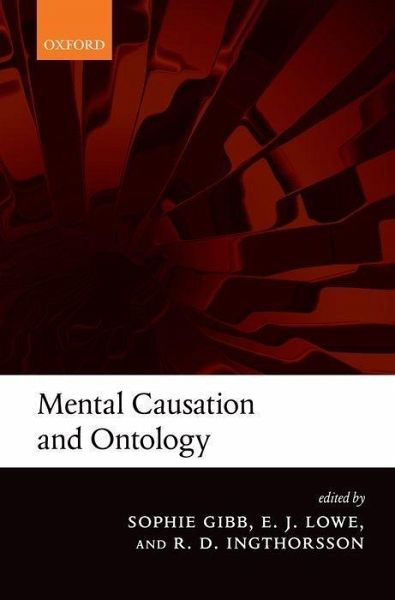
An international team of contributors presents new work on the importance of ontology for a central debate in philosophy of mind. Mental causation has been a hotly disputed topic in recent years, with reductive and non-reductive physicalists vying with each other and with dualists over how to accommodate, or else to challenge, two widely accepted metaphysical principles--the principle of the causal closure of the physical domain and the principle of causal non-overdetermination--which together appear to support reductive physicalism, despite the latter's lack of intuitive appeal. Current…mehr
An international team of contributors presents new work on the importance of ontology for a central debate in philosophy of mind. Mental causation has been a hotly disputed topic in recent years, with reductive and non-reductive physicalists vying with each other and with dualists over how to accommodate, or else to challenge, two widely accepted metaphysical principles--the principle of the causal closure of the physical domain and the principle of causal non-overdetermination--which together appear to support reductive physicalism, despite the latter's lack of intuitive appeal. Current debate about these matters appears to have reached something of an impasse, prompting the question of why this should be so. One possibility is that, while this debate makes extensive use of ontological vocabulary--by talking, for instance, of substances, events, states, properties, powers, and relations--relatively little attempt has been made within the debate itself to achieve either clarity or agreement about what, precisely, such terms should be taken to mean. The debate has become somewhat detached from broader developments in metaphysics and ontology, which have lately been proceeding apace, providing us with an increasingly rich and refined set of ontological categories upon which to draw, as well as a much deeper understanding of how they are related to one another. In this volume, leading metaphysicians and philosophers of mind reflect afresh upon the problem of mental causation in the light of some of these recent developments, with a view to making new headway with one of the most challenging and seemingly intractable issues in contemporary philosophy.
Sophie Gibb is Senior Lecturer in the Department of Philosophy at the University of Durham. She is the author of many journal papers and essays in edited collections, and was awarded the Dialectica essay prize for in 2007. E. J. Lowe is Professor of Philosophy at the University of Durham, and has published over 200 articles on metaphysics, the philosophy of mind and action, the philosophy of logic, the philosophy of language, and early modern philosophy. His books include The Possibility of Metaphysics (OUP, 1998), A Survey of Metaphysics (OUP, 2002), The Four-Category Ontology (OUP, 2005), and Personal Agency (OUP, 2008). R. D. Ingthorsson is a researcher at Lund University in Sweden, and has published articles in The European Journal of Philosophy, Metaphysica, Axiomathes, and the Sats-Nordic Journal of Philosophy.
Inhaltsangabe
* Introduction * 1: John Heil: Mental Causation * 2: Sydney Shoemaker: Physical Realization without Preemption * 3: Peter Menzies: Mental Causation in the Physical World * 4: Paul Noordhof: Mental Causation: Ontology and Patterns of Variation * 5: David Papineau: Causation is Macroscopic but not Irreducible * 6: E. J. Lowe: Substance Causation, Powers, and Human Agency * 7: Jonathan D. Jacobs and Timothy O'Connor: Agent Causation in a Neo-Aristotelian Metaphysics * 8: Sophie Gibb: Mental Causation and Double Prevention * 9: David Robb: The Identity Theory as a Solution to the Exclusion Problem * 10: Peter Simons: Continuant Causation, Fundamentality, and Freedom * 11: Steinvör Thöll Árnadóttir and Tim Crane: There is no Exclusion Problem * Index
* Introduction * 1: John Heil: Mental Causation * 2: Sydney Shoemaker: Physical Realization without Preemption * 3: Peter Menzies: Mental Causation in the Physical World * 4: Paul Noordhof: Mental Causation: Ontology and Patterns of Variation * 5: David Papineau: Causation is Macroscopic but not Irreducible * 6: E. J. Lowe: Substance Causation, Powers, and Human Agency * 7: Jonathan D. Jacobs and Timothy O'Connor: Agent Causation in a Neo-Aristotelian Metaphysics * 8: Sophie Gibb: Mental Causation and Double Prevention * 9: David Robb: The Identity Theory as a Solution to the Exclusion Problem * 10: Peter Simons: Continuant Causation, Fundamentality, and Freedom * 11: Steinvör Thöll Árnadóttir and Tim Crane: There is no Exclusion Problem * Index
Es gelten unsere Allgemeinen Geschäftsbedingungen: www.buecher.de/agb
Impressum
www.buecher.de ist ein Internetauftritt der buecher.de internetstores GmbH
Geschäftsführung: Monica Sawhney | Roland Kölbl | Günter Hilger
Sitz der Gesellschaft: Batheyer Straße 115 - 117, 58099 Hagen
Postanschrift: Bürgermeister-Wegele-Str. 12, 86167 Augsburg
Amtsgericht Hagen HRB 13257
Steuernummer: 321/5800/1497
USt-IdNr: DE450055826