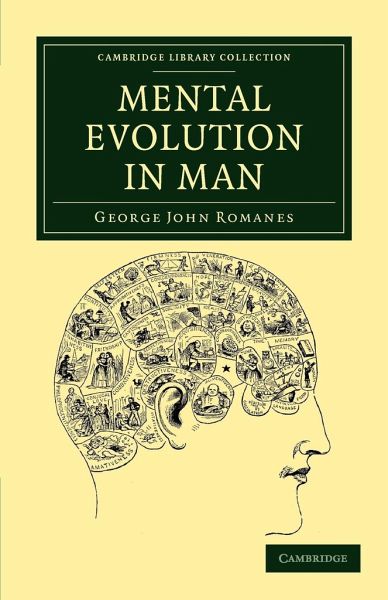
George John Romanes (1848-94) was considered by The Times to be 'the biological investigator upon whom in England the mantle of Mr. Darwin has most conspicuously descended'. Incorporating some of Darwin's unpublished notes, this book explores the question of whether human intelligence evolved. In a stance still often considered controversial at the time of its first printing in 1888, the first half establishes a link between humans and animals, and introduces some of the most important issues of nineteenth-century evolutionary psychology: the impact of relative brain sizes of humans and…mehr
George John Romanes (1848-94) was considered by The Times to be 'the biological investigator upon whom in England the mantle of Mr. Darwin has most conspicuously descended'. Incorporating some of Darwin's unpublished notes, this book explores the question of whether human intelligence evolved. In a stance still often considered controversial at the time of its first printing in 1888, the first half establishes a link between humans and animals, and introduces some of the most important issues of nineteenth-century evolutionary psychology: the impact of relative brain sizes of humans and primates, the origin of self-consciousness and the possible reasons behind the apparent mental stasis of what Romanes terms 'savage man'. Following the argument that one of the main factors to be considered is language, the second half focuses on philology. Romanes' earlier work, Mental Evolution in Animals (1883), is also reissued in this series.
George John Romanes FRS was a Canadian-Scottish evolutionary biologist and physiologist who pioneered comparative psychology by proposing that humans and other animals share cognitive processes and mechanisms. He was the youngest of Charles Darwin's academic friends, and his ideas about evolution are historically significant. He is regarded to originate the phrase neo-Darwinism, which in the late 19th century was seen as a theory of evolution that concentrates on natural selection as the main evolutionary force. However, Samuel Butler used this term with a similar meaning in 1880. George Romanes was born in Kingston, Canada West, in 1848, as the youngest of three boys from a wealthy and highly developed family. His father, Rev. George Romanes (1805-1871), was a Scottish Presbyterian pastor. Two years after his birth, his parents relocated to Cornwall Terrace in London, United Kingdom, paving the way for Romanes' fruitful and long-lasting association with Charles Darwin. Romanes spent time growing up in Germany and Italy, where he became fluent in both languages. His early education was erratic, taking both in public schools and at home. He developed an early interest in poetry and music, at which he excelled.
Inhaltsangabe
Preface 1. Man and brute 2. Ideas 3. Logic of recepts 4. Logic of concepts 5. Language 6. Tone and gesture 7. Articulation 8. Relation of tone and gesture to words 9. Speech 10. Self-consciousness 11. The transition in the individual 12. Comparative philology 13. Roots of language 14. The witness of philology 15. The witness of philology continued 16. The transition in the race 17. General summary and concluding remarks Index.
Preface 1. Man and brute 2. Ideas 3. Logic of recepts 4. Logic of concepts 5. Language 6. Tone and gesture 7. Articulation 8. Relation of tone and gesture to words 9. Speech 10. Self-consciousness 11. The transition in the individual 12. Comparative philology 13. Roots of language 14. The witness of philology 15. The witness of philology continued 16. The transition in the race 17. General summary and concluding remarks Index.
Es gelten unsere Allgemeinen Geschäftsbedingungen: www.buecher.de/agb
Impressum
www.buecher.de ist ein Internetauftritt der buecher.de internetstores GmbH
Geschäftsführung: Monica Sawhney | Roland Kölbl | Günter Hilger
Sitz der Gesellschaft: Batheyer Straße 115 - 117, 58099 Hagen
Postanschrift: Bürgermeister-Wegele-Str. 12, 86167 Augsburg
Amtsgericht Hagen HRB 13257
Steuernummer: 321/5800/1497
USt-IdNr: DE450055826