
Andere Kunden interessierten sich auch für
 Doping für das Gehirn. Neuro-Enhancement und sein erhoffter und tatsächlicher Effekt17,95 €
 Psychosocial Experiences of African Migrants in Six European Countries38,99 €
 Robotics, AI, and Humanity38,99 €
 Buddhism and Psychiatry38,99 €
 Creative Applications of Artificial Intelligence in Education24,99 €
 Robotics, AI, and Humanity64,19 €
 An Interdependent Approach to Happiness and Well-Being23,99 €






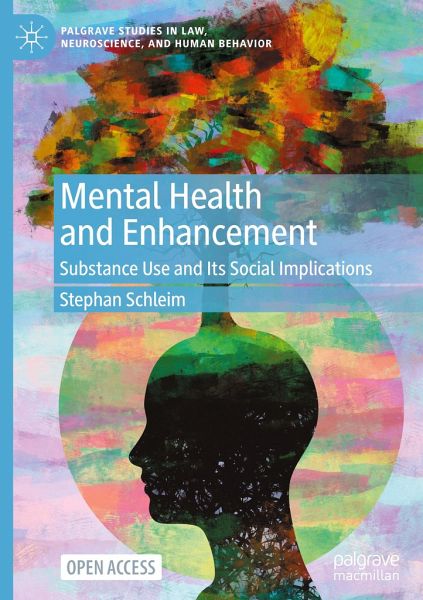
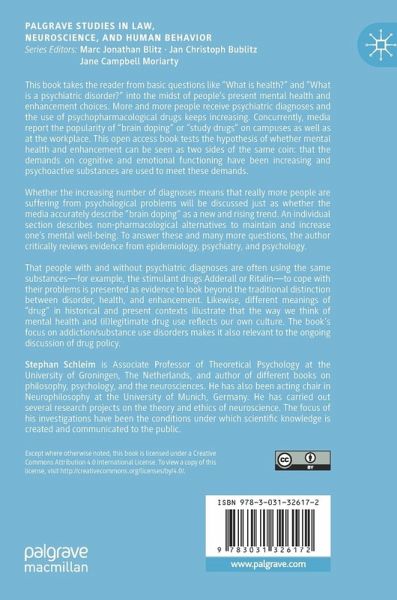
This book takes the reader from basic questions like "What is health?" and "What is a psychiatric disorder?", into the midst of people's present mental health and enhancement choices. More and more people receive psychiatric diagnoses and the use of psychopharmacological drugs keeps increasing. Concurrently, media report the popularity of "brain doping" or "study drugs" on campuses as well as at the workplace. This open access book tests the hypothesis of whether mental health and enhancement can be seen as two sides of the same coin: that the demands on cognitive and emotional functioning have been increasing and psychoactive substances are used to meet these demands.
Whether the increasing number of diagnoses means that really more people are suffering from psychological problems will be discussed just as whether the media accurately describe "brain doping" as a new and rising trend. An individual section describes non-pharmacological alternatives to maintain and increase one'smental well-being. To answer these and many more questions, the author critically reviews evidence from epidemiology, psychiatry, and psychology.
That people with and without psychiatric diagnoses are often using the same substances - for example, the stimulant drugs Adderall or Ritalin - to cope with their problems is presented as evidence to look beyond the traditional distinction between disorder, health, and enhancement. Likewise, different meanings of "drug" in historical and present contexts illustrate that the way we think of mental health and (il)legitimate drug use reflects our own culture. The book's focus on addiction/substance use disorders makes it also relevant to the ongoing discussion of drug policy.
Whether the increasing number of diagnoses means that really more people are suffering from psychological problems will be discussed just as whether the media accurately describe "brain doping" as a new and rising trend. An individual section describes non-pharmacological alternatives to maintain and increase one'smental well-being. To answer these and many more questions, the author critically reviews evidence from epidemiology, psychiatry, and psychology.
That people with and without psychiatric diagnoses are often using the same substances - for example, the stimulant drugs Adderall or Ritalin - to cope with their problems is presented as evidence to look beyond the traditional distinction between disorder, health, and enhancement. Likewise, different meanings of "drug" in historical and present contexts illustrate that the way we think of mental health and (il)legitimate drug use reflects our own culture. The book's focus on addiction/substance use disorders makes it also relevant to the ongoing discussion of drug policy.