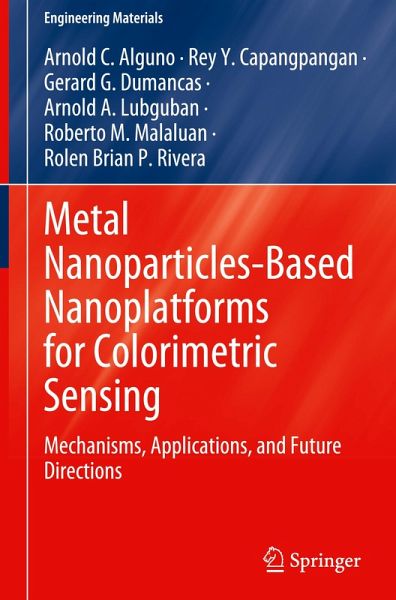
This book highlights an in-depth examination of metal nanoparticles as transformative agents in colorimetric sensing technology. Targeted toward researchers, practitioners, and students in nanotechnology, analytical chemistry, and related fields, this book consolidates the latest advancements in nanoparticle-based colorimetric systems for highly sensitive and selective detection. With chapters dedicated to gold, copper, iron, silver, platinum, and palladium nanoparticles, it explores their unique optical and catalytic properties and their role in diverse applications, from biosensing and environmental monitoring to medical diagnostics and food safety. …mehr
This book highlights an in-depth examination of metal nanoparticles as transformative agents in colorimetric sensing technology. Targeted toward researchers, practitioners, and students in nanotechnology, analytical chemistry, and related fields, this book consolidates the latest advancements in nanoparticle-based colorimetric systems for highly sensitive and selective detection. With chapters dedicated to gold, copper, iron, silver, platinum, and palladium nanoparticles, it explores their unique optical and catalytic properties and their role in diverse applications, from biosensing and environmental monitoring to medical diagnostics and food safety.
Dr. Arnold A. Lubguban is a professor of Chemical Engineering and senior researcher at the Mindanao State University-Iligan Institute of Technology (MSU-IIT) in the Philippines. With a Ph.D. in chemical engineering, his expertise lies in the development of petroleum-based and sustainable polymers, focusing on industrial, environmental, biomedical, and nanotechnology applications. Dr. Lubguban's research is dedicated to advancing renewable materials, with the goal of creating sustainable solutions for industrial and medical sectors. He obtained his Ph.D. from the University of Missouri. Dr. Arnold C. Alguno is a professor of Materials Science and Engineering program at the Mindanao State University-Iligan Institute of Technology (MSU-IIT), specializing in semiconductor physics, solar cell technology, and nanotechnology. He obtained his Ph.D. in physics at Tohoku University, Japan. His research spans a broad range of fields, including sensor technology, quantum dots, and advanced functional materials. Dr. Roberto M. Malaluan is a professor of Chemical Engineering at the Mindanao State University-Iligan Institute of Technology (MSU-IIT) and a pioneering researcher in the field of sustainable polymers and supercritical fluid extraction. He completed his Doctor of Engineering at Tohoku University, Japan. Dr. Malaluan has dedicated his career to teaching and research, particularly focusing on the supercritical carbon dioxide extraction of natural products, a technique he has applied to drug discovery and industrial applications. Dr. Gerard Dumancas is a professor of Chemistry and associate dean of Research and Program Innovation at North Carolina Agricultural and Technical State University. He obtained his Ph.D. in Analytical Chemistry (Chemometrics) from Oklahoma State University. His research interests are in the areas of chemometrics, molecular genetics, analytical chemistry, analytical method development, STEM education, and machine learning techniques as applied to innovative bioenergy solutions.
Inhaltsangabe
Introduction to Metal Nanoparticle-Based Colorimetric Sensing.- Gold Nanoparticle-Based Colorimetric Detection Systems.- Copper Nanoparticles in Colorimetric Sensing.- Iron Nanoparticles for Enhanced Colorimetric Sensing.- Silver, Platinum, and Palladium Nanoparticles in Colorimetric Systems.- Hybrid and Composite Metal Nanoparticles for Colorimetric Sensing.- Applications in Biosensing, Environmental Monitoring, and Medical Diagnostics.- Challenges, Innovations, and Recommendations Conclusion.
Introduction to Metal Nanoparticle-Based Colorimetric Sensing.- Gold Nanoparticle-Based Colorimetric Detection Systems.- Copper Nanoparticles in Colorimetric Sensing.- Iron Nanoparticles for Enhanced Colorimetric Sensing.- Silver, Platinum, and Palladium Nanoparticles in Colorimetric Systems.- Hybrid and Composite Metal Nanoparticles for Colorimetric Sensing.- Applications in Biosensing, Environmental Monitoring, and Medical Diagnostics.- Challenges, Innovations, and Recommendations Conclusion.
Rezensionen
The textbook is organised into nine chapters, each offering a clear summary of recent advances in metal-based nanoparticle technologies for colorimetric sensing over the 2020s. Readers will obtain a straightforward overview of developments related to each metal and its applications as presented in the chapters and can consult the cited literature for further details. (Ross J. Gordon and Huda Shaikh, Johnson Matthey Technology Review, Vol. 70 (1), January, 2026)
Es gelten unsere Allgemeinen Geschäftsbedingungen: www.buecher.de/agb
Impressum
www.buecher.de ist ein Internetauftritt der buecher.de internetstores GmbH
Geschäftsführung: Monica Sawhney | Roland Kölbl | Günter Hilger
Sitz der Gesellschaft: Batheyer Straße 115 - 117, 58099 Hagen
Postanschrift: Bürgermeister-Wegele-Str. 12, 86167 Augsburg
Amtsgericht Hagen HRB 13257
Steuernummer: 321/5800/1497
USt-IdNr: DE450055826