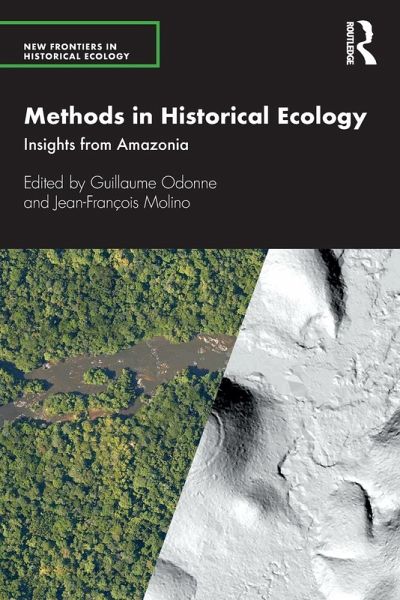
This book presents some of the most recent tools, methods and concepts in historical ecology. It introduces students and researchers to state of the art techniques and showcases a wide array of methods dedicated to understanding the history of tropical landscapes.
This book presents some of the most recent tools, methods and concepts in historical ecology. It introduces students and researchers to state of the art techniques and showcases a wide array of methods dedicated to understanding the history of tropical landscapes.
Guillaume Odonne is affiliated with the Centre National de la Recherche scientifique (CNRS) within the Laboratoire Ecologie, Evolution, Interactions des Systèmes Amazoniens (LEEISA) in Cayenne, French Guiana. Jean-François Molino is based at the Institut de Recherche pour le Développement (IRD) in Montpellier, France. He is deputy director of the Joint Research Unit AMAP (botAnique et Modélisation de l'Architecture des Plantes et des végétations).
Inhaltsangabe
Introduction Part 1: Detection and characterisation of archaeological features 1. Archaeology of invisible landscapes 2. Pedological perspective: concepts and facts 3. Soil micromorphology 4. Physicochemical analysis of Neotropical soils 5. Magnetic properties of soils 6. Geomagnetic survey 7. Pedestrian archaeological surveys in Neotropical rainforests 8. Detecting ditched sites on LiDAR-generated Digital Elevation Models: from technical specifications to interpretation keys Part 2: Living organisms as witnesses of past human activities 9. Phytoliths: a tool for Neotropical historical ecology, with focus on bamboo-dominated forests 10. Anthracology in the tropics: how wood charcoals help us to better understand today ecosystems 11. Forest trees inventories 12. Historical genomics 13. Landscape-scale study of soil communities 14. The multiple roles of soil animals in the interpretation of archaeological soils and sediments in lowland tropical South America Part 3: Ethnoecological knowledge on ancient anthropogenic landscapes 15. History and ethnohistory of ancient settlements 16. Ethnoecology of landscape uses and interpretations 17. From single species to multiethnic ethnobotanical databases to understand past land use 18. Historical ecology as an instrument in defence of forest peoples: reflections from the Tapajós River, Brazil 19. Applied historical ecology Conclusion. Historical ecology: challenges and perspectives in a changing world
Introduction Part 1: Detection and characterisation of archaeological features 1. Archaeology of invisible landscapes 2. Pedological perspective: concepts and facts 3. Soil micromorphology 4. Physicochemical analysis of Neotropical soils 5. Magnetic properties of soils 6. Geomagnetic survey 7. Pedestrian archaeological surveys in Neotropical rainforests 8. Detecting ditched sites on LiDAR-generated Digital Elevation Models: from technical specifications to interpretation keys Part 2: Living organisms as witnesses of past human activities 9. Phytoliths: a tool for Neotropical historical ecology, with focus on bamboo-dominated forests 10. Anthracology in the tropics: how wood charcoals help us to better understand today ecosystems 11. Forest trees inventories 12. Historical genomics 13. Landscape-scale study of soil communities 14. The multiple roles of soil animals in the interpretation of archaeological soils and sediments in lowland tropical South America Part 3: Ethnoecological knowledge on ancient anthropogenic landscapes 15. History and ethnohistory of ancient settlements 16. Ethnoecology of landscape uses and interpretations 17. From single species to multiethnic ethnobotanical databases to understand past land use 18. Historical ecology as an instrument in defence of forest peoples: reflections from the Tapajós River, Brazil 19. Applied historical ecology Conclusion. Historical ecology: challenges and perspectives in a changing world
Es gelten unsere Allgemeinen Geschäftsbedingungen: www.buecher.de/agb
Impressum
www.buecher.de ist ein Internetauftritt der buecher.de internetstores GmbH
Geschäftsführung: Monica Sawhney | Roland Kölbl | Günter Hilger
Sitz der Gesellschaft: Batheyer Straße 115 - 117, 58099 Hagen
Postanschrift: Bürgermeister-Wegele-Str. 12, 86167 Augsburg
Amtsgericht Hagen HRB 13257
Steuernummer: 321/5800/1497
USt-IdNr: DE450055826