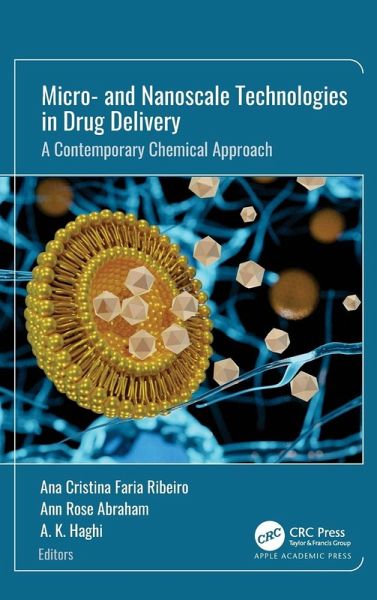
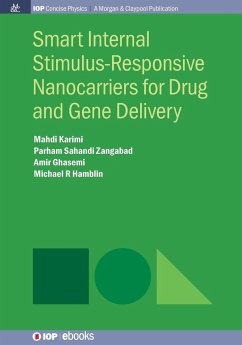
Details latest in the development of controlled drug delivery systems, offering novel perspectives, therapeutics, and strategies for the development of drug delivery. Discusses theoretical and practical aspects of drug delivery for the discovery and development of novel therapeutics for health problems through an interdisciplinary approach.
Details latest in the development of controlled drug delivery systems, offering novel perspectives, therapeutics, and strategies for the development of drug delivery. Discusses theoretical and practical aspects of drug delivery for the discovery and development of novel therapeutics for health problems through an interdisciplinary approach.
Ana Cristina Faria Ribeiro, PhD, is a researcher in the Department of Chemistry at the University of Coimbra, Portugal. Her main areas of research interest are transport properties of ionic and non-ionic components in aqueous solutions. Dr. Ribeiro has supervised master's degree and PhD theses and has been a theses jury member. She has been a referee for various journals, as well an expert evaluator of some of the research programs funded by the Romanian government through the National Council for Scientific Research. She has been a member of the organizing committees of scientific conferences, and she is an editorial member of several journals and has co-edited several books with Apple Academic Press. She is a member of the Research Chemistry Centre, Coimbra, Portugal. Ann Rose Abraham, PhD, is an Assistant Professor at the Department of Physics, Sacred Heart College (Autonomous), Kerala, India. She has collaborated with various international laboratories and has research experience at reputed national institutes, including Bose Institute, SAHA Institute of Nuclear Physics, UGC-DAE Consortium for Scientific Research Centre, all in Kolkata, India. She is a recipient of a young researcher award in physics and best paper awards. She served as Assistant Professor and Examiner at the Department of Basic Sciences, Amal Jyothi College of Engineering, under APJ Abdul Kalam Technological University, Kerala, India. Dr. Abraham is a frequent speaker at national and international conferences and has a good number of publications to her credit in many international journals. A. K. Haghi, PhD, is a retired professor and published more than 1000 publications, including books, book chapters, and papers in refereed journals. He is currently a research associate at the University of Coimbra, Portugal. Professor Haghi has received several grants, consulted for several major corporations, and is a frequent speaker to national and international audiences. He is Founder and former Editor-in-Chief of the International Journal of Chemoinformatics and Chemical Engineering and Polymers Research Journal. He served as a member of the Canadian Research and Development Center of Sciences & Cultures.
Inhaltsangabe
1. Effects of Drug-Loaded Exosomes with a Peptide Linker on Immunogenic Cell Death of Cancer Cells. 2. Drug-Delivery Systems Using Hydrogel Nanocomposite Systems: Physicochemical Characterization. 3. Protein-Based Nanocarriers for Drug Delivery Applications. 4. Cancer Therapy and Treatment Using Functionalized Peptide-Based Nanoformulations: An Environmental Friendly Method of Providing Health Care. 5. Nanosystem Based on a Functionalized Protein for Safer Cancer Treatment. 6. Hydrogel-Assisted Neuroregeneration Techniques for Treating Brain Injuries: A Cutting-Edge Review. 7. Effective Mucoadhesive Custom Biopolymer-Based Nanoparticles for Improved Probiotic Oral Availability: Current Developments and Future Prospects. 8. Current Developments and the Future of Biopolymers for Antitumor Implantable Drug Delivery Systems. 9. Self-Assembled Peptide-Based Nanomaterials for Targeted Drug Delivery. 10. A Review of Green Synthesis and Characterization Techniques for Bismuth Ferrite Nanoparticles and Their Application. 11. Green Synthesis of Nanoparticles in Biomedicine. 12. Application of Artificial Intelligence (AI) in Biomedical Engineering Education. 13. Diffusion in Aqueous Electrolyte Solutions in Clinical and Pharmaceutical Research: Concepts, Models, and Its Impact in the Scientific Community.
1. Effects of Drug-Loaded Exosomes with a Peptide Linker on Immunogenic Cell Death of Cancer Cells. 2. Drug-Delivery Systems Using Hydrogel Nanocomposite Systems: Physicochemical Characterization. 3. Protein-Based Nanocarriers for Drug Delivery Applications. 4. Cancer Therapy and Treatment Using Functionalized Peptide-Based Nanoformulations: An Environmental Friendly Method of Providing Health Care. 5. Nanosystem Based on a Functionalized Protein for Safer Cancer Treatment. 6. Hydrogel-Assisted Neuroregeneration Techniques for Treating Brain Injuries: A Cutting-Edge Review. 7. Effective Mucoadhesive Custom Biopolymer-Based Nanoparticles for Improved Probiotic Oral Availability: Current Developments and Future Prospects. 8. Current Developments and the Future of Biopolymers for Antitumor Implantable Drug Delivery Systems. 9. Self-Assembled Peptide-Based Nanomaterials for Targeted Drug Delivery. 10. A Review of Green Synthesis and Characterization Techniques for Bismuth Ferrite Nanoparticles and Their Application. 11. Green Synthesis of Nanoparticles in Biomedicine. 12. Application of Artificial Intelligence (AI) in Biomedical Engineering Education. 13. Diffusion in Aqueous Electrolyte Solutions in Clinical and Pharmaceutical Research: Concepts, Models, and Its Impact in the Scientific Community.
Es gelten unsere Allgemeinen Geschäftsbedingungen: www.buecher.de/agb
Impressum
www.buecher.de ist ein Internetauftritt der buecher.de internetstores GmbH
Geschäftsführung: Monica Sawhney | Roland Kölbl | Günter Hilger
Sitz der Gesellschaft: Batheyer Straße 115 - 117, 58099 Hagen
Postanschrift: Bürgermeister-Wegele-Str. 12, 86167 Augsburg
Amtsgericht Hagen HRB 13257
Steuernummer: 321/5800/1497
USt-IdNr: DE450055826