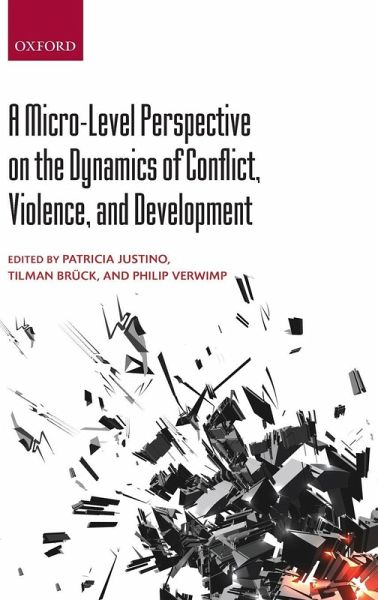
This edited volume analyses violent conflict and its impact on local institutional and development processes. It shows how the behaviour of individuals helps us understand the complex dynamic links between conflict, violence and development.
This edited volume analyses violent conflict and its impact on local institutional and development processes. It shows how the behaviour of individuals helps us understand the complex dynamic links between conflict, violence and development.
Patricia Justino is a development economist specialising in applied microeconomics. Her research work focuses on the impact of violence and conflict on household welfare and local institutional structures, the micro-foundations of violent conflict, and the implications of violence for economic development. Dr Justino has led several research projects funded by the British Academy, DFID, the European Commission, the ESRC, FAO, the Leverhulme Trust, UNDP, UNESCO, UN Women, and the World Bank. She is the Director of MICROCON and co-founder and co-director of the Households in Conflict Network. Since June 2010, she has convened the Conflict, Violence and Development cluster, part of the Vulnerability and Poverty Reduction Team, at the Institute of Development Studies. Tilman Brück is the Director of the Stockholm International Peace Research Institute, and a Professor at Humboldt-University of Berlin. Previously he was Head of the Department of Development and Security at the German Institute for Economic Research. He studied economics at Glasgow University and Oxford University and obtained his doctorate in economics from Oxford University. His research interests focus on the economics of household behaviour and well-being in conflict and post-conflict economies and the economics of terrorism and insecurity. Professor Brück is a co-founder and co-director of the Households in Conflict Network, the coordinator of the Economics of Security Initiative, and the coordinator or deputy coordinator of several European research projects in the 6th and 7th framework programmes. He has also worked as a consultant for BMZ, DFID, the European Commission, GIZ, ILO, KfW, OECD, UNDP, USAID, and the World Bank. Philip Verwimp obtained his PhD in Economics from the Catholic University of Leuven in January 2003 with a dissertation on the political economy of development and genocide in Rwanda. He specialises in the economic causes and consequences of conflict at the micro-level. He has done quantitative work on the death toll of the genocide and on the demography of post-genocide Rwanda. He works on poverty and health in conflict-affected countries. Dr Verwimp was a Fulbright-Hays Fellow at Yale University and worked for the World Bank as a Poverty Economist. He received the Jacques Rozenberg Award from the Auschwitz Foundation for his dissertation. He taught Development Economics at the Institute of Social Studies in The Hague and at the Universities of Antwerp, Leuven, and Utrecht. He was a research fellow from the Fund for Scientific Research (Flanders, Belgium) and visiting fellow at ECARES (2007-2009).
Inhaltsangabe
* Part I: Understanding Violent Conflict from a Micro-Level Perspective * 1: Patricia Justino, Tilman Brück, and Philip Verwimp: Micro-Level Dynamics of Conflict, Violence, and Development: A New Analytical Framework * 2: Timothy Raeymaekers: The Social Geography of Armed Conflict * 3: José Cuesta and Syed Mansoob Murshed: Greed, Grievance, and Globalization * Part II: Individual and Group Motivations in Conflict Processes * 4: Yvan Guichaoua: Group Formation, Identities, and Violent Mobilization: Evidence from Nigeria and Niger * 5: Frances Stewart: Inequality, Conflict, and Policy: A Review of some MICROCON Findings * 6: Michael Emerson: Interculturalism: Europe and its Muslims in Search of Sound Societal Models * Part III: Micro-Level Consequences of Violent Conflict * 7: Julie Litchfield: Poverty, Livelihoods, and Violent Conflict * 8: Philip Verwimp and Olivia D'Aoust: Risk, Security, and Coping Mechanisms in Contexts of Violent Conflict: Evidence from Rwanda and Burundi * 9: Chiara Altare and Debarati Guha-Sapir: The Burden of Armed Conflict: A Public Health Approach * 10: Roger Zetter, Andrea Purdekova, and Ana Maríá Ibáñez Londoño: Violence, Conflict, and Mobility: A Micro-Level Analysis * 11: Colette Harris: What Can Applying a Gender Lens Contribute to Conflict Studies? A Review of Selected MICROCON Working Papers * Part IV: Policy Implications and Future Research Agenda * 12: Carlos Bozzoli, Tilman Brück and Nina Wald: Evaluating Programmes in Conflict-Affected Areas * 13: Nathalie Tocci: EU, Conflict Transformation, and Civil Society: Promoting Peace from the Bottom Up? * 14: Patricia Justino: Research and Policy Implications From a Micro-Level Perspective on the Dynamics of Conflict, Violence, and Development
* Part I: Understanding Violent Conflict from a Micro-Level Perspective * 1: Patricia Justino, Tilman Brück, and Philip Verwimp: Micro-Level Dynamics of Conflict, Violence, and Development: A New Analytical Framework * 2: Timothy Raeymaekers: The Social Geography of Armed Conflict * 3: José Cuesta and Syed Mansoob Murshed: Greed, Grievance, and Globalization * Part II: Individual and Group Motivations in Conflict Processes * 4: Yvan Guichaoua: Group Formation, Identities, and Violent Mobilization: Evidence from Nigeria and Niger * 5: Frances Stewart: Inequality, Conflict, and Policy: A Review of some MICROCON Findings * 6: Michael Emerson: Interculturalism: Europe and its Muslims in Search of Sound Societal Models * Part III: Micro-Level Consequences of Violent Conflict * 7: Julie Litchfield: Poverty, Livelihoods, and Violent Conflict * 8: Philip Verwimp and Olivia D'Aoust: Risk, Security, and Coping Mechanisms in Contexts of Violent Conflict: Evidence from Rwanda and Burundi * 9: Chiara Altare and Debarati Guha-Sapir: The Burden of Armed Conflict: A Public Health Approach * 10: Roger Zetter, Andrea Purdekova, and Ana Maríá Ibáñez Londoño: Violence, Conflict, and Mobility: A Micro-Level Analysis * 11: Colette Harris: What Can Applying a Gender Lens Contribute to Conflict Studies? A Review of Selected MICROCON Working Papers * Part IV: Policy Implications and Future Research Agenda * 12: Carlos Bozzoli, Tilman Brück and Nina Wald: Evaluating Programmes in Conflict-Affected Areas * 13: Nathalie Tocci: EU, Conflict Transformation, and Civil Society: Promoting Peace from the Bottom Up? * 14: Patricia Justino: Research and Policy Implications From a Micro-Level Perspective on the Dynamics of Conflict, Violence, and Development
Es gelten unsere Allgemeinen Geschäftsbedingungen: www.buecher.de/agb
Impressum
www.buecher.de ist ein Internetauftritt der buecher.de internetstores GmbH
Geschäftsführung: Monica Sawhney | Roland Kölbl | Günter Hilger
Sitz der Gesellschaft: Batheyer Straße 115 - 117, 58099 Hagen
Postanschrift: Bürgermeister-Wegele-Str. 12, 86167 Augsburg
Amtsgericht Hagen HRB 13257
Steuernummer: 321/5800/1497
USt-IdNr: DE450055826