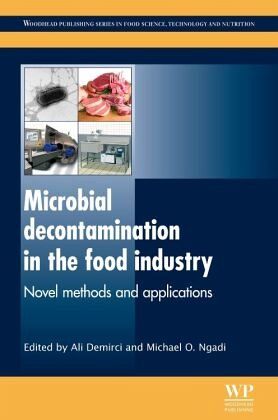
Microbial Decontamination in the Food Industry Novel Methods and Applications Herausgegeben:Demirci, Ali; Ngadi, Michael O
Microbial Decontamination in the Food Industry Novel Methods and Applications Herausgegeben:Demirci, Ali; Ngadi, Michael O Jetzt bewerten Jetzt bewerten
The problem of creating microbiologically-safe food with an acceptable shelf-life and quality for the consumer is a constant challenge for the food industry. Microbial decontamination in the food industry provides a comprehensive guide to the decontamination problems faced by the industry, and the current and emerging methods being used to solve them. Part one deals with various food commodities such as fresh produce, meats, seafood, nuts, juices and dairy products, and provides background on contamination routes and outbreaks as well as proposed processing methods for each commodity. Part …mehr
Andere Kunden interessierten sich auch für
The problem of creating microbiologically-safe food with an acceptable shelf-life and quality for the consumer is a constant challenge for the food industry. Microbial decontamination in the food industry provides a comprehensive guide to the decontamination problems faced by the industry, and the current and emerging methods being used to solve them.
Part one deals with various food commodities such as fresh produce, meats, seafood, nuts, juices and dairy products, and provides background on contamination routes and outbreaks as well as proposed processing methods for each commodity. Part two goes on to review current and emerging non-chemical and non-thermal decontamination methods such as high hydrostatic pressure, pulsed electric fields, irradiation, power ultrasound and non-thermal plasma. Thermal methods such as microwave, radio-frequency and infrared heating and food surface pasteurization are also explored in detail. Chemical decontamination methods with ozone, chlorine dioxide, electrolyzed oxidizing water, organic acids and dense phase CO2 are discussed in part three. Finally, part four focuses on current and emerging packaging technologies and post-packaging decontamination.
With its distinguished editors and international team of expert contributors, Microbial decontamination in the food industry is an indispensable guide for all food industry professionals involved in the design or use of novel food decontamination techniques, as well as any academics researching or teaching this important subject.
Produktdetails
Woodhead Publishing Series in Food Science, Technology and Nutrition Verlag: Elsevier Science & Technology / Woodhead Publishing Artikelnr. des Verlages: C2013-0-16141-7 Englisch Abmessung: 233mm x 155mm x 234mm Gewicht: 1400g ISBN-13: 9780857090850 Artikelnr.: 34749607 Die Herstellerinformationen sind derzeit nicht verfügbar.
Ali Demirci is Professor of Food Engineering in the Department of Agricultural and Biological Engineering at The Pennsylvania State University, USA. Michael O. Ngadi is Professor of Food Engineering in the Department of Bioresource Engineering at McGill University, Canada.
Contributor contact details Woodhead Publishing Series in Food Science, Technology and Nutrition Preface Part I: Microbial decontamination of different food products Chapter 1: Microbial decontamination of fresh produce Abstract: 1.1 Introduction 1.2 Pathogens of concern and pathways of contamination in fresh produce 1.3 Current decontamination methods for fresh produce and their limitations 1.4 Novel methods of fresh produce decontamination 1.5 Conclusions and future trends 1.6 Sources of further information and advice Chapter 2: Microbial decontamination of raw and ready-to-eat meats Abstract: 2.1 Introduction 2.2 Decontamination of carcasses 2.3 Chemical methods for decontamination of carcasses 2.4 Decontamination of fresh meats 2.5 Decontamination of processed meats 2.6 Conclusions and future trends 2.7 Sources of further information and advice Chapter 3: Microbial decontamination of poultry carcasses Abstract: 3.1 Introduction 3.2 Contamination of poultry carcasses and major pathogens of concern 3.3 Antibacterial activity of decontamination treatments for poultry carcasses 3.4 Physical decontamination treatments for poultry carcasses 3.5 Chemical decontamination treatments for poultry carcasses 3.6 Combinations of chemical and physical or of chemical decontamination treatments for poultry carcasses 3.7 Biological decontamination treatments for poultry carcasses 3.8 Conclusions and future trends 3.9 Sources of further information and advice Chapter 4: Microbial decontamination of seafood Abstract: 4.1 Introduction 4.2 Organisms of concern: pathogens that may contaminate fish surfaces 4.3 Pathways of contamination 4.4 Current methods of seafood decontamination 4.5 Novel methods of seafood decontamination 4.6 Regulatory issues surrounding decontamination of seafood 4.7 Conclusions and future trends 4.8 Sources of further information and advice Chapter 5: Microbial decontamination of nuts and spices Abstract: 5.1 Introduction 5.2 Microorganisms of concern in nuts and spices and related outbreaks 5.3 Contamination pathways and persistence of microorganisms in nuts and spices 5.4 Decontamination of nuts 5.5 Decontamination of spices 5.6 The limitations of technologies and the challenges to adoption of technologies for decontamination of nuts and spices 5.7 Strategic issues and research and development priorities 5.8 Sources of further information and advice Chapter 6: Microbial decontamination of juices Abstract: 6.1 Introduction 6.2 Pathogens of concern and potential for contamination 6.3 Current methods of juice decontamination 6.4 Novel methods of juice decontamination 6.5 Future trends 6.6 Sources of further information Chapter 7: Microbial decontamination of milk and dairy products Abstract: 7.1 Introduction 7.2 Important pathogens and pathways of contamination in milk and dairy products 7.3 Decontamination methods for milk and dairy products 7.4 Novel techniques for the decontamination of milk and dairy products 7.5 Conclusions and future trends 7.6 Sources of further information and advice Part II: Current and emerging non-chemical decontamination methods Chapter 8: Advances in food surface pasteurisation by thermal methods Abstract: 8.1 Introduction 8.2 The principles of thermal surface pasteurisation 8.3 Wet heat pasteurisation 8.4 Dry heat pasteurisation 8.5 Selecting the right method 8.6 The limitations of technologies and the challenges to adoption of surface pasteurisation by thermal method