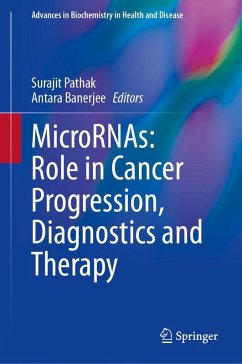
This book describes microRNAs as relevant tools that form a new bridge in modern oncological progress between molecular insights and clinical practice. It also highlights the therapeutic applications, emphasizing their utility in personalized medicine and targeted therapies. MicroRNAs (miRNAs) are short, non-coding RNAs that play a crucial role in regulating gene expression. Their importance in cancer biology has grown significantly in recent years, as they have been found to influence various aspects of cancer development and progression. This book provides a comprehensive overview of the…mehr
This book describes microRNAs as relevant tools that form a new bridge in modern oncological progress between molecular insights and clinical practice. It also highlights the therapeutic applications, emphasizing their utility in personalized medicine and targeted therapies.
MicroRNAs (miRNAs) are short, non-coding RNAs that play a crucial role in regulating gene expression. Their importance in cancer biology has grown significantly in recent years, as they have been found to influence various aspects of cancer development and progression. This book provides a comprehensive overview of the diverse roles of miRNAs in several cancers, from their biogenesis and functions to their potential as therapeutic targets and biomarkers. This book further looks into the critical role of the miRNAs in the tumor microenvironment (TME) and their influence on processes such as epithelial-to-mesenchymal transition, immune modulation, and angiogenesis. The chapters focus on their diagnostic and therapeutic importance in several cancer types, such as colorectal, cervical, lung, and breast cancers, with particular emphasis on cancers that exhibits unusual metastatic patterns such as breast and prostate cancer metastasis to bones. The chapters will additionally address the process by which miRNA-mediated pathways contribute to the development of brain and gynaecological tumors, as well as explores the potential of exosomal miRNAs as non-invasive biomarkers for cancer detection through mechanisms that trigger intracellular signaling within the TME.
The development of AI and bioinformatics has transformed miRNA research, enabling a deeper understanding of miRNA function and facilitating the development of innovative diagnostic and therapeutic strategies. By incorporating them into high-throughput sequencing with machine learning approaches, several models have been developed that have favoured the identification, classification, and prediction of the target functions of miRNAs and their targets, particularly in cancer biology.
Prof. Surajit Pathak, Ph.D., is a leading researcher and academic, currently a Professor at Chettinad Academy of Research and Education in Chennai. He has previously held esteemed positions as Principal Research Scientist at Linkoping University, Sweden, With a Ph.D. from India (2007) and an extensive post-doctoral journey at renowned institutions like the University of Alabama (USA), University of Padova (Italy), and University of Linkoping (Sweden), his research focuses on microRNAs for early colorectal cancer detection. Prof. Pathak has published over 150 research and review articles, earning more than 5000 citations and an h-index of 39. Prof. Pathak is a member of national research societies. Prof. Antara Banerjee, Ph.D., is currently working as a Professor at Chettinad Academy of Research and Education (CARE), Chennai. Dr. Banerjee pursued her post-doctoral research on Cancer Biology and Regenerative Medicine at the University of Padova, Italy, and Linkoping University. She has published over 120 articles with an h-index of 34 and 3804 citations (Google scholar) with 2 patents awarded and 5 filed and secured national and international grants. Dr. Banerjee has edited several books on Stem Cells and Cancer. She is affiliated with professional research bodies and is a member of several national research societies.
Inhaltsangabe
Chapter 1: An Overview of MicroRNA Biology From Biogenesis to Therapeutic Implications.- Chapter 2: The role of microRNA in cancer from molecular insights to therapeutic potential.- Chapter 3: Impact of microRNAs on tumor microenvironment and their therapeutic implications.- Chapter 4: Epigenetic Regulation of microRNA in Cancer.- Chapter 5: MicroRNAs and Cancer Stem Cells Mechanisms and Their Role in Cancer.- Chapter 6: Impending role of exosomal miRNA as a Substantial player in Early Cancer Diagnostics.- Chapter 7: Advanced bioinformatics and Machine Learning methods in the prediction of microRNAs and their targets in cancer.- Chapter 8: MicroRNA Mediated Cell Cycle Regulation in Cancer.- Chapter 9: MicroRNAs in Breast Cancer Diagnostic and Therapeutic Potential.- Chapter 10: miR200c as a master regulator for breast cancer therapeutic and diagnosis.- Chapter 11: Oral Cancer, MicroRNAs, and Cannabinoids A Complicated Ménage à Trois.- Chapter 12: MicroRNAs in lung cancer.- Chapter 13: MicroRNAs and their roles in epigenetic regulation of tumor microenvironment in prostate cancer.- Chapter 14: Role of miRNAs in bone metastasis of prostate cancer, a comprehensive review.- Chapter 15: MicroRNAs for treatment and diagnosis of cancer in bone metastasis.- Chapter 16: Understanding the role of miRNA modulators in gastrointestinal cancers and exploring novel therapeutic capabilities.- Chapter 17: Exploring MicroRNA Mediated Pathways in Gynaecological Cancer Progression and Therapeutic Resistance.- Chapter 18: MicroRNAs involved in the regulation of critical genes and their relevance in the theragnosis of HPV driven cervical cancer.- Chapter 19: Role of microRNA in Intestinal Epithelial Transport and its Mechanism Leading to Colorectal Cancer.- Chapter 20: The Role of MicroRNAs in Hepatocellular Carcinoma Biomarkers and Therapeutic Targets.- Chapter 21: The Role of microRNAs in Cancer Radiotherapy.- Chapter 22: MicroRNAs Innovative Clinical Tools for Diagnosis, Prognosis, and Therapy in Colorectal Cancer.- Chapter 23: Artificial Intelligence Enhanced Insights Leveraging MicroRNA Sequencing Data for Cancer Prognosis and Treatment.- Chapter 24: Exosome Derived microRNAs in Cancer Bridging Mechanistic Insights with Clinical Implementation.- Chapter 25: Emerging Clinical Applications of MicroRNAs in Cancer.
Chapter 1: An Overview of MicroRNA Biology From Biogenesis to Therapeutic Implications.- Chapter 2: The role of microRNA in cancer from molecular insights to therapeutic potential.- Chapter 3: Impact of microRNAs on tumor microenvironment and their therapeutic implications.- Chapter 4: Epigenetic Regulation of microRNA in Cancer.- Chapter 5: MicroRNAs and Cancer Stem Cells Mechanisms and Their Role in Cancer.- Chapter 6: Impending role of exosomal miRNA as a Substantial player in Early Cancer Diagnostics.- Chapter 7: Advanced bioinformatics and Machine Learning methods in the prediction of microRNAs and their targets in cancer.- Chapter 8: MicroRNA Mediated Cell Cycle Regulation in Cancer.- Chapter 9: MicroRNAs in Breast Cancer Diagnostic and Therapeutic Potential.- Chapter 10: miR200c as a master regulator for breast cancer therapeutic and diagnosis.- Chapter 11: Oral Cancer, MicroRNAs, and Cannabinoids A Complicated Ménage à Trois.- Chapter 12: MicroRNAs in lung cancer.- Chapter 13: MicroRNAs and their roles in epigenetic regulation of tumor microenvironment in prostate cancer.- Chapter 14: Role of miRNAs in bone metastasis of prostate cancer, a comprehensive review.- Chapter 15: MicroRNAs for treatment and diagnosis of cancer in bone metastasis.- Chapter 16: Understanding the role of miRNA modulators in gastrointestinal cancers and exploring novel therapeutic capabilities.- Chapter 17: Exploring MicroRNA Mediated Pathways in Gynaecological Cancer Progression and Therapeutic Resistance.- Chapter 18: MicroRNAs involved in the regulation of critical genes and their relevance in the theragnosis of HPV driven cervical cancer.- Chapter 19: Role of microRNA in Intestinal Epithelial Transport and its Mechanism Leading to Colorectal Cancer.- Chapter 20: The Role of MicroRNAs in Hepatocellular Carcinoma Biomarkers and Therapeutic Targets.- Chapter 21: The Role of microRNAs in Cancer Radiotherapy.- Chapter 22: MicroRNAs Innovative Clinical Tools for Diagnosis, Prognosis, and Therapy in Colorectal Cancer.- Chapter 23: Artificial Intelligence Enhanced Insights Leveraging MicroRNA Sequencing Data for Cancer Prognosis and Treatment.- Chapter 24: Exosome Derived microRNAs in Cancer Bridging Mechanistic Insights with Clinical Implementation.- Chapter 25: Emerging Clinical Applications of MicroRNAs in Cancer.
Es gelten unsere Allgemeinen Geschäftsbedingungen: www.buecher.de/agb
Impressum
www.buecher.de ist ein Internetauftritt der buecher.de internetstores GmbH
Geschäftsführung: Monica Sawhney | Roland Kölbl | Günter Hilger
Sitz der Gesellschaft: Batheyer Straße 115 - 117, 58099 Hagen
Postanschrift: Bürgermeister-Wegele-Str. 12, 86167 Augsburg
Amtsgericht Hagen HRB 13257
Steuernummer: 321/5800/1497
USt-IdNr: DE450055826