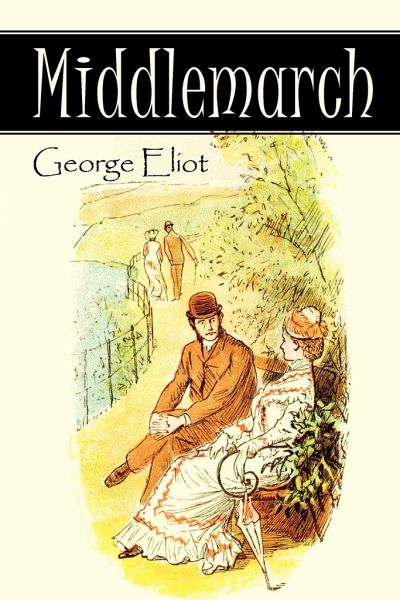
A literary landmark in its groundbreaking approach, as well as a priceless document of its age One of the most ambitious narratives of nineteenth-century realism, "Middlemarch" tells the story of an entire town in the years leading up to the Reform Bill of 1832, a time when modern methods were starting to challenge old orthodoxies. Eliot's sophisticated and acute characterization gives rich expression to every nuance of feeling, and vividly brings to life the town's inhabitants--including the young idealist Dorothea Brooke, the dry scholar Casaubon, the young, passionate reformist doctor…mehr
A literary landmark in its groundbreaking approach, as well as a priceless document of its age One of the most ambitious narratives of nineteenth-century realism, "Middlemarch" tells the story of an entire town in the years leading up to the Reform Bill of 1832, a time when modern methods were starting to challenge old orthodoxies. Eliot's sophisticated and acute characterization gives rich expression to every nuance of feeling, and vividly brings to life the town's inhabitants--including the young idealist Dorothea Brooke, the dry scholar Casaubon, the young, passionate reformist doctor Lydgate, the flighty young beauty Rosamond, and the old, secretive banker Bulstrode--as they move in counterpoint to each other. Art, religion, politics, society, science, human relationships in all their complexity--nothing is left unexamined under the narrator's microscope. Also included in this edition are pictures and an extensive section on George Eliot's life and works.
George Eliot, the pen name of Mary Ann Evans, was a prominent 19th-century English novelist celebrated for her psychological depth and realistic portrayal of human nature. Born in rural Warwickshire, Eliot's early life was shaped by the responsibilities of caring for her family after her mother's death. Following her father's passing, she moved to London and became involved in intellectual circles. Eliot began her literary career with Scenes of Clerical Life, and her first novel, Adam Bede, was a major success. To ensure her works were taken seriously, she used a male pen name, as female authors were often dismissed in her time. Her later works include The Mill on the Floss, Silas Marner, Romola, Middlemarch, Daniel Deronda, and the psychological novella The Lifted Veil, which explores themes of clairvoyance, fate, and despair. Despite personal controversies, including her relationship with the married George Henry Lewes, Eliot became a respected literary and intellectual figure.
Es gelten unsere Allgemeinen Geschäftsbedingungen: www.buecher.de/agb
Impressum
www.buecher.de ist ein Internetauftritt der buecher.de internetstores GmbH
Geschäftsführung: Monica Sawhney | Roland Kölbl | Günter Hilger
Sitz der Gesellschaft: Batheyer Straße 115 - 117, 58099 Hagen
Postanschrift: Bürgermeister-Wegele-Str. 12, 86167 Augsburg
Amtsgericht Hagen HRB 13257
Steuernummer: 321/5800/1497
USt-IdNr: DE450055826