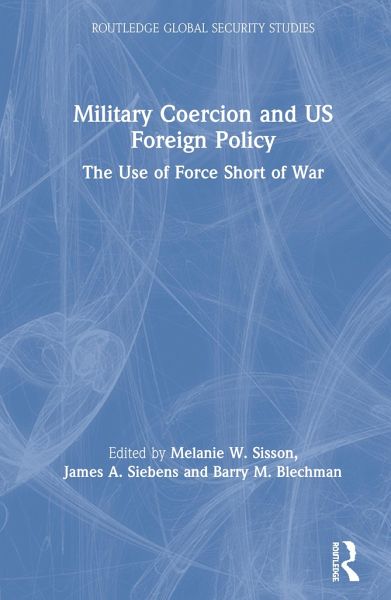
This book examines the use of military force as a coercive tool by the United States, using lessons drawn from the post-Cold War era (1991-2018). The volume reveals that despite its status as sole superpower during the post-Cold War period, US efforts to coerce other states failed as often as they succeeded. In the coming decades, the United States will face states that are more capable and creative, willing to challenge its interests and able to take advantage of missteps and vulnerabilities. By using lessons derived from in-depth case studies and statistical analysis of an original dataset…mehr
This book examines the use of military force as a coercive tool by the United States, using lessons drawn from the post-Cold War era (1991-2018). The volume reveals that despite its status as sole superpower during the post-Cold War period, US efforts to coerce other states failed as often as they succeeded. In the coming decades, the United States will face states that are more capable and creative, willing to challenge its interests and able to take advantage of missteps and vulnerabilities. By using lessons derived from in-depth case studies and statistical analysis of an original dataset of more than 100 coercive incidents in the post-Cold War era, this book generates insight into how the US military can be used to achieve policy goals. Specifically, it provides guidance about the ways in which, and the conditions under which, the US armed forces can work in concert with economic and diplomatic elements of US power to create effective coercive strategies. This book will be of interest to students of US national security, US foreign policy, strategic studies and International Relations in general.
Melanie W. Sisson is Senior Fellow with the Stimson Center in Washington, DC, USA. James A. Siebens is a Research Associate with the Stimson Center's Defense Strategy and Planning Program, Washington, DC, USA. Barry M. Blechman co-founded the Stimson Center in 1989, and chaired its board until 2004.
Inhaltsangabe
1. Coercion in a Competitive World Melanie W. Sisson James A. Siebens and Barry M. Blechman 2. Multi-tasking: How the Armed Forces Support US National Interests Short of War Melanie W. Sisson James A. Siebens and Barry M. Blechman 3. Making Use of History Jacob Aronson Daniel Tuke Paul Huth and Melanie Sisson 4. Syria: Stumbling into Stalemate Alex Bollfrass 5. Iran and Iraq: Strange Successes Strange Failures Kenneth M. Pollack 6. Western Balkans: Hard Targets and Harder Victories William J. Durch 7. Russia: What's Old is New Again Thomas Wright 8. China: Narrow Straits and Rising Tensions Michael S. Chase 9. Coercion in the Past and the Future of Competition Melanie W. Sisson James A. Siebens and Barry M. Blechman
1. Coercion in a Competitive World Melanie W. Sisson James A. Siebens and Barry M. Blechman 2. Multi-tasking: How the Armed Forces Support US National Interests Short of War Melanie W. Sisson James A. Siebens and Barry M. Blechman 3. Making Use of History Jacob Aronson Daniel Tuke Paul Huth and Melanie Sisson 4. Syria: Stumbling into Stalemate Alex Bollfrass 5. Iran and Iraq: Strange Successes Strange Failures Kenneth M. Pollack 6. Western Balkans: Hard Targets and Harder Victories William J. Durch 7. Russia: What's Old is New Again Thomas Wright 8. China: Narrow Straits and Rising Tensions Michael S. Chase 9. Coercion in the Past and the Future of Competition Melanie W. Sisson James A. Siebens and Barry M. Blechman
Es gelten unsere Allgemeinen Geschäftsbedingungen: www.buecher.de/agb
Impressum
www.buecher.de ist ein Internetauftritt der buecher.de internetstores GmbH
Geschäftsführung: Monica Sawhney | Roland Kölbl | Günter Hilger
Sitz der Gesellschaft: Batheyer Straße 115 - 117, 58099 Hagen
Postanschrift: Bürgermeister-Wegele-Str. 12, 86167 Augsburg
Amtsgericht Hagen HRB 13257
Steuernummer: 321/5800/1497
USt-IdNr: DE450055826