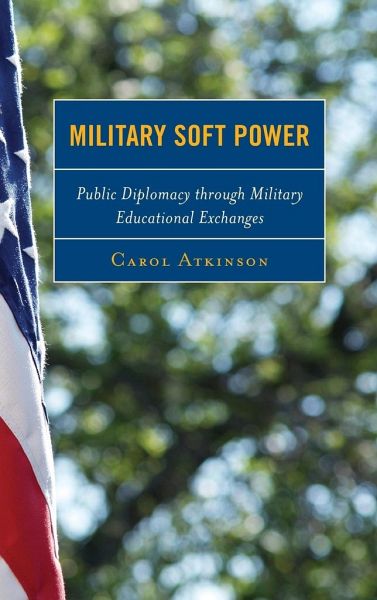
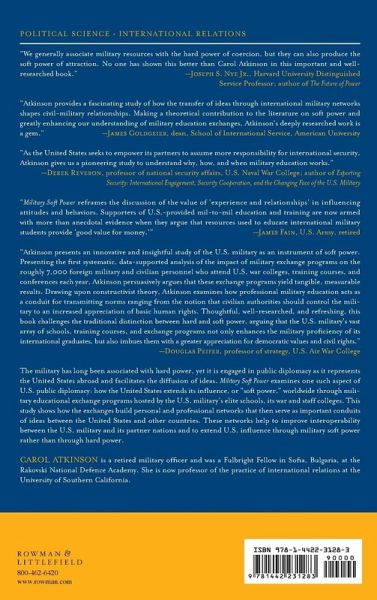
The military has long been associated with hard power, yet it is engaged in public diplomacy as it represents the United States abroad and facilitates the diffusion of ideas. Military Soft Power examines one such aspect of U.S. public diplomacy: how the United States extends its influence or "soft power" worldwide through military educational exchange programs hosted by the United States’ elite military schools, its war and staff colleges.
The military has long been associated with hard power, yet it is engaged in public diplomacy as it represents the United States abroad and facilitates the diffusion of ideas. Military Soft Power examines one such aspect of U.S. public diplomacy: how the United States extends its influence or "soft power" worldwide through military educational exchange programs hosted by the United States’ elite military schools, its war and staff colleges.
Carol Atkinson is a retired military officer who is now a Fulbright Fellow in Sofia, Bulgaria at the Rakovski National Defence Academy. As of spring 2014, she will be Professor of the Practice of International Relations at the University of Southern California. While in the military, she served in a wide range of operational assignments in the fields of intelligence, targeting, and combat assessment. She is a veteran of Operation Desert Storm (1991) where she served on the Central Command Headquarters' staff in Riyadh, and on the contingency planning staff in Dhahran/Khobar, Saudi Arabia. Her research interest in military-to-military exchange programs stems from her experiences working with foreign military officers both abroad and in the United States. She has taught at the U.S. Air Force Academy, U.S. Air Force Command and Staff College, University of Southern California, Stanford University, and Vanderbilt University.
Inhaltsangabe
Chapter 1: Military Soft Power in American Foreign Policy PART I: THEORY AND ARGUMENT Chapter 2: Political Socialization and Educational Exchanges Chapter 3: Building Military Soft Power PART II: IMPACT OF MILITARY EDUCATIONAL EXCHANGES ON PARTICIPANTS Chapter 4: The History of Educational Exchanges at U.S. War and Staff Colleges Chapter 5: Backgrounds, Social Integration, and Promotion Potential of the Exchange Officers Chapter 6: Perspectives and Opinions of the Exchange Officers PART III: IMPACT OF MILITARY EDUCATIONAL EXCHANGES ON DEMOCRATIC TRENDS Chapter 7: Impact on the Development of Democratic Institutions Chapter 8: Impact on Democratic Practices Chapter 9: Conclusion and Policy Implications References
Chapter 1: Military Soft Power in American Foreign Policy PART I: THEORY AND ARGUMENT Chapter 2: Political Socialization and Educational Exchanges Chapter 3: Building Military Soft Power PART II: IMPACT OF MILITARY EDUCATIONAL EXCHANGES ON PARTICIPANTS Chapter 4: The History of Educational Exchanges at U.S. War and Staff Colleges Chapter 5: Backgrounds, Social Integration, and Promotion Potential of the Exchange Officers Chapter 6: Perspectives and Opinions of the Exchange Officers PART III: IMPACT OF MILITARY EDUCATIONAL EXCHANGES ON DEMOCRATIC TRENDS Chapter 7: Impact on the Development of Democratic Institutions Chapter 8: Impact on Democratic Practices Chapter 9: Conclusion and Policy Implications References
Es gelten unsere Allgemeinen Geschäftsbedingungen: www.buecher.de/agb
Impressum
www.buecher.de ist ein Internetauftritt der buecher.de internetstores GmbH
Geschäftsführung: Monica Sawhney | Roland Kölbl | Günter Hilger
Sitz der Gesellschaft: Batheyer Straße 115 - 117, 58099 Hagen
Postanschrift: Bürgermeister-Wegele-Str. 12, 86167 Augsburg
Amtsgericht Hagen HRB 13257
Steuernummer: 321/5800/1497
USt-IdNr: DE450055826