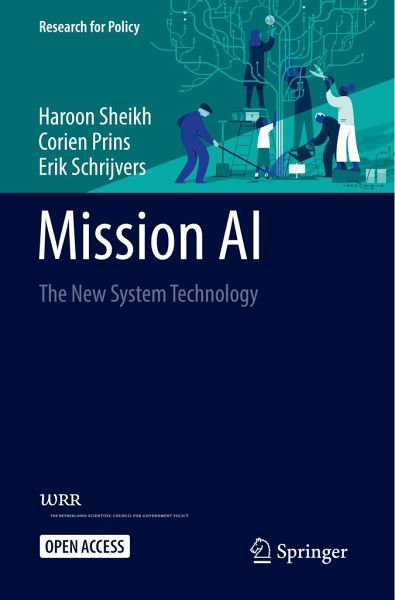
This open access book offers a strategic perspective on AI and the process of embedding it in society. After decades of research, Artificial Intelligence (AI) is now entering society at large. Due to its general purpose character, AI will change society in multiple, fundamental and unpredictable ways. Therefore, the Netherlands Scientific Council for Government Policy (WRR) characterizes AI as a system technology: a rare type of technologies that have a systemic impact on society. Earlier system technologies include electricity, the combustion engine and the computer. The history of these…mehr
This open access book offers a strategic perspective on AI and the process of embedding it in society. After decades of research, Artificial Intelligence (AI) is now entering society at large. Due to its general purpose character, AI will change society in multiple, fundamental and unpredictable ways. Therefore, the Netherlands Scientific Council for Government Policy (WRR) characterizes AI as a system technology: a rare type of technologies that have a systemic impact on society. Earlier system technologies include electricity, the combustion engine and the computer. The history of these technologies provides us with useful insights about what it takes to direct the introduction of AI in society. The WRR identifies five key tasks to structurally work on this process: demystification, contextualisation, engagement, regulation and positioning. By clarifying what AI is (demystification), creating a functional ecosystem (contextualisation), involving diverse stakeholders (engagement), developing directive frameworks (regulation) and engaging internationally (positioning), societies can meaningfully influence how AI settles. Collectively, these activities steer the process of co-development between technology and society, and each representing a different path to safeguard public values. Mission AI - The New System Technology was originally published as an advisory report for the government of the Netherlands. The strategic analysis and the outlined recommendations are, however, relevant to every government and organization that aims to take up 'misson AI' and embed this newest system technology in our world.
Dr. Ruth Mampuys is a senior research fellow at the Netherlands Scientific Council for Government Policy (WRR) and a visiting fellow at the department Theory and Methodology of the Erasmus School of Law in Rotterdam. At the WRR, she has contributed to research on the evolving fragmentation of the world order, COVID19 scenarios and the role of science advisory systems during crises. Prof. dr. Corien Prins is chair of the Netherlands Scientific Council for Government Policy (WRR) as well as professor of law and information technology at Tilburg University. As part of her work at the WRR she was responsible for reports on digital government, digital disaster, artificial intelligence, geopolitics as well as long term policy making. Prof. dr. Haroon Sheikh is a senior scientist and project coordinator at the Dutch Scientific Council for Government Policy (WRR), and a Professor in The Strategic Governance of Global Technologies at VU University. His research focuses on the intersection of new technology and international relations. At the WRR he has been project coordinator of projects on artificial intelligence and the fragmenting world order. Prof. dr. Paul 't Hart is Professor of Public Administration, Utrecht University. He also serves as a Member of the Scientific Council for Government Policy (WRR) of the Netherlands, the Dutch government's independent think tank advising the Dutch cabinet and parliament about long-range and boundary-crossing public policy challenges. As a council member, Paul has been involved in projects on the fragmenting world order, climate policy and government expertise.
Inhaltsangabe
Part I Building blocks: introducing and interpreting AI as a new system technology, similar to electricity and the internal combustion engine.- Introduction.- Chapter 1 Artificial Intelligence: definition and background.- Chapter 2 AI is leaving the lab and entering society.- Chapter 3 AI as a system technology.- Part II Five tasks: discussion of the tasks for embedding AI into society.- Chapter 4 Demystification.- Chapter 5 Contextualization.- Chapter 6 Engagement.- Chapter 7 Regulation.- Chapter 8 Consider AI as a system technology.- Part III Agenda: conclusions and recommendations for AI policy in the Netherlands.- Chapter 9 Policy for AI as a system technology.- Appendix: Examples of AI applications in the Netherlands.- Terms and definitions.- Keywords.- Bibliography.
Part I Building blocks: introducing and interpreting AI as a new system technology, similar to electricity and the internal combustion engine.- Introduction.- Chapter 1 Artificial Intelligence: definition and background.- Chapter 2 AI is leaving the lab and entering society.- Chapter 3 AI as a system technology.- Part II Five tasks: discussion of the tasks for embedding AI into society.- Chapter 4 Demystification.- Chapter 5 Contextualization.- Chapter 6 Engagement.- Chapter 7 Regulation.- Chapter 8 Consider AI as a system technology.- Part III Agenda: conclusions and recommendations for AI policy in the Netherlands.- Chapter 9 Policy for AI as a system technology.- Appendix: Examples of AI applications in the Netherlands.- Terms and definitions.- Keywords.- Bibliography.
Es gelten unsere Allgemeinen Geschäftsbedingungen: www.buecher.de/agb
Impressum
www.buecher.de ist ein Internetauftritt der buecher.de internetstores GmbH
Geschäftsführung: Monica Sawhney | Roland Kölbl | Günter Hilger
Sitz der Gesellschaft: Batheyer Straße 115 - 117, 58099 Hagen
Postanschrift: Bürgermeister-Wegele-Str. 12, 86167 Augsburg
Amtsgericht Hagen HRB 13257
Steuernummer: 321/5800/1497
USt-IdNr: DE450055826