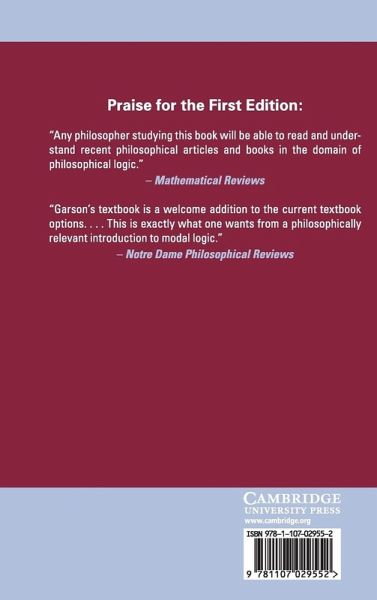
This book on modal logic is especially designed for philosophy students. It provides an accessible yet technically sound treatment of modal logic and its philosophical applications. Every effort is made to simplify the presentation by using diagrams instead of more complex mathematical apparatus. These and other innovations provide philosophers with easy access to a rich variety of topics in modal logic, including a full coverage of quantified modal logic, non-rigid designators, definite descriptions, and the de-re de-dicto distinction. Discussion of philosophical issues concerning the…mehr
This book on modal logic is especially designed for philosophy students. It provides an accessible yet technically sound treatment of modal logic and its philosophical applications. Every effort is made to simplify the presentation by using diagrams instead of more complex mathematical apparatus. These and other innovations provide philosophers with easy access to a rich variety of topics in modal logic, including a full coverage of quantified modal logic, non-rigid designators, definite descriptions, and the de-re de-dicto distinction. Discussion of philosophical issues concerning the development of modal logic is woven into the text. The book uses natural deduction systems, which are widely regarded as the easiest to teach and use. It also includes a diagram technique that extends the method of truth trees to modal logic. This provides a foundation for a novel method for showing completeness that is easy to extend to quantifiers. This second edition contains a new chapter on logics of conditionals, an updated and expanded bibliography, and is updated throughout.
James W. Garson is a Professor in the Department of Philosophy at the University of Houston. His research interests include logic, especially modal logic, the philosophy of mind, neural networks, formal semantics, natural language processing and philosophical issues concerning the impact of information technology. He has held grants from the National Endowment for the Humanities, the National Science Foundation and the Apple Education Foundation to study the use of computers in education and to develop software for training students in logic and computer science. He is the author of numerous articles in logic, semantics, linguistics, the philosophy of cognitive science, and computerized education. His review article on quantified modal logic in the Handbook of Philosophical Logic is a standard reference in the area. Garson is also author of What Logics Mean: From Proof to Model-Theoretic Semantics (Cambridge, 2013).
Inhaltsangabe
Preface to the second edition Introduction 1. The System K: a foundation for modal logic 2. Extensions of K 3. Basic concepts of intensional semantics 4. Trees for K 5. The accessibility of relation 6. Trees for extensions of K 7. Converting trees to proofs 8. Adequacy of propositional modal logics 9. Completeness of using canonical models 10. Axioms and their corresponding conditions on R 11. Relations between the modal logics 12. Systems of quantified modal logic 13. Semantics for quantified modal logics 14. Trees for quantified modal logics 15. The adequacy of quantified modal logics 16. Completeness of quantified modal logics using trees 17. Completeness using canonical models 18. Descriptions 19. Lambda abstraction 20. Conditionals.
Preface to the second edition Introduction 1. The System K: a foundation for modal logic 2. Extensions of K 3. Basic concepts of intensional semantics 4. Trees for K 5. The accessibility of relation 6. Trees for extensions of K 7. Converting trees to proofs 8. Adequacy of propositional modal logics 9. Completeness of using canonical models 10. Axioms and their corresponding conditions on R 11. Relations between the modal logics 12. Systems of quantified modal logic 13. Semantics for quantified modal logics 14. Trees for quantified modal logics 15. The adequacy of quantified modal logics 16. Completeness of quantified modal logics using trees 17. Completeness using canonical models 18. Descriptions 19. Lambda abstraction 20. Conditionals.
Es gelten unsere Allgemeinen Geschäftsbedingungen: www.buecher.de/agb
Impressum
www.buecher.de ist ein Internetauftritt der buecher.de internetstores GmbH
Geschäftsführung: Monica Sawhney | Roland Kölbl | Günter Hilger
Sitz der Gesellschaft: Batheyer Straße 115 - 117, 58099 Hagen
Postanschrift: Bürgermeister-Wegele-Str. 12, 86167 Augsburg
Amtsgericht Hagen HRB 13257
Steuernummer: 321/5800/1497
USt-IdNr: DE450055826