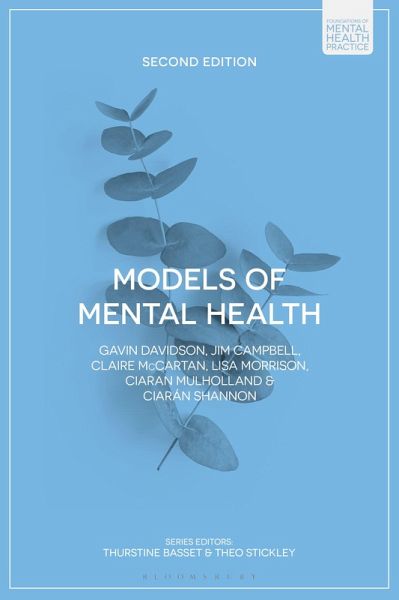
Gavin Davidson, Jim Campbell, Claire McCartan, Lisa Morrison, Ciaran Mulholland, Ciarán Shannon
Models of Mental Health
Versandkostenfrei innerhalb Deutschlands
39,99 €
inkl. MwSt.
Versandkostenfrei*
Erscheint vorauss. 19. Februar 2026
Melden Sie sich
hier
hier
für den Produktalarm an, um über die Verfügbarkeit des Produkts informiert zu werden.
oder sofort lesen als eBook

20 °P sammeln
Gavin Davidson, Jim Campbell, Claire McCartan, Lisa Morrison, Ciaran Mulholland, Ciarán Shannon
Models of Mental Health
- Broschiertes Buch
A critical overview of the main theoretical perspectives relevant to mental health practice.
Andere Kunden interessierten sich auch für
Geoff GoodmanThe Internal World and Attachment69,99 €
Jon RonsonThe Psychopath Test14,99 €
Ellen VoraThe Anatomy of Anxiety17,99 €
Gary G. FordEthical Reasoning for Mental Health Professionals150,99 €
Navin KumarMental Health and Well-being56,99 €
Mental Models In Cognitive Science67,99 €
Viktor E FranklEmbracing Hope22,99 €-
-
-
A critical overview of the main theoretical perspectives relevant to mental health practice.
Produktdetails
- Produktdetails
- Verlag: Bloomsbury Academic
- 2nd edition
- Seitenzahl: 264
- Erscheinungstermin: 19. Februar 2026
- Englisch
- Abmessung: 234mm x 156mm x 25mm
- Gewicht: 454g
- ISBN-13: 9781350477636
- ISBN-10: 135047763X
- Artikelnr.: 72898900
- Herstellerkennzeichnung
- Libri GmbH
- Europaallee 1
- 36244 Bad Hersfeld
- gpsr@libri.de
- Verlag: Bloomsbury Academic
- 2nd edition
- Seitenzahl: 264
- Erscheinungstermin: 19. Februar 2026
- Englisch
- Abmessung: 234mm x 156mm x 25mm
- Gewicht: 454g
- ISBN-13: 9781350477636
- ISBN-10: 135047763X
- Artikelnr.: 72898900
- Herstellerkennzeichnung
- Libri GmbH
- Europaallee 1
- 36244 Bad Hersfeld
- gpsr@libri.de
Gavin Davidson, Jim Campbell, Claire McCartan, Lisa Morrison, Ciaran Mulholland & Ciarán Shannon
Introduction
PART I: TRADITIONAL MODELS OF MENTAL HEALTH
1. Bio-medical Perspectives
2. Psychological Perspectives
3. Social Perspectives
PART II: CHALLENGING EXISTING MODELS OF MENTAL HEALTH THEORY
4. Intersectional Perspectives
5. Critical Mental Health Perspectives
6. Service User-Led Perspectives
7. Religious and Spiritual Perspectives
8. Environmental Perspectives
9. Integrated Perspectives
Conclusion
Index
PART I: TRADITIONAL MODELS OF MENTAL HEALTH
1. Bio-medical Perspectives
2. Psychological Perspectives
3. Social Perspectives
PART II: CHALLENGING EXISTING MODELS OF MENTAL HEALTH THEORY
4. Intersectional Perspectives
5. Critical Mental Health Perspectives
6. Service User-Led Perspectives
7. Religious and Spiritual Perspectives
8. Environmental Perspectives
9. Integrated Perspectives
Conclusion
Index
1. Introduction.- PART I: TRADITIONAL MODELS OF MENTAL HEALTH THEORY.-2. Bio-medical Perspectives.- 3. Psychological Perspectives.- 4. Social Perspectives.- PART II: CHALLENGING EXISTING MODELS OF MENTAL HEALTH THEORY.- 5. Post-psychiatry Perspectives.- 6. Service-user Led Perspectives.- 7. Philosophical and Spiritual Perspectives.- 8. Integrated Perspectives.- 9. Conclusion.
Introduction
PART I: TRADITIONAL MODELS OF MENTAL HEALTH
1. Bio-medical Perspectives
2. Psychological Perspectives
3. Social Perspectives
PART II: CHALLENGING EXISTING MODELS OF MENTAL HEALTH THEORY
4. Intersectional Perspectives
5. Critical Mental Health Perspectives
6. Service User-Led Perspectives
7. Religious and Spiritual Perspectives
8. Environmental Perspectives
9. Integrated Perspectives
Conclusion
Index
PART I: TRADITIONAL MODELS OF MENTAL HEALTH
1. Bio-medical Perspectives
2. Psychological Perspectives
3. Social Perspectives
PART II: CHALLENGING EXISTING MODELS OF MENTAL HEALTH THEORY
4. Intersectional Perspectives
5. Critical Mental Health Perspectives
6. Service User-Led Perspectives
7. Religious and Spiritual Perspectives
8. Environmental Perspectives
9. Integrated Perspectives
Conclusion
Index
1. Introduction.- PART I: TRADITIONAL MODELS OF MENTAL HEALTH THEORY.-2. Bio-medical Perspectives.- 3. Psychological Perspectives.- 4. Social Perspectives.- PART II: CHALLENGING EXISTING MODELS OF MENTAL HEALTH THEORY.- 5. Post-psychiatry Perspectives.- 6. Service-user Led Perspectives.- 7. Philosophical and Spiritual Perspectives.- 8. Integrated Perspectives.- 9. Conclusion.