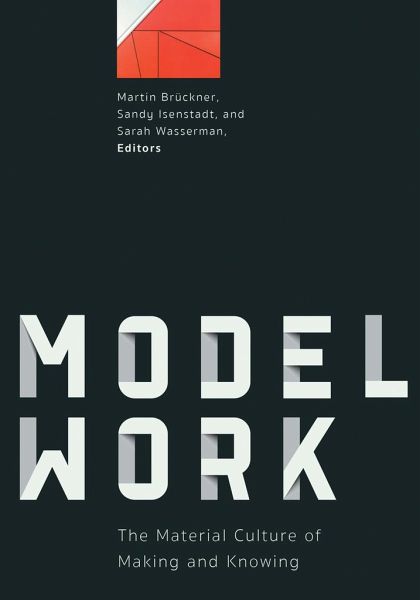
"Scholars from diverse fields examine the interrelationships between a model's material foundations and the otherwise invisible things it gestures toward, underscoring the pivotal role of models in understanding and shaping the world around us"--
"Scholars from diverse fields examine the interrelationships between a model's material foundations and the otherwise invisible things it gestures toward, underscoring the pivotal role of models in understanding and shaping the world around us"--
Martin BrÜckner is professor of English and material culture studies at the University of Delaware. He is author or coeditor of several books, most recently The Social Life of Maps in America, 1750–1860. Sandy Isenstadt is professor and chair of art history at the University of Delaware and author or coeditor of several books, most recently Electric Light: An Architectural History. Sarah Wasserman is associate professor of English and material culture studies at the University of Delaware. She is author of The Death of Things: Ephemera and the American Novel (Minnesota, 2020).
Inhaltsangabe
Contents Introduction: Modelwork Martin Brückner and Sandy Isenstadt Part I. Knowing 1. Defining Models Annabel Jane Wharton 2. Material Models of Immaterial Things Peter Galison Part II. Sensing 3. William Farish’s Devices and Drawings: Models for Envisioning Immaterial and Material Realms Hilary Bryon 4. “The Instructed Eye”: What Eighteenth- and Nineteenth-Century Drawing Books Tell Us about Vision and How We See Christopher J. Lukasik 5. Algorithmic Audition: Modeling Musical Perception Martin Scherzinger Part III. Making 6. The Useful Arts of Nineteenth-Century Patent Models Reed Gochberg 7. Bodies Made of Numbers, Numbers Made of Bodies Catherine Newman Howe 8. Hypermodels: Architectural Production in Virtual Spaces Seher Erdöan Ford Part IV. Doing 9. Modeling Maneuvers: Anatomical Illustration and the Practice of Touch Juliet S. Sperling 10. Models and Manufactures: The Shoe as Commodity Lisa Gitelman 11. Modeling Interpretation Johanna Drucker Afterword: On the Humility of Models Sarah Wasserman Acknowledgments Contributors Index
Contents Introduction: Modelwork Martin Brückner and Sandy Isenstadt Part I. Knowing 1. Defining Models Annabel Jane Wharton 2. Material Models of Immaterial Things Peter Galison Part II. Sensing 3. William Farish’s Devices and Drawings: Models for Envisioning Immaterial and Material Realms Hilary Bryon 4. “The Instructed Eye”: What Eighteenth- and Nineteenth-Century Drawing Books Tell Us about Vision and How We See Christopher J. Lukasik 5. Algorithmic Audition: Modeling Musical Perception Martin Scherzinger Part III. Making 6. The Useful Arts of Nineteenth-Century Patent Models Reed Gochberg 7. Bodies Made of Numbers, Numbers Made of Bodies Catherine Newman Howe 8. Hypermodels: Architectural Production in Virtual Spaces Seher Erdöan Ford Part IV. Doing 9. Modeling Maneuvers: Anatomical Illustration and the Practice of Touch Juliet S. Sperling 10. Models and Manufactures: The Shoe as Commodity Lisa Gitelman 11. Modeling Interpretation Johanna Drucker Afterword: On the Humility of Models Sarah Wasserman Acknowledgments Contributors Index
Es gelten unsere Allgemeinen Geschäftsbedingungen: www.buecher.de/agb
Impressum
www.buecher.de ist ein Internetauftritt der buecher.de internetstores GmbH
Geschäftsführung: Monica Sawhney | Roland Kölbl | Günter Hilger
Sitz der Gesellschaft: Batheyer Straße 115 - 117, 58099 Hagen
Postanschrift: Bürgermeister-Wegele-Str. 12, 86167 Augsburg
Amtsgericht Hagen HRB 13257
Steuernummer: 321/5800/1497
USt-IdNr: DE450055826