Over three decades, Paul Griffiths's survey has remained the definitive study of music since the Second World War; this fully revised and updated edition re-establishes Modern Music and After as the preeminent introduction to the music of our time. The disruptions of the war, and the struggles of the ensuing peace, were reflected in the music of the time: in Pierre Boulez's radical reformation of compositional technique and in John Cage's development of zen music; in Milton Babbitt's settling of the serial system and in Dmitry Shostakovich's unsettling symphonies; in Karl Stockhausen's…mehr
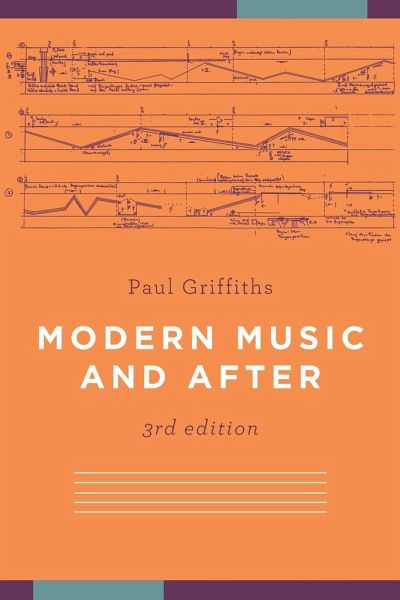
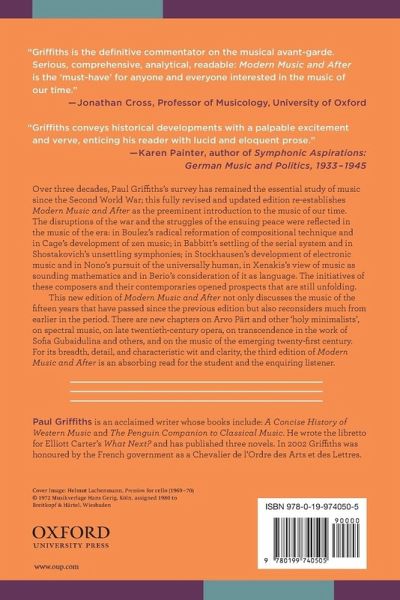
Over three decades, Paul Griffiths's survey has remained the definitive study of music since the Second World War; this fully revised and updated edition re-establishes Modern Music and After as the preeminent introduction to the music of our time. The disruptions of the war, and the struggles of the ensuing peace, were reflected in the music of the time: in Pierre Boulez's radical reformation of compositional technique and in John Cage's development of zen music; in Milton Babbitt's settling of the serial system and in Dmitry Shostakovich's unsettling symphonies; in Karl Stockhausen's development of electronic music and in Luigi Nono's pursuit of the universally human, in Iannis Xenakis's view of music as sounding mathematics and in Luciano Berio's consideration of it as language. The initiatives of these composers and their contemporaries opened prospects that haven't yet stopped unfolding. This constant expansion of musical thinking since 1945 has left us with no singular history of music; Griffiths's study accordingly follows several different paths, showing how and why they converge and diverge. This new edition of Modern Music and After discusses not only the music of the fifteen years that have passed since the previous edition, but also the recent explosion of scholarly interest in the latter half of the Twentieth Century. In particular, the third section of the book, 1980-1990, is expanded to incorporate the variety of responses to the modernist impasse experienced by composers of the time. In addition, a new fourth part, "After Postmodernism: the 1990s and 2000s," examines highly influential composers like Philip Glass and Pierre Boulez as well as such topics as "Modernist Continuation" and "Music and the Internet." For its breadth, wealth of detail, and characteristic wit and clarity, the third edition of Modern Music and After is required reading for the student and the enquiring listener.
Paul Griffiths is an acclaimed writer on contemporary and classical music whose books include A Concise History of Western Music and The Penguin Companion to Classical Music. He is a frequent contributor to The New Yorker and has written the libretto for Elliott Carter's What Next? as well as three novels. In 2002, Griffiths was honored by the French government as a Chevalier de l'Ordre des Arts et des Lettres.
Inhaltsangabe
* Prelude * 1.: Rational and irrational: western Europe, 1945 50 * Paris, 1945 8 The young Boulez Boulez's Second Piano Sonata Other stories Musique concrète Variations: Nono * 2.: Silencing music: Cage, 1946 52 * Rhythmic structuring Towards silence Around Cage * 3.: Total organization: western Europe, 1949 54 * The moment of total serialism 1: Darmstadt 1949 and Darmstadt 1951 Interlude: the patrons of modernism The moment of total serialism 2: Paris 1952 The human voice 1: Nono Electronic music The human voice 2: Barraqué * 4.: Classic modernism and other kinds: the United States, 1945 55 * Schoenberg Carter Babbitt Home made music Wolpe After silence * 5.: The Cold War * 6.: Extension and development: western Europe, 1953 6 * From points to groups Systems of organization Le Marteau sans maître Sound and word ...how time passes... Statistics * 7.: Mobile form: 1956 61 * Cage Stockhausen and Boulez Boulez and Berio Barraqué Exit from the labyrinth * 8.: Elder responses * Stravinsky Messiaen Varèse Symphonists and others * 9.: Reappraisal and disintegration: 1959 64 * Questioning voices: Ligeti, Bussotti, Kagel Stumbling steps: Kurtág Listening ears: Cage, Young, Babbitt Exploiting the moment: Stockhausen The last concert: Nono * 10.: Of elsewhen and elsewhere * The distant past (The imaginary past) The distant or not so distant east Quotation Meta music * 11.: Music theatre * Opera and 'Opera' Music theatre Instrumental theatre * 12.: Politics * Cardew Rzewski The composer in the factory * 13.: Virtuosity and improvisation * The virtuoso Virtuosity in question The electric musician Improvisation * 14.: Orchestras or Computers * Ochestras Computer Music * 15.: Minimalism and melody * New York minimalism Minimalism in Europe Melody * 16.: Ending * * 17.: Holy Minimalisms * Pärt Tavener and Górecki (Messiaen) Ustvolskaya * 18.: New Romanticisms * Rihm Schnittke, and the hectic present Gubaidulina, and the visionary future Silvestrov, and the reverberating past Symphony? Feldman and loss Lachenmann and regain * 19.: New Simplicities * Cage, or innocence Denyer, or outsiderness Kurtág, or immediacy Holliger, or extremity Sciarrino, or intimacy * 20.: New Complexities * Ferneyhough Finnissy Charged solos * 21.: Old Complexities * Carter and the poets Xenakis and the Arditti Quartet Nono and listening Stockhausen and Licht Birtwistle and ritual Berio and memory IRCAM and Boulez * 22.: Spectralisms * Radulescu and Tenney Grisey Vivier * 23.: (Unholy?) Minimalisms * Reich Andriessen * 24.: Eclecticisms * Kagel et al. Donatoni Bolcom and Adams Ligeti * 25.: . Towards mode/meme * Rootless routes: Ligeti Memory's memorials: Berio and Kurtág Remade modes: Adams, Adès, Benjamin Pesson's past and Pauset's Traditions' tracks: around Zorn * 26.: Towards the strange self * Act I: Schneewittchen Entr'acte: Kurtág's Beckett Act II: Luci mie traditrici Entr'acte: Birtwistle's Celan Act III: Three Sisters Entr'acte: Kyburz's no one Act IV: Das Mädchen mit den Schwefelhölzern * 27.: Towards transcendence * Gubaidulina and Christ Haas and darkness Harvey and the Buddha Grisey and rebirth * 28.: Towards change? * Resources * Index
Es gelten unsere Allgemeinen Geschäftsbedingungen: www.buecher.de/agb
Impressum
www.buecher.de ist ein Internetauftritt der buecher.de internetstores GmbH
Geschäftsführung: Monica Sawhney | Roland Kölbl | Günter Hilger
Sitz der Gesellschaft: Batheyer Straße 115 - 117, 58099 Hagen
Postanschrift: Bürgermeister-Wegele-Str. 12, 86167 Augsburg
Amtsgericht Hagen HRB 13257
Steuernummer: 321/5800/1497
USt-IdNr: DE450055826