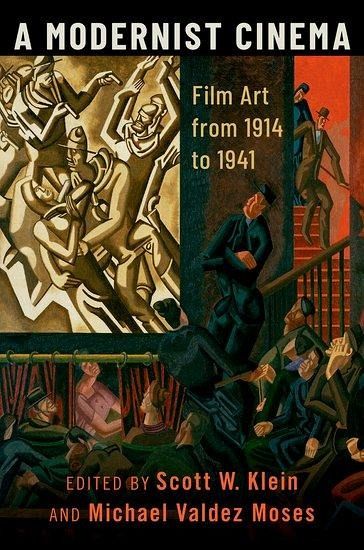
In A Modernist Cinema, sixteen distinguished scholars in the field of the New Modernist Studies explore the interrelationships among modernism, cinema, and modernity. Focusing on several culturally influential films from Europe, America, and Asia produced between 1914 and 1941, this collection of essays contends that cinema was always a modernist enterprise. Examining the dialectical relationship between a modernist cinema and modernity itself, these essays reveal how the movies represented and altered our notions and practices of modern life, as well as how the so-called crises of modernity…mehr
In A Modernist Cinema, sixteen distinguished scholars in the field of the New Modernist Studies explore the interrelationships among modernism, cinema, and modernity. Focusing on several culturally influential films from Europe, America, and Asia produced between 1914 and 1941, this collection of essays contends that cinema was always a modernist enterprise. Examining the dialectical relationship between a modernist cinema and modernity itself, these essays reveal how the movies represented and altered our notions and practices of modern life, as well as how the so-called crises of modernity shaped the evolution of filmmaking. Attending to the technical achievements and formal qualities of the works of several prominent directors - Giovanni Pastrone, D. W. Griffith, Sergei Eisenstein, Fritz Lang, Alfred Hitchcock, F. W. Murnau, Carl Theodore Dreyer, Dziga Vertov, Luis Buñuel, Yasujiro Ozu, John Ford, Jean Renoir, Charlie Chaplin, Leni Riefenstahl, and Orson Welles - these essays investigate several interrelated topics: how a modernist cinema represented and intervened in the political and social struggles of the era; the ambivalent relationship between cinema and the other modernist arts; the controversial interconnection between modern technology and the new art of filmmaking; the significance of representing the mobile human body in a new medium; the gendered history of modernity; and the transformative effects of cinema on modern conceptions of temporality, spatial relations, and political geography.
Scott W. Klein is Professor of English and Artistic Director of the Secrest Artists Series at Wake Forest University, North Carolina. He is the author of The Fictions of James Joyce and Wyndham Lewis: Monsters of Nature and Design the editor of the Oxford World's Classics edition of the 1928 edition of Wyndham Lewis's Tarr, and with Mark Antliff the editor of the essay collection Vorticism: New Perspectives. He has published essays in such journals as ELH, Modernist Cultures, Twentieth Century Literature, and The James Joyce Quarterly, and is on the editorial boards of the Oxford Complete Writings of Wyndham Lewis edition and of the The Journal of Wyndham Lewis. Michael Valdez Moses is Professor of Literature and the Humanities in the Smith Institute for Political Economy and Philosophy and in the Argyros School of Business and Economics at Chapman University, and Associate Emeritus Professor at Duke University, where he was a faculty member of the English Department from 1987 to 2019. He is the author of The Novel and the Globalization of Culture (1995), co-editor of Modernism and Colonialism: British and Irish Literature, 1900-1939 (2010) and Modernism, Postcolonialism, and Globalism: Anglophone Literature, 1950 to the Present (2019), and editor of The Writings of J. M. Coetzee (special issue of South Atlantic Quarterly, 1994) and Modernism and Cinema (special issue of Modernist Cultures, 2010). He has been a Visiting Fellow at the Humanities Research Centre at the Australian National University, a Duke Endowment Fellow at the National Humanities Center, USIA Visiting Professor at the Universitat Autónoma de Barcelona and at Université Cadi Ayyad in Marrakech, and the MacLean Distinguished Visiting Professor at Colorado College. He is former Director of Graduate Studies in the English Department of Duke University and a founding co-editor of the journal, Modernist Cultures.
Inhaltsangabe
* Introduction * Chapter 1: Giovanni Pastrone's Cabiria, Gesture, Modernism, by Enda Duffy and Maurizia Boscagli * Chapter 2: D. W. Griffith's Intolerance and the Ever-Present Now, by Michael North * Chapter 3: Sergei Eisenstein's Collage: Filming Montage in Museums at Night, by Lisa Siraganian * Chapter 4: From Automaton to Autonomy: Mechanical Reproduction in Fritz Lang's Metropolis, by Richard Begam * Chapter 5: "Suspense is Like a Woman": Sex and Style in Alfred Hitchcock's Pleasure Garden and The Lodger, by Laura Frost * Chapter 6: F. W. Murnau's Sunrise: Between Two Worlds, by Laura Marcus * Chapter 7: "A Language Worth the Trouble of Learning"? Carl Theodore Dreyer's The Passion of Joan of Arc, by Andrzej Gasiorek * Chapter 8: Intervals of Transition: Dziga Vertov's The Man With a Movie Camera, by Tyrus Miller * Chapter 9: Luis Buñuel, Surrealism and the Politics of Disorder, by Michael Wood * Chapter 10: Yasujir's Ozu's A Story of Floating Weeds and the Art of Being Behind, by Carrie J. Preston * Chapter 11: "Saved from the Blessings of Civilization": John Ford's Stagecoach, the West, and American Vernacular Modernism, by Michael Valdez Moses * Chapter 12: "Tout le monde a ses raisons" The Problem of Impressionist Commitment in Jean Renoir's La Règle du jeu, by Jesse Matz * Chapter 13: "You Must Speak": Silence, Scale, and Power in Charlie Chaplin's The Great Dictator, by Scott W. Klein * Chapter 14: Leni Riefenstahl's Nazi Neoclassicism: Olympia, by Elizabeth Otto * Chapter 15: On Auratic and Sentimental Objects: High and Low Modernism in Orson Welles' Citizen Kane, by Douglas Mao * Index
* Introduction * Chapter 1: Giovanni Pastrone's Cabiria, Gesture, Modernism, by Enda Duffy and Maurizia Boscagli * Chapter 2: D. W. Griffith's Intolerance and the Ever-Present Now, by Michael North * Chapter 3: Sergei Eisenstein's Collage: Filming Montage in Museums at Night, by Lisa Siraganian * Chapter 4: From Automaton to Autonomy: Mechanical Reproduction in Fritz Lang's Metropolis, by Richard Begam * Chapter 5: "Suspense is Like a Woman": Sex and Style in Alfred Hitchcock's Pleasure Garden and The Lodger, by Laura Frost * Chapter 6: F. W. Murnau's Sunrise: Between Two Worlds, by Laura Marcus * Chapter 7: "A Language Worth the Trouble of Learning"? Carl Theodore Dreyer's The Passion of Joan of Arc, by Andrzej Gasiorek * Chapter 8: Intervals of Transition: Dziga Vertov's The Man With a Movie Camera, by Tyrus Miller * Chapter 9: Luis Buñuel, Surrealism and the Politics of Disorder, by Michael Wood * Chapter 10: Yasujir's Ozu's A Story of Floating Weeds and the Art of Being Behind, by Carrie J. Preston * Chapter 11: "Saved from the Blessings of Civilization": John Ford's Stagecoach, the West, and American Vernacular Modernism, by Michael Valdez Moses * Chapter 12: "Tout le monde a ses raisons" The Problem of Impressionist Commitment in Jean Renoir's La Règle du jeu, by Jesse Matz * Chapter 13: "You Must Speak": Silence, Scale, and Power in Charlie Chaplin's The Great Dictator, by Scott W. Klein * Chapter 14: Leni Riefenstahl's Nazi Neoclassicism: Olympia, by Elizabeth Otto * Chapter 15: On Auratic and Sentimental Objects: High and Low Modernism in Orson Welles' Citizen Kane, by Douglas Mao * Index
Es gelten unsere Allgemeinen Geschäftsbedingungen: www.buecher.de/agb
Impressum
www.buecher.de ist ein Internetauftritt der buecher.de internetstores GmbH
Geschäftsführung: Monica Sawhney | Roland Kölbl | Günter Hilger
Sitz der Gesellschaft: Batheyer Straße 115 - 117, 58099 Hagen
Postanschrift: Bürgermeister-Wegele-Str. 12, 86167 Augsburg
Amtsgericht Hagen HRB 13257
Steuernummer: 321/5800/1497
USt-IdNr: DE450055826