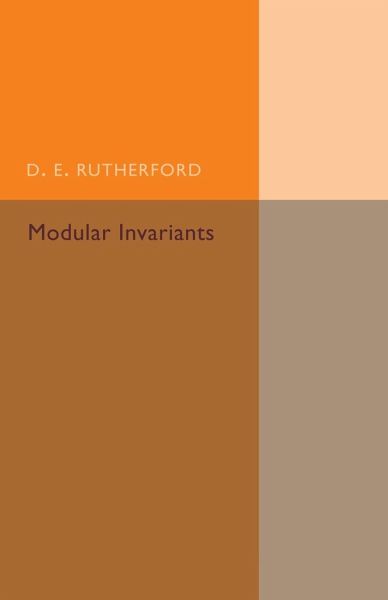
Originally published in 1932 as number twenty=seven in the Cambridge Tracts in Mathematics and Mathematical Physics series, this book provides a concise account of the theory of modular invariants as embodied in the work of Dickson, Glenn and Hazlett. Appendices are included. This book will be of value to anyone with an interest in modular invariants and the history of mathematics.
Originally published in 1932 as number twenty=seven in the Cambridge Tracts in Mathematics and Mathematical Physics series, this book provides a concise account of the theory of modular invariants as embodied in the work of Dickson, Glenn and Hazlett. Appendices are included. This book will be of value to anyone with an interest in modular invariants and the history of mathematics.
Preface Part I: 1. A new notation 2. Galois fields and Fermat's theorem 3. Transformations in the Galois fields 4. Types of concomitants 5. Systems and finiteness 6. Symbolical notation 7. Generators of linear transformations 8. Weight and isobarbism 9. Congruent concomitants 10. Relation between congruent and algebraic covariants 11. Formal covariants 13. Dickson's theorem 14. Formal invariants of linear form 15. The use of symbolical operators 16. Annihilators of formal invariants 17. Dickson's method for formal covariants 18. Symbolical representation of pseudo-isobaric formal covariants 19. Classes 20. Characteristic invariants 21. Syzygies 22. Residual covariants 23. Miss Sanderson's theorem 24. A method of finding characteristic invariants 25. Smallest full systems 26. Residual invariants of linear forms 27. Residual invariants of quadratic forms 28. Cubic and higher forms 29. Relative unimportance of residual covariants 30. Non-formal residual covariants Part II: 31. Rings and fields 32. Expansions 33. Isomorphism 34. Finite expansions 35. Transcendental and algebraic expansions 36. Rational basis theorem of E. Noether 37. The fields Ky+/-f 38. Expansions of the first and second sorts 39. The theorem on divisor chains 40. R-modules 41. A theorem of Artin and of van der Waerden 42. The finiteness criterion of E. Noether 43. Application of E. Noether's theorem to modular covariants Appendix I Appendix II Appendix III Index.
Preface Part I: 1. A new notation 2. Galois fields and Fermat's theorem 3. Transformations in the Galois fields 4. Types of concomitants 5. Systems and finiteness 6. Symbolical notation 7. Generators of linear transformations 8. Weight and isobarbism 9. Congruent concomitants 10. Relation between congruent and algebraic covariants 11. Formal covariants 13. Dickson's theorem 14. Formal invariants of linear form 15. The use of symbolical operators 16. Annihilators of formal invariants 17. Dickson's method for formal covariants 18. Symbolical representation of pseudo-isobaric formal covariants 19. Classes 20. Characteristic invariants 21. Syzygies 22. Residual covariants 23. Miss Sanderson's theorem 24. A method of finding characteristic invariants 25. Smallest full systems 26. Residual invariants of linear forms 27. Residual invariants of quadratic forms 28. Cubic and higher forms 29. Relative unimportance of residual covariants 30. Non-formal residual covariants Part II: 31. Rings and fields 32. Expansions 33. Isomorphism 34. Finite expansions 35. Transcendental and algebraic expansions 36. Rational basis theorem of E. Noether 37. The fields Ky+/-f 38. Expansions of the first and second sorts 39. The theorem on divisor chains 40. R-modules 41. A theorem of Artin and of van der Waerden 42. The finiteness criterion of E. Noether 43. Application of E. Noether's theorem to modular covariants Appendix I Appendix II Appendix III Index.
Es gelten unsere Allgemeinen Geschäftsbedingungen: www.buecher.de/agb
Impressum
www.buecher.de ist ein Internetauftritt der buecher.de internetstores GmbH
Geschäftsführung: Monica Sawhney | Roland Kölbl | Günter Hilger
Sitz der Gesellschaft: Batheyer Straße 115 - 117, 58099 Hagen
Postanschrift: Bürgermeister-Wegele-Str. 12, 86167 Augsburg
Amtsgericht Hagen HRB 13257
Steuernummer: 321/5800/1497
USt-IdNr: DE450055826