The electrocatalytic reduction of CO2 into high-value multi-carbon products represents a crucial pathway toward achieving carbon neutrality and sustainable chemical production. The transition from lab-scale studies to industrial-scale implementation is imperative to bridge the gap between fundamental mechanistic insights and practical applications. This book explores the mechanistic understanding and functional design of electrocatalysts for CO2 electroreduction, focusing on bridging the gap between lab-scale research and industrial-scale implementation. It systematically investigates the…mehr
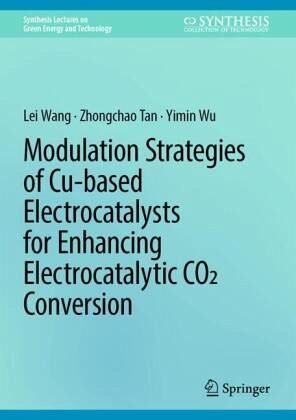
The electrocatalytic reduction of CO2 into high-value multi-carbon products represents a crucial pathway toward achieving carbon neutrality and sustainable chemical production. The transition from lab-scale studies to industrial-scale implementation is imperative to bridge the gap between fundamental mechanistic insights and practical applications.
This book explores the mechanistic understanding and functional design of electrocatalysts for CO2 electroreduction, focusing on bridging the gap between lab-scale research and industrial-scale implementation. It systematically investigates the role of grain boundary structures, oxidation states, and interfacial microenvironments in stabilizing Cu-based catalysts, thereby enhancing the selective production of multi-carbon products. By integrating oxidation and alloying strategies, this work introduces new approaches to modulate copper oxidation states, leading to improved catalytic performance. Advanced characterization techniques, including in situ multimodal spectroscopy, provide insights into the electrochemical stability of Cu species and their impact on reaction pathways.
Beyond catalyst design, this book extends the discussion to CO2 electrolyzer configurations, emphasizing membrane electrode assemblies and gas diffusion electrode engineering for scalable applications. The introduction of functionalized carbon black to modulate the interfacial environment, effectively suppresses the hydrogen evolution reaction, stabilizing active Cu species and promoting ethylene production with high Faradaic efficiency.
By integrating fundamental insights with industrial feasibility, this book offers a comprehensive guide for researchers and engineers developing next-generation CO2 electrolysis technologies, contributing to carbon-neutral chemical manufacturing and sustainable energy solutions.
Xin Li is currently a professor and deputy director at the Institute of Tibetan Plateau Research (ITP), Chinese Academy of Sciences (CAS), and holds the position of director at the National Tibetan Plateau Data Center at ITP/CAS. His primary research focuses on land data assimilation, remote sensing, and integrated modeling of hydrological and cryospheric processes at the river basin scale. Dr. Li earned the B.S. degree in GIS and Cartography from Nanjing University in 1992 and the Ph.D. degree in Remote Sensing and GIS from CAS in 1998. He was a member of WCRP GEWEX (World Climate Research Programme/ The Global Energy and Water Exchanges) scientific steering committee and is presently a member of the International Science Advisory Panel of Global Water Futures programme. Dr. Li also serves on the editorial boards of Science Bulletin, Science China Earth Science, Journal of Hydrology, Vadose Zone Journal, Remote Sensing, Big Earth Data, and other international journals. He has published over 500 journal articles and coauthored 10 books. The total citations of Dr. Li’s publications exceed 31,000, with h-indexes of 89+. Dr. Li is the lead scientist of WATER (Watershed Allied Telemetry Experimental Research, 2007-2010) and HiWATER (Heihe Watershed Allied Telemetry Experimental Research, 2012-2017), which are two comprehensive remote sensing ecohydrology experiments conducted sequentially in recent years in China. Currently, he has led the "CASEarth Poles: Big Data for the Three Poles" Project of the Chinese Academy of Sciences. He has been a recipient of the First-Class Natural Science Prize and the First-Class Science and Technology Progress Prize of Gansu Province, and the Outstanding Science and Technology Achievement Prize of the CAS. Anmin Duan is a distinguished professor at Xiamen University since 2021, the leader of Center for Marine Meteorology and Climate Change, Xiamen University since 2023, and a recipient of the National Science Fund for Distinguished Young Scholars. He served at the Institute of Atmospheric Physics, Chinese Academy of Sciences from 2003 to 2021. He holds positions as a distinguished researcher at the International Research Center of Big Data for Sustainable Development Goals, a member of the Chinese Committee for the Global Energy and Water Exchanges Project (GEWEX), a member of the Chinese Committee for Future Earth, and an executive member of China Society on Tibetan Plateau. He has received awards such as the Zhao Jiuzhang Outstanding Young Scientist Award. His research primarily focuses on the meteorology of the Tibetan Plateau, land-air-sea interactions in the Asian monsoon region, and climate change. He systematically studies and summarizes the physical conceptual model of the interaction between the atmospheric heat source of the Tibetan Plateau and global sea temperatures and their synergistic impact on the variability of the East Asian summer monsoon. His research reveals several new climate teleconnections among the Earth’s three poles. He has led major projects funded by the National Natural Science Foundation of China, including key projects, international collaboration projects, general projects, and a Category A project under the Chinese Academy of Sciences Pilot Program on "Multi-layered Interactions within the Three-Pole Climate System". Donghui Shangguan is a professor at the Northwest Institute of Eco-Environment and Resources, Chinese Academy of Sciences, mainly engaged in the research of glacier resources, glacier disasters, and hydrology in cold regions. He is a member of GLIMS (Global land ice measurements from space), Vice President of the Gansu Provincial Geographical Society, and editorial board member of the Journal of Glaciology and Geocryology. He participated in the 21st Century Climate Center project of the Ministry of Science and Technology: Report on the Impact Assessment of Glacier melting on the Economic and Social Developm
Inhaltsangabe
Introduction.-Literature Review.- Enhanced CO2-to-CH4 conversion via grain boundaries oxidation effect in CuAg systems.- Revealing real active sites in intricate grain boundaries assemblies on electroreduction of CO2 to C2+ products.- Stabilized Cu +-OH species on in situ reconstructed Cu nanoparticles for CO2-to-C2H4 conversion in neutral media.- Conclusion and Outlook.
Introduction.-Literature Review.- Enhanced CO2-to-CH4 conversion via grain boundaries oxidation effect in CuAg systems.- Revealing real active sites in intricate grain boundaries assemblies on electroreduction of CO2 to C2+ products.- Stabilized Cu +-OH species on in situ reconstructed Cu nanoparticles for CO2-to-C2H4 conversion in neutral media.- Conclusion and Outlook.
Es gelten unsere Allgemeinen Geschäftsbedingungen: www.buecher.de/agb
Impressum
www.buecher.de ist ein Internetauftritt der buecher.de internetstores GmbH
Geschäftsführung: Monica Sawhney | Roland Kölbl | Günter Hilger
Sitz der Gesellschaft: Batheyer Straße 115 - 117, 58099 Hagen
Postanschrift: Bürgermeister-Wegele-Str. 12, 86167 Augsburg
Amtsgericht Hagen HRB 13257
Steuernummer: 321/5800/1497
USt-IdNr: DE450055826