
Andere Kunden interessierten sich auch für
 Very Slow Flows of Solids226,99 €
 Moduli di elasticità29,99 €
 Meteorology Today: An Introduction to Weather, Climate, and the Environment118,99 €
 Defining the Wind17,99 €
 Introduction to Geophysical Fluid Dynamics66,99 €
 The Deliberate Corruption of Climate Science18,99 €
 Atmospheric and Oceanic Fluid Dynamics182,99 €




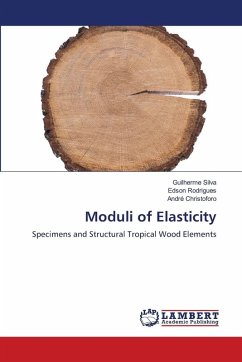
Wood is a renewable, anisotropic material with high strength-to-mass ratio, making it ideal for low-carbon construction. Although Brazilian standards outline testing methods, results from small, defect-free specimens may not reflect full-size member behavior. This study compares elastic moduli from small specimens and structural elements of five tropical hardwoods: Caixeta, Tauari, Cambará, Piquiá, and Peroba Mica. Static bending and transverse-vibration tests were conducted, with ANOVA used to assess consistency. The vibration method was statistically valid (p = 0.647), and mean moduli from small specimens matched those of structural members in bending and compression parallel to grain (p = 0.767 and 0.308). Findings confirm that elasticity moduli from small specimens reliably represent structural-scale behavior in these species.