Written by pioneering experts in the field, this book offers a wide range of approaches for molecular imprinting, experimental protocols that exemplify specific techniques, and a detailed survey on molecular imprinting research and applications. It supplies a comprehensive tutorial for learning basic techniques and making new contributions to the field, as well as in-depth discussions, guidelines, and experimental protocols to help beginners gain a jump-start in the field of molecular imprinting. Molecularly Imprinted Materials: Science and Technology contains a multitude of experimental protocols illustrating specific techniques discussed in the text.…mehr
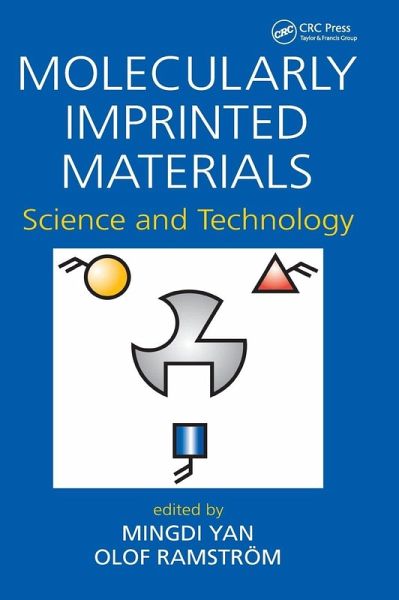
Written by pioneering experts in the field, this book offers a wide range of approaches for molecular imprinting, experimental protocols that exemplify specific techniques, and a detailed survey on molecular imprinting research and applications. It supplies a comprehensive tutorial for learning basic techniques and making new contributions to the field, as well as in-depth discussions, guidelines, and experimental protocols to help beginners gain a jump-start in the field of molecular imprinting. Molecularly Imprinted Materials: Science and Technology contains a multitude of experimental protocols illustrating specific techniques discussed in the text.
Molecular Imprinting - An Introduction. A Brief History of the "New Era" of Molecular Imprinting. The Non-Covalent Approach. The covalent and other stoichiometric approaches. The Semi-covalent Approach. The Use of Metal Coordination for Controlling the Microenvironment of Imprinted Polymers. Synthesis and Selection of Functional and Structural Monomers. Combinatorial Approaches to Molecular Imprinting. Surface Imprinting. Scaffold Imprinting. Imprinting in Inorganic Matrices. Post Modification of Imprinted Polymers. Molecular Imprinting Using Hybrid Materials as Host Matrices. Thermodynamic Considerations and the Use of Molecular Modeling as a Tool for Predicting MIP Performances. Selectivity in Molecularly Imprinted Matrices Binding Isotherms. Molecularly Imprinted Polymer Beads. Molecularly Imprinted Polymer Films and Membranes. Micromonoliths and Microfabricated Molecularly Imprinted Polymers. Chromatographic Techniques. Capillary Electrophoresis. Metal Ion selective Molecularly Imprinted Materials. Solid Phase Extraction and Byproduct Removal. Applications of Molecularly Imprinted Materials as Enzyme Mimics. Application of MIPs as Antibody Mimics in Immunoassays. Molecularly Imprinted Polymers as Recognition Elements in Sensors: Mass and Electrochemical Sensors. Molecularly Imprinted Polymers as Recognition Elements in Optical Sensors
Es gelten unsere Allgemeinen Geschäftsbedingungen: www.buecher.de/agb
Impressum
www.buecher.de ist ein Internetauftritt der buecher.de internetstores GmbH
Geschäftsführung: Monica Sawhney | Roland Kölbl | Günter Hilger
Sitz der Gesellschaft: Batheyer Straße 115 - 117, 58099 Hagen
Postanschrift: Bürgermeister-Wegele-Str. 12, 86167 Augsburg
Amtsgericht Hagen HRB 13257
Steuernummer: 321/5800/1497
USt-IdNr: DE450055826