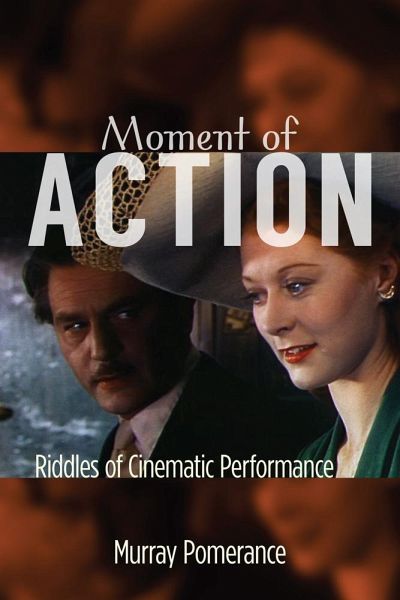
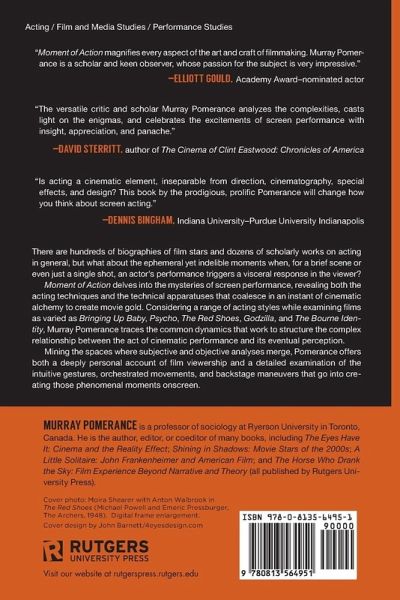
There are hundreds of biographies of filmstars and dozens of scholarly works on acting in general. But what about the ephemeral yet indelible moments when, for a brief scene or even just a single shot, an actor’s performance triggers a visceral response in the viewer? Moment of Action delves into the mysteries of screen performance, revealing both the acting techniques and the technical apparatuses that coalesce in an instant of cinematic alchemy to create movie gold. Considering a range of acting styles while examining films as varied as Bringing Up Baby, Psycho, The Red Shoes, Godzilla,…mehr
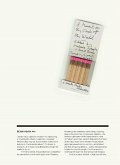
There are hundreds of biographies of filmstars and dozens of scholarly works on acting in general. But what about the ephemeral yet indelible moments when, for a brief scene or even just a single shot, an actor’s performance triggers a visceral response in the viewer? Moment of Action delves into the mysteries of screen performance, revealing both the acting techniques and the technical apparatuses that coalesce in an instant of cinematic alchemy to create movie gold. Considering a range of acting styles while examining films as varied as Bringing Up Baby, Psycho, The Red Shoes, Godzilla, and The Bourne Identity, Murray Pomerance traces the common dynamics that work to structure the complex relationship between the act of cinematic performance and its eventual perception. Mining the spaces where subjective and objective analyses merge, Pomerance offers both a deeply personal account of film viewership and a detailed examination of the intuitive gestures, orchestrated movements, and backstage maneuvers that go into creating those phenomenal moments onscreen. Moment of Action takes us on an innovative exploration of the nexus at which the actor’s keen skills spark and kindle the audience’s receptive energies.
MURRAY POMERANCE is an independent film scholar in Toronto, Canada. He is the author, editor, or co-editor of many books, including The Eyes Have It , Shining in Shadows: Movie Stars of the 2000s, A Little Solitaire: John Frankenheimer and American Film, and The Horse Who Drank the Sky: Film Experience Beyond Narrative and Theory (all published by Rutgers University Press).
Inhaltsangabe
Acknowledgments Preamble: Saw the Air Thinking about actors and their allure Natalie Wood in Rebel Without a Cause viewers’ love of acting momentary performance acting, action, and activity acting, evidence, and biography Linda Darnell casting and gatekeeping. 1 Fantastic Performance Thinking about acting style and culture innocent and scientific watching, and “falling in” The Edge of Tomorrow The Last Laugh With Blood on My Hands: Pusher II predictive performance and John Wayne transcendent performance and Katharine Hepburn Bringing Up Baby Now, Voyager El Dorado. 2 Beaux Gestes Thinking about language and gesture The Disorderly Orderly Anthony Perkins in Psycho Jeff Goldblum in Le Weekend Touch of Evil the flower of the gest Ralph Richardson and Christophe Lambert in Greystoke: The Legend of Tarzan, Lord of the Apes effects gesture Life of Pi and keyframing animated performance and puppetry Blithe Spirit Robert Walker in My Son John The Stepford Wives The Musée Grévin Jacques de Vaucanson’s duck The Thief of Bagdad Charlton Heston and Gary Cooper in The Wreck of the Mary Deare cinematic gesture and The King of Comedy The Thin Man Cool Hand Luke The Red Shoes hands and handfulness actors under direction John Frankenheimer, Burt Lancaster, and The Train Antony and Cleopatra Hitchcock, gesture, and “cattle” Kim Novak, Vertigo, and vertiginous gesture. 3 Curtains Thinking about the actor’s multiple selves Vivian Sobchack and the actor’s four bodies performance amplification Alec Guinness and preparation rehearsal and “downkeying” curtain calls Whose Life Is It Anyway? Murder on the Orient Express Citizen Kane The Magnificent Ambersons The Bad Seed “behind-the-scenes” musicals theatrical exhibition spaces credit-roll “goofing” Peter O’Toole and Winona Ryder offscreen Birdman fans and fan logic actor-in-the-street stories acting audiences the Academy Awards. 4 “It’s Not a Man, It’s a Place!” Thinking about setting and the actor’s labor workplaces under capitalism and factory design the sound stage environment Rope acting and make-up Technicolor My Dinner with André Ian Carmichael Ingrid Bergman and Under Capricorn The Wizard of Oz Grey Gardens Simon Callow and A Room with a View Charles Laughton in The Hunchback of Notre Dame Boris Karloff 2001: A Space Odyssey Haruo Nakajima, Godzilla, and body division Billion Dollar Brain The French Lieutenant’s Woman Chinatown Fred Astaire dancing with Ginger Rogers the sound boom the “caffeination schedule” acting, editing, and lighting predetermined focus Suddenly, Last Summer The Hands of Orlac The Man Who Shot Liberty Valance “Instructions for John Howell” panoptical setting Laurence Olivier in Sleuth setting and characters Bette Davis in The Letter the character “at home” in Marnie “hypothetical” performance, Sandra Bullock, and Gravity Andy Serkis the actor’s mirror animation vocalizing The Member of the Wedding. 5 Acting Intimate Thinking about actors’ trade secrecy Philip Seymour Hoffman in Boogie Nights Anthony Hopkins and Hannibal Lecter Colin Farrell and truth-telling Joaquin Phoenix in The Master zombie performance George Herbert Mead Hud Bob & Carol & Ted & Alice onscreen urination and bleeding Leonardo DiCaprio in Django Unchained the actor’s voice acting and musculature the actor’s touch interpersonal contact and audience exclusion The Bourne Identity anxious interiors Peter Lorre in Casablanca, The Maltese Falcon, and Hotel Berlin Richard Burton in The Spy Who Came In from the Cold the “Doctrine of Natural Expression” anti-intellectualism, the portrayal of genius, and Jesse Eisenberg acting the “amnesiac” forgotten moralities and cathartic awakening. Notes Works Cited and Consulted Index
Acknowledgments Preamble: Saw the Air Thinking about actors and their allure Natalie Wood in Rebel Without a Cause viewers’ love of acting momentary performance acting, action, and activity acting, evidence, and biography Linda Darnell casting and gatekeeping. 1 Fantastic Performance Thinking about acting style and culture innocent and scientific watching, and “falling in” The Edge of Tomorrow The Last Laugh With Blood on My Hands: Pusher II predictive performance and John Wayne transcendent performance and Katharine Hepburn Bringing Up Baby Now, Voyager El Dorado. 2 Beaux Gestes Thinking about language and gesture The Disorderly Orderly Anthony Perkins in Psycho Jeff Goldblum in Le Weekend Touch of Evil the flower of the gest Ralph Richardson and Christophe Lambert in Greystoke: The Legend of Tarzan, Lord of the Apes effects gesture Life of Pi and keyframing animated performance and puppetry Blithe Spirit Robert Walker in My Son John The Stepford Wives The Musée Grévin Jacques de Vaucanson’s duck The Thief of Bagdad Charlton Heston and Gary Cooper in The Wreck of the Mary Deare cinematic gesture and The King of Comedy The Thin Man Cool Hand Luke The Red Shoes hands and handfulness actors under direction John Frankenheimer, Burt Lancaster, and The Train Antony and Cleopatra Hitchcock, gesture, and “cattle” Kim Novak, Vertigo, and vertiginous gesture. 3 Curtains Thinking about the actor’s multiple selves Vivian Sobchack and the actor’s four bodies performance amplification Alec Guinness and preparation rehearsal and “downkeying” curtain calls Whose Life Is It Anyway? Murder on the Orient Express Citizen Kane The Magnificent Ambersons The Bad Seed “behind-the-scenes” musicals theatrical exhibition spaces credit-roll “goofing” Peter O’Toole and Winona Ryder offscreen Birdman fans and fan logic actor-in-the-street stories acting audiences the Academy Awards. 4 “It’s Not a Man, It’s a Place!” Thinking about setting and the actor’s labor workplaces under capitalism and factory design the sound stage environment Rope acting and make-up Technicolor My Dinner with André Ian Carmichael Ingrid Bergman and Under Capricorn The Wizard of Oz Grey Gardens Simon Callow and A Room with a View Charles Laughton in The Hunchback of Notre Dame Boris Karloff 2001: A Space Odyssey Haruo Nakajima, Godzilla, and body division Billion Dollar Brain The French Lieutenant’s Woman Chinatown Fred Astaire dancing with Ginger Rogers the sound boom the “caffeination schedule” acting, editing, and lighting predetermined focus Suddenly, Last Summer The Hands of Orlac The Man Who Shot Liberty Valance “Instructions for John Howell” panoptical setting Laurence Olivier in Sleuth setting and characters Bette Davis in The Letter the character “at home” in Marnie “hypothetical” performance, Sandra Bullock, and Gravity Andy Serkis the actor’s mirror animation vocalizing The Member of the Wedding. 5 Acting Intimate Thinking about actors’ trade secrecy Philip Seymour Hoffman in Boogie Nights Anthony Hopkins and Hannibal Lecter Colin Farrell and truth-telling Joaquin Phoenix in The Master zombie performance George Herbert Mead Hud Bob & Carol & Ted & Alice onscreen urination and bleeding Leonardo DiCaprio in Django Unchained the actor’s voice acting and musculature the actor’s touch interpersonal contact and audience exclusion The Bourne Identity anxious interiors Peter Lorre in Casablanca, The Maltese Falcon, and Hotel Berlin Richard Burton in The Spy Who Came In from the Cold the “Doctrine of Natural Expression” anti-intellectualism, the portrayal of genius, and Jesse Eisenberg acting the “amnesiac” forgotten moralities and cathartic awakening. Notes Works Cited and Consulted Index
Es gelten unsere Allgemeinen Geschäftsbedingungen: www.buecher.de/agb
Impressum
www.buecher.de ist ein Internetauftritt der buecher.de internetstores GmbH
Geschäftsführung: Monica Sawhney | Roland Kölbl | Günter Hilger
Sitz der Gesellschaft: Batheyer Straße 115 - 117, 58099 Hagen
Postanschrift: Bürgermeister-Wegele-Str. 12, 86167 Augsburg
Amtsgericht Hagen HRB 13257
Steuernummer: 321/5800/1497
USt-IdNr: DE450055826