
Andere Kunden interessierten sich auch für
 Monastic Prisons and Torture Chambers16,99 €
 John Cassian and the Creation of Monastic Subjectivity84,99 €
 Monastic Prisons and Torture Chambers29,99 €
 Church of St Peter, St. Albans26,99 €
 This Monastic Moment32,99 €
 Abtei von St Albans34,00 €
 Renaissance Monks22,99 €
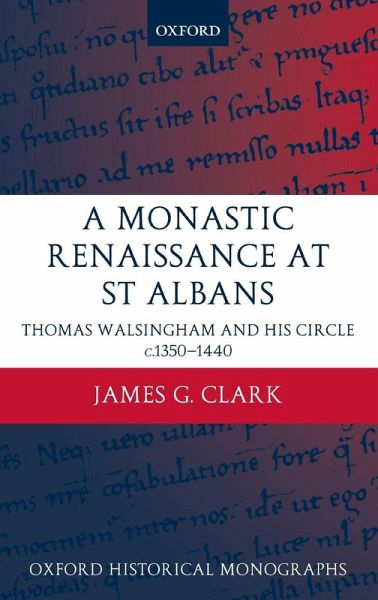
Walsingham was not only a compiler of contemporary chronicles but also a Classical scholar of extraordinary originality. His commentary on Ovid's Metamorphoses, his re-working of the histories of Alexander of Macedon and the Trojan War, and his Genealogia deorum gentilium, are discussed in detail here for the first time. Walsingham's interest in the Classics was shared by many of his St Albans colleagues, and they in turn were members of a wider circle of literary scholars, which included the London schoolmaster, John Seward. The work of these scholars, monastic and secular, points towards a revival of Classical and literary scholarship in England long before Italian humanism and other traces of the continental Renaissance first found their way into the country.
It has always been assumed that the monasteries fell into decline long before the Dissolution, but this study demonstrates the continuing vitality of education and learning in English cloisters and even uncovers evidence of a revival in Classical studies comparable to the continental Renaissance.
A Monastic Renaissance at St Albans is a study of intellectual life at the abbey of St Albans - one of Britain's greatest Benedictine monasteries - during the lifetime of Thomas Walsingham (c.1340-1422), one of the most prolific scholars of the later midd
Introduction; 1. St Albans in the Later Middle Ages; 2. Education; 3. Books; 4. Patterns of Reading; 5. Walsingham, History, and Literature; 6. Classicism; 7. Public Issues; Conclusion; Bibliography
It has always been assumed that the monasteries fell into decline long before the Dissolution, but this study demonstrates the continuing vitality of education and learning in English cloisters and even uncovers evidence of a revival in Classical studies comparable to the continental Renaissance.
A Monastic Renaissance at St Albans is a study of intellectual life at the abbey of St Albans - one of Britain's greatest Benedictine monasteries - during the lifetime of Thomas Walsingham (c.1340-1422), one of the most prolific scholars of the later midd
Introduction; 1. St Albans in the Later Middle Ages; 2. Education; 3. Books; 4. Patterns of Reading; 5. Walsingham, History, and Literature; 6. Classicism; 7. Public Issues; Conclusion; Bibliography