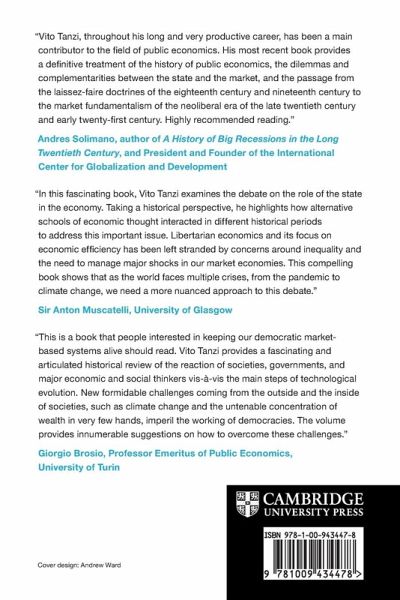
The book is written in a style that should be accessible to most readers from different intellectual disciplines, while still retaining a high intellectual rigor. It discusses areas not covered by similar books and provides a novel interpretation of developments in the past fifty years.
The book is written in a style that should be accessible to most readers from different intellectual disciplines, while still retaining a high intellectual rigor. It discusses areas not covered by similar books and provides a novel interpretation of developments in the past fifty years.
Vito Tanzi is Honorary President of the International Institute of Public Finance (IIPF). He was the Undersecretary for Economy and Finance for the Italian government and the Director of the Fiscal Affairs Department at the International Monetary Fund. He is the recipient of five honorary degrees and has authored twenty-five books and hundreds of articles. An economic effect, the 'Tanzi Effect,' carries his name.
Inhaltsangabe
Part I.: 1. Introduction 2. Early views on the economic role of the state 3. Laissez faire and the industrial revolution 4. The Beginning of economic reforms 5. On resource allocation, optimality and equity 6. On beginning of changes in the activities of governments 7. Toward larger government roles Part II.: 8. The Growing importance of equity and safety nets 9. The creation of welfare states 10. The conservative counterrevolution 11. Different approaches to social protection 12. The economy in the 1970s Part III.: 13. A return to 'laissez faire'? 14. The policies of market fundamentalism: tax reforms, globalization and deregulation 15. The growing importance of monetary policy 16. Equity aspects of market fundamentalism 17. Other aspects of market fundamentalism 18. Cultural aspects of fundamentalism 19. Growing conflict between efficiency and equity 20. Intellectual property and venture capitalists 21. The world in the 21st century 22. Impact of new economic developments on market and democracy 23. More on economy and culture in the present time 24. Summing up and general conclusions.
Part I.: 1. Introduction 2. Early views on the economic role of the state 3. Laissez faire and the industrial revolution 4. The Beginning of economic reforms 5. On resource allocation, optimality and equity 6. On beginning of changes in the activities of governments 7. Toward larger government roles Part II.: 8. The Growing importance of equity and safety nets 9. The creation of welfare states 10. The conservative counterrevolution 11. Different approaches to social protection 12. The economy in the 1970s Part III.: 13. A return to 'laissez faire'? 14. The policies of market fundamentalism: tax reforms, globalization and deregulation 15. The growing importance of monetary policy 16. Equity aspects of market fundamentalism 17. Other aspects of market fundamentalism 18. Cultural aspects of fundamentalism 19. Growing conflict between efficiency and equity 20. Intellectual property and venture capitalists 21. The world in the 21st century 22. Impact of new economic developments on market and democracy 23. More on economy and culture in the present time 24. Summing up and general conclusions.
Es gelten unsere Allgemeinen Geschäftsbedingungen: www.buecher.de/agb
Impressum
www.buecher.de ist ein Internetauftritt der buecher.de internetstores GmbH
Geschäftsführung: Monica Sawhney | Roland Kölbl | Günter Hilger
Sitz der Gesellschaft: Batheyer Straße 115 - 117, 58099 Hagen
Postanschrift: Bürgermeister-Wegele-Str. 12, 86167 Augsburg
Amtsgericht Hagen HRB 13257
Steuernummer: 321/5800/1497
USt-IdNr: DE450055826