

Andere Kunden interessierten sich auch für
 Tales from English History for Children19,00 €
 Scouting with Kit Carson Everett14,00 €
 The Financier A Novel19,00 €
 Leibniz's New Essays Concerning The Human Understanding17,00 €
 The Frontier Boys in the Sierras: The Lost Mine14,00 €
 The Mountain Girl17,00 €
 Meditations14,00 €







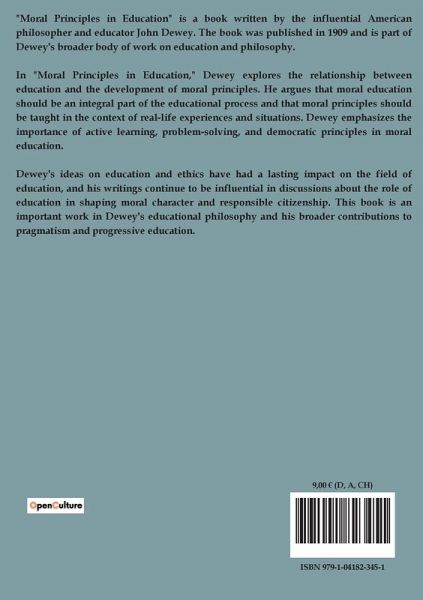
In "Moral Principles in Education," John Dewey explores the integral role of moral education within the school system, emphasizing its social and psychological dimensions. Dewey argues that education is fundamentally a public endeavor, with schools serving as vital social institutions that shape the moral character of students. He critiques the traditional separation of intellectual and moral training, advocating for a more integrated approach where moral education is embedded in all aspects of school life. Dewey highlights the importance of the school community in fostering moral development, suggesting that schools should mirror the social order to prepare students for active participation in society. He stresses that moral education should not be limited to direct instruction about ethics but should permeate the entire educational experience, influencing methods of instruction and the curriculum. Dewey also underscores the need for education to develop students' social intelligence, power, and interests, aligning with the demands of a democratic and progressive society. He calls for a curriculum that reflects social realities and encourages students to engage with the world around them, fostering habits of social imagination and cooperation. Dewey concludes by emphasizing the psychological aspects of moral education, advocating for an approach that nurtures students' instincts and impulses, develops their judgment, and enhances their emotional responsiveness. Through this comprehensive framework, Dewey envisions an educational system that not only imparts knowledge but also cultivates the moral and social capacities necessary for students to thrive as responsible and engaged citizens.