

Andere Kunden interessierten sich auch für
 The Chinese Human Rights Reader49,99 €
 Women's Suffrage in Asia53,99 €
 Covid-19 and Atrocity Prevention in East Asia38,99 €
 The Kremlin's Chinese Advance Guard40,99 €
 Hannah Arendt19,90 €
 Buddhist Manuscript Cultures53,99 €
 The Moral Sayings of Publius Syrus, a Roman Slave27,99 €




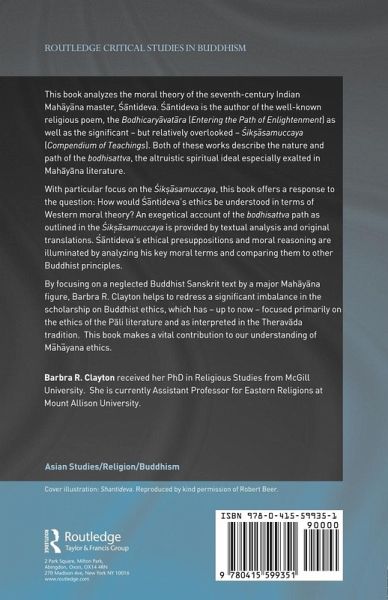
This important text analyzes the moral theory of the seventh century Indian Mahayana master, Santideva, author of the well-known religious poem, the Bodhicaryavatara (Entering the Path of Enlightenment) as well as the significant, but relatively overlooked, Siksasamuccaya (Compendium of Teachings).
With particular focus on the Siksasamuccaya, this book uses original translations and critical analysis in order to answer the question: How would Santideva's ethics be understood in terms of Western moral theory? Santideva's ethical presuppositions and moral reasoning are illuminated by analyzing his key moral terms and comparing them to other Buddhist principles.
By focusing on a neglected Buddhist Sanskrit text by a major Mahayana figure, Barbra R. Clayton helps to redress a significant imbalance in the scholarship on Buddhist ethics, which has - up to now - focused primarily on the ethics of the Pali literature as interpreted in the Theravada tradition.
With particular focus on the Siksasamuccaya, this book uses original translations and critical analysis in order to answer the question: How would Santideva's ethics be understood in terms of Western moral theory? Santideva's ethical presuppositions and moral reasoning are illuminated by analyzing his key moral terms and comparing them to other Buddhist principles.
By focusing on a neglected Buddhist Sanskrit text by a major Mahayana figure, Barbra R. Clayton helps to redress a significant imbalance in the scholarship on Buddhist ethics, which has - up to now - focused primarily on the ethics of the Pali literature as interpreted in the Theravada tradition.
'This study, through its de-tailed description of an important Indian Mahayana text, adds necessary nuance to the growing body of literature on Buddhist ethics, and doub-tlessly will remain a useful introduction to Santideva's ethical thinking for some time to come. '- Journal of Buddhist Ethics, 2008