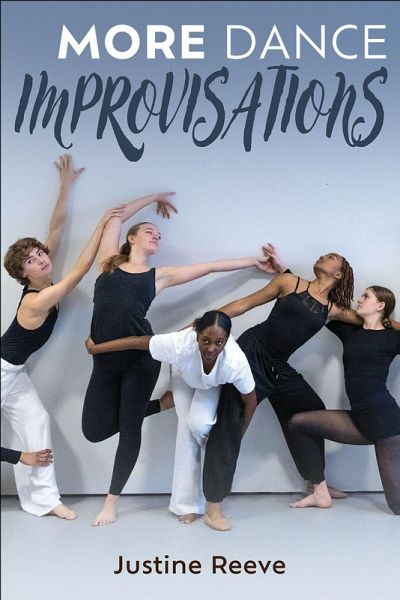
Offering 78 tested dance improvisation exercises, this resource energizes class segments from warm-up games to solo, duo, and group explorations. With step-by-step guides, creative extensions, and choreographic strategies, it empowers instructors and dancers to unlock creative movement and craft original choreography.
Offering 78 tested dance improvisation exercises, this resource energizes class segments from warm-up games to solo, duo, and group explorations. With step-by-step guides, creative extensions, and choreographic strategies, it empowers instructors and dancers to unlock creative movement and craft original choreography.
Justine Reeve has taught for over 29 years-across all age ranges-and her roles have included teacher, department head, youth dance artistic director, choreographer and consultant. Ms. Reeve earned her BA (with honours) in dance and related arts and a postgraduate diploma in dance and collaborative arts from the University of Chichester in West Sussex, England, and a postgraduate certificate in education (PGCE). She was the artistic director of the West Sussex Youth Dance Company and a standards verifier for Edexcel/Pearson BTEC levels 2 and 3. She was an A-level dance examiner/moderator for AQA. She is presently an external expert for Ofqual and a moderator for the WJEC exam board. Ms. Reeve has written units for a well-known exam board’s specifications for 10 years and has delivered continued professional development courses for teachers of dance curriculum (key stages 4 and 5) in the United Kingdom for 20 years. She has written published dance resources for the English National Ballet, Russell Maliphant Dance Company, RSL, Rambert Dance Company, Pearson Education and the London Curriculum for the Mayor of London. She has been the director of dance at the BRIT School, a dance animateur with Rambert Dance Company and a choreographer with her own company, Puppik Dance. She enjoys visiting the theatre, reading and raising her family.
Inhaltsangabe
Chapter 1. Introduction and How to Use This Book This chapter explores how to use this book, warming up and safe practice, effective planning, top tips for dance improvisation, planning your workshop, inclusive practice, and finding the right music, musicality, phrases and a table of improvisations. Chapter 2. Warm-Up Games and Tasks This chapter explores the concepts of play and spontaneous movement as stimuli for warming up the body and preparing the mind for new experiences. The games and improvisations within will prepare dancers for the creative tasks ahead, improve reaction times and explore key features of movement. Chapter 3. Solo and Duo Improvisations This chapter explores the movement responses dancers can generate on their own and with partners. Through these tasks, they’ll discover spontaneous movement answers that will develop, challenge and refine their creative responses, solo or in duos. Chapter 4. Group Creative Tasks This chapter explores the movement responses dancers can generate in groups. By working with others, they can explore and discover new movement ideas. The tasks within aim to develop, challenge and refine creative responses and the feeling of working as a team that comes with making group decisions in the moment. Chapter 5. Moving Beyond the Kinaesthetic: Using Physical and Aural Improvisation Tasks This chapter explores how starting with elements of physical and aural settings can lead students to create interesting dance. It acts as a taster for being inspired by external stimuli and will hopefully inspire an abundance of future ideas. Chapter 6. Developing Improvisations This chapter encourages dancers to use the movements, phrases and sequences created in previous tasks to play with development and structuring to manipulate the movement material. They can also develop ideas using existing material and repertoire. These are only a few suggestions to inspire additional ideas on how to develop movements into dance pieces or works.
Chapter 1. Introduction and How to Use This Book This chapter explores how to use this book, warming up and safe practice, effective planning, top tips for dance improvisation, planning your workshop, inclusive practice, and finding the right music, musicality, phrases and a table of improvisations. Chapter 2. Warm-Up Games and Tasks This chapter explores the concepts of play and spontaneous movement as stimuli for warming up the body and preparing the mind for new experiences. The games and improvisations within will prepare dancers for the creative tasks ahead, improve reaction times and explore key features of movement. Chapter 3. Solo and Duo Improvisations This chapter explores the movement responses dancers can generate on their own and with partners. Through these tasks, they’ll discover spontaneous movement answers that will develop, challenge and refine their creative responses, solo or in duos. Chapter 4. Group Creative Tasks This chapter explores the movement responses dancers can generate in groups. By working with others, they can explore and discover new movement ideas. The tasks within aim to develop, challenge and refine creative responses and the feeling of working as a team that comes with making group decisions in the moment. Chapter 5. Moving Beyond the Kinaesthetic: Using Physical and Aural Improvisation Tasks This chapter explores how starting with elements of physical and aural settings can lead students to create interesting dance. It acts as a taster for being inspired by external stimuli and will hopefully inspire an abundance of future ideas. Chapter 6. Developing Improvisations This chapter encourages dancers to use the movements, phrases and sequences created in previous tasks to play with development and structuring to manipulate the movement material. They can also develop ideas using existing material and repertoire. These are only a few suggestions to inspire additional ideas on how to develop movements into dance pieces or works.
Es gelten unsere Allgemeinen Geschäftsbedingungen: www.buecher.de/agb
Impressum
www.buecher.de ist ein Internetauftritt der buecher.de internetstores GmbH
Geschäftsführung: Monica Sawhney | Roland Kölbl | Günter Hilger
Sitz der Gesellschaft: Batheyer Straße 115 - 117, 58099 Hagen
Postanschrift: Bürgermeister-Wegele-Str. 12, 86167 Augsburg
Amtsgericht Hagen HRB 13257
Steuernummer: 321/5800/1497
USt-IdNr: DE450055826