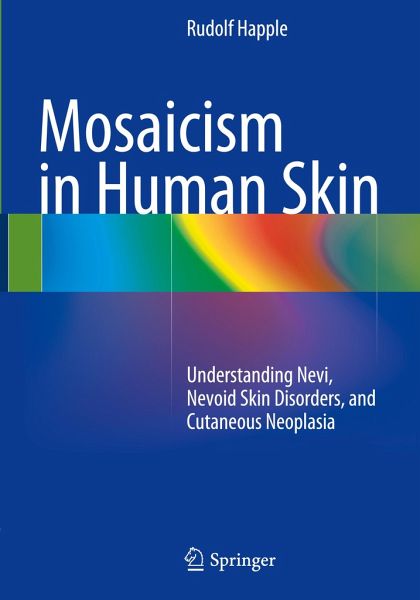
Mosaicism is a powerful biologic concept, originally developed from studying plants and animals. All cutaneous neoplasms, both benign and malignant, reflect mosaicism, which is the necessary basis to explain numerous human skin disorders. For example, various mosaic patterns visualize the embryonic development of human skin and X-linked skin disorders explain why women live longer than men, and so on. This book presents, for the first time, a comprehensive overview on the strikingly manifold patterns and peculiarities of mosaic skin disorders. This reader-friendly structured and…mehr
Mosaicism is a powerful biologic concept, originally developed from studying plants and animals. All cutaneous neoplasms, both benign and malignant, reflect mosaicism, which is the necessary basis to explain numerous human skin disorders. For example, various mosaic patterns visualize the embryonic development of human skin and X-linked skin disorders explain why women live longer than men, and so on. This book presents, for the first time, a comprehensive overview on the strikingly manifold patterns and peculiarities of mosaic skin disorders. This reader-friendly structured and straightforward publication will help the dermatologist to understand the underlying molecular mechanisms of skin disorders in order to further improve the treatment outcome.
Rudolf Happle was born in Freiburg, Germany. In 1986 he was appointed as Chairman, Department of Dermatology, University of Nijmegen, The Netherlands. In 1991 he was appointed as Chairman, Department of Dermatology, University of Marburg, Germany. During his professional career he has functioned as Founding President of the European Society for Pediatric Dermatology, and as President of the European Hair Research Society. Presently he serves as a guest professor at the University Department of Dermatology in Freiburg (Germany). In 2014, his book "Mosaicism in Human Skin" was published by Springer (Berlin). He is an honorary member of the national Dermatological Societies of 16 countries as well as the European Society for Pediatric Dermatology, the Dutch Society for Pediatric Dermatology, and the Sociedad Latinoamericana de Dermatología Pediátrica. He is an elected member of the American Dermatological Association and of the German National Academy of Sciences Leopoldina. Antonio Torrelo was born in Madrid, Spain. In 1992 he became a Consultant in Pediatric Dermatology at the Hospital Infantil Universitario Niño Jesús in Madrid, Spain, and since 2007 he has headed the Dermatology Department at the same hospital. During his professional career he has served as President of the Spanish Group of Pediatric Dermatology, the International Society of Pediatric Dermatology, and the European Society for Pediatric Dermatology. Dr. Torrelo has acted as Associate Editor of the textbooks 'Pediatric Dermatology' edited by Schachner & Hansen 4th Ed, and 'Dermatology' edited by Bolognia, Schaffer and Cerroni, 4th Ed. He has been Associate Editor of the journal 'Pediatric Dermatology,' and was recently nominated Editor-in-Chief for the new journal JEADV Clinical Practice.
Inhaltsangabe
PATTERNS AND MECHANISMS: Mosaicism as a Biological Concept:.- History.- Mosaicism in Plants, Animals, Humans.- Mosaicism Versus Chimerism.- The Mechanisms of Mosaicism .- Genomic Mosaicism of Autosomes.- Epigenetic Mosaicism of autosomes.- Genomic Mosaicism of X Chromosomes.- Epigenetic Mosaicism of X Chromosomes.- The patterns of Mosaicism .- Lines of Blaschko.- Checkerboard Pattern.- Phylloid Pattern.- Patchy Pattern Without Midline Separation.- Lateralization.- Other Patterns, so far Unclassifiable.- MOSAIC SKIN DISORDERS: Nevi.- Melanocytic Nevi.- Other Forms of Pigmentary Mosaicism.- Epidermal Nevi.- Vascular Nevi.- Connective Tissue Nevi.- Nevoid Skin Disorders.- Lyonization (Functional X-Chromosome Mosaicism) in X-Linked Skin Disorders.- Autosomal Non-Nevi.- Neoplastic Skin Lesions.- Benign Tumors.- Malignant Tumors.- CONCLUSION.
PATTERNS AND MECHANISMS: Mosaicism as a Biological Concept:.- History.- Mosaicism in Plants, Animals, Humans.- Mosaicism Versus Chimerism.- The Mechanisms of Mosaicism .- Genomic Mosaicism of Autosomes.- Epigenetic Mosaicism of autosomes.- Genomic Mosaicism of X Chromosomes.- Epigenetic Mosaicism of X Chromosomes.- The patterns of Mosaicism .- Lines of Blaschko.- Checkerboard Pattern.- Phylloid Pattern.- Patchy Pattern Without Midline Separation.- Lateralization.- Other Patterns, so far Unclassifiable.- MOSAIC SKIN DISORDERS: Nevi.- Melanocytic Nevi.- Other Forms of Pigmentary Mosaicism.- Epidermal Nevi.- Vascular Nevi.- Connective Tissue Nevi.- Nevoid Skin Disorders.- Lyonization (Functional X-Chromosome Mosaicism) in X-Linked Skin Disorders.- Autosomal Non-Nevi.- Neoplastic Skin Lesions.- Benign Tumors.- Malignant Tumors.- CONCLUSION.
Es gelten unsere Allgemeinen Geschäftsbedingungen: www.buecher.de/agb
Impressum
www.buecher.de ist ein Internetauftritt der buecher.de internetstores GmbH
Geschäftsführung: Monica Sawhney | Roland Kölbl | Günter Hilger
Sitz der Gesellschaft: Batheyer Straße 115 - 117, 58099 Hagen
Postanschrift: Bürgermeister-Wegele-Str. 12, 86167 Augsburg
Amtsgericht Hagen HRB 13257
Steuernummer: 321/5800/1497
USt-IdNr: DE450055826