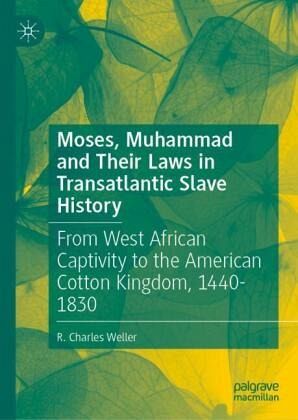
This book engages the way Christian, Jewish, Muslim and secular-progressivist actors used Mosaic and Islamic law and ethics in relation to slavery in American, West African and transatlantic history from 1440 to 1830. It focuses on how various groups marshalled these religious-legal traditions to respond to questions of enslavement, amelioration, emancipation and abolition in the face of ever-transforming social, religious-cultural, legal and political contexts over several centuries. The study offers a vital corrective to secularized histories of slavery by showing that sacred law was not…mehr
This book engages the way Christian, Jewish, Muslim and secular-progressivist actors used Mosaic and Islamic law and ethics in relation to slavery in American, West African and transatlantic history from 1440 to 1830. It focuses on how various groups marshalled these religious-legal traditions to respond to questions of enslavement, amelioration, emancipation and abolition in the face of ever-transforming social, religious-cultural, legal and political contexts over several centuries. The study offers a vital corrective to secularized histories of slavery by showing that sacred law was not peripheral but ever-central to the making and unmaking of American slavery, with legacies that reverberate through Reconstruction, segregation and modern civil rights debates.
R. Charles Weller, Ph.D., is Associate Professor of History (Career), Washington State University, and Senior Research Fellow, Al-Farabi Kazakh National University. He has also been a visiting fellow at Yale University (2010-11), a visiting researcher at Georgetown University’s Center for Muslim-Christian Understanding (2014-19) and Affiliate (Research) Faculty of History at George Mason University (2021-22).
Inhaltsangabe
1 Introduction: Historiographical Backgrounds, Contexts and Frameworks. Part I: Laying the Foundations. 2 The Early Historical and Theological Origins and Development of Mosaic and Islamic Law in West African, Transatlantic and American Enslavement History. 3 Mosaic Law in the Transition from Indentured Servitude to Racialized Lifelong Hereditary Bondage for Black Africans, 1600 1710. Part II: Mosaic and Islamic Slave Law Before and After the American Revolution. 4 The Rise & Fall of Moses the Liberator Before and After the American Revolution, 1710 1830. 5 Moses, Muhammad and Slavery among Jews and Muslims in Colonial and Early Independent America, 1654 1830. 6 Moses, Muhammad and Slavery in the Thought & Writings of Key American Founders, 1750 1830. 7 Concluding Reflections and Contributions of the Study.
Es gelten unsere Allgemeinen Geschäftsbedingungen: www.buecher.de/agb
Impressum
www.buecher.de ist ein Internetauftritt der buecher.de internetstores GmbH
Geschäftsführung: Monica Sawhney | Roland Kölbl | Günter Hilger
Sitz der Gesellschaft: Batheyer Straße 115 - 117, 58099 Hagen
Postanschrift: Bürgermeister-Wegele-Str. 12, 86167 Augsburg
Amtsgericht Hagen HRB 13257
Steuernummer: 321/5800/1497
USt-IdNr: DE450055826