
Andere Kunden interessierten sich auch für
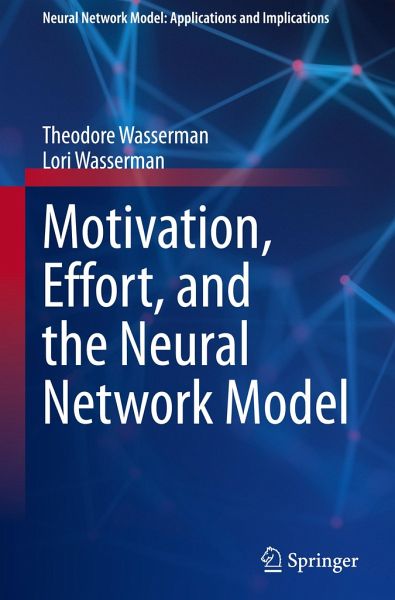
 Motivation, Effort, and the Neural Network Model38,99 €
 Therapy and the Neural Network Model38,99 €
 Therapy and the Neural Network Model38,99 €
 Basic and Translational Applications of the Network Theory for Dystonia129,99 €
 Basic and Translational Applications of the Network Theory for Dystonia129,99 €
 The Sonar of Dolphins113,99 €
 The Relevance of the Time Domain to Neural Network Models113,99 €







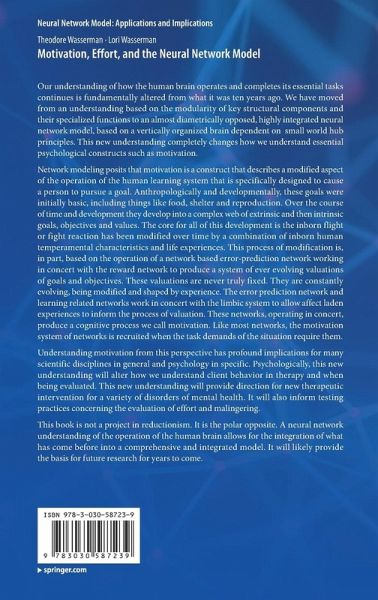
Our understanding of how the human brain operates and completes its essential tasks continues is fundamentally altered from what it was ten years ago. We have moved from an understanding based on the modularity of key structural components and their specialized functions to an almost diametrically opposed, highly integrated neural network model, based on a vertically organized brain dependent on small world hub principles. This new understanding completely changes how we understand essential psychological constructs such as motivation.
Network modeling posits that motivation is a construct that describes a modified aspect of the operation of the human learning system that is specifically designed to cause a person to pursue a goal. Anthropologically and developmentally, these goals were initially basic, including things like food, shelter and reproduction. Over the course of time and development they develop into a complex web of extrinsic and then intrinsic goals, objectives and values. The core for all of this development is the inborn flight or fight reaction has been modified over time by a combination of inborn human temperamental characteristics and life experiences. This process of modification is, in part, based on the operation of a network based error-prediction network working in concert with the reward network to produce a system of ever evolving valuations of goals and objectives. These valuations are never truly fixed. They are constantly evolving, being modified and shaped by experience. The error prediction network and learning related networks work in concert with the limbic system to allow affect laden experiences to inform the process of valuation. These networks, operating in concert, produce a cognitive process we call motivation. Like most networks, the motivation system of networks is recruited when the task demands of the situation require them.
Understanding motivation from this perspective has profound implications for many scientific disciplines in general and psychology in specific. Psychologically, this new understanding will alter how we understand client behavior in therapy and when being evaluated. This new understanding will provide direction for new therapeutic intervention for a variety of disorders of mental health. It will also inform testing practices concerning the evaluation of effort and malingering.
This book is not a project in reductionism. It is the polar opposite. A neural network understanding of the operation of the human brain allows for the integration of what has come before into a comprehensive and integrated model. It will likely provide the basis for future research for years to come.
Network modeling posits that motivation is a construct that describes a modified aspect of the operation of the human learning system that is specifically designed to cause a person to pursue a goal. Anthropologically and developmentally, these goals were initially basic, including things like food, shelter and reproduction. Over the course of time and development they develop into a complex web of extrinsic and then intrinsic goals, objectives and values. The core for all of this development is the inborn flight or fight reaction has been modified over time by a combination of inborn human temperamental characteristics and life experiences. This process of modification is, in part, based on the operation of a network based error-prediction network working in concert with the reward network to produce a system of ever evolving valuations of goals and objectives. These valuations are never truly fixed. They are constantly evolving, being modified and shaped by experience. The error prediction network and learning related networks work in concert with the limbic system to allow affect laden experiences to inform the process of valuation. These networks, operating in concert, produce a cognitive process we call motivation. Like most networks, the motivation system of networks is recruited when the task demands of the situation require them.
Understanding motivation from this perspective has profound implications for many scientific disciplines in general and psychology in specific. Psychologically, this new understanding will alter how we understand client behavior in therapy and when being evaluated. This new understanding will provide direction for new therapeutic intervention for a variety of disorders of mental health. It will also inform testing practices concerning the evaluation of effort and malingering.
This book is not a project in reductionism. It is the polar opposite. A neural network understanding of the operation of the human brain allows for the integration of what has come before into a comprehensive and integrated model. It will likely provide the basis for future research for years to come.