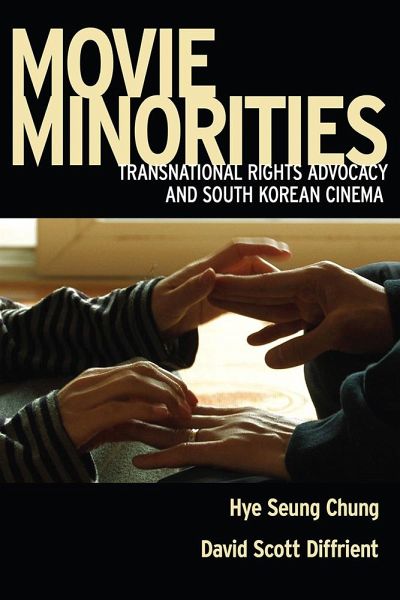
Rights advocacy has become a prominent facet of South Korea's increasingly transnational motion picture output, especially following the 1998 presidential inauguration of Kim Dae-jung, a former political prisoner and victim of human rights abuses who received the Nobel Peace Prize in 2000. Today it is not unusual to see a big-budget production about the pursuit of social justice or the protection of civil liberties contending for the top spot at the box office. With that cultural shift has come a diversification of film subjects, which range from undocumented workers' rights to the sexual…mehr
Rights advocacy has become a prominent facet of South Korea's increasingly transnational motion picture output, especially following the 1998 presidential inauguration of Kim Dae-jung, a former political prisoner and victim of human rights abuses who received the Nobel Peace Prize in 2000. Today it is not unusual to see a big-budget production about the pursuit of social justice or the protection of civil liberties contending for the top spot at the box office. With that cultural shift has come a diversification of film subjects, which range from undocumented workers' rights to the sexual harassment experienced by women to high-school bullying to the struggles among people with disabilities to gain inclusion within a society that has transformed significantly since winning democratic freedoms three decades ago. Combining in-depth textual analyses of films such as Bleak Night, Okja, Planet of Snail, Repatriation, and Silenced with broader historical contextualization, Movie Minorities offers the first English-language study of South Korean cinema's role in helping to galvanize activist social movements across several identity-based categories.
HYE SEUNG CHUNG is an associate professor of film and media studies at Colorado State University and the author of Hollywood Asian: Philip Ahn and the Politics of Cross-Ethnic Performance, Kim Ki-duk, and Hollywood Diplomacy: Film Regulation, Foreign Relations, and East Asian Representations (Rutgers University Press). She is the coauthor of Movie Migrations: Transnational Genre Flows and South Korean Cinema (Rutgers University Press). DAVID SCOTT DIFFRIENT is a professor of film and media studies at Colorado State University and the author of M*A*S*H and Omnibus Films: Theorizing Transauthorial Cinema. He is the coauthor of Movie Migrations: Transnational Genre Flows and South Korean Cinema (Rutgers University Press).
Inhaltsangabe
A Note on the Text Introduction: "I Am a Human Being": The Question of Rights in South Korean Cinema Part I Institutional Foundations and Formal Structures 1 The Rise of Rights-Advocacy Cinema in Postauthoritarian South Korea 2 If You Were Me: Transnational Crossings and South Korean Omnibus Films Part II Movie Minors and Minor Cinemas 3 Hell Is Other High Schoolers: Bigots, Bullies, and Teenage "Villainy" in South Korean Cinema 4 Indie Filmmaking and Queer Advocacy: Converging Identities in Leesong Hee-il's Films and Writings Part III Disability Rights in Mainstream and Minoritarian Filmmaking 5 Always, Blind, and Silenced: Disability Discourses in Contemporary South Korean Cinema 6 Barrier-Free Cinema: Caring for People with Disabilities and Touching the Other in Planet of Snail Part IV Representing Prisoners of the North and South 7 Beyond Torture Epistephilia: The Ethics of Encounter and Separation in Kim Dong-won's Repatriation 8 Story as Freedom or Prison? Narrative Invention and Human Rights Interventions in Camp 14: Total Control Zone Part V Migrant Worker Rights in Hybrid Documentaries 9 Between Scenery and Scenario: Landscape, Narrative, and Structured Absence in a Korean Migrant Workers Documentary 10 "Powers of the False" and "Real Fiction": Migrant Workers in The City of Cranes and Other Mockumentaries Part VI Nonhuman Rights in a Posthuman World 11 Animal Rights Advocacy, Holocaustal Imagery, and Interspecies Empathy in An Omnivorous Family's Dilemma and Okja Coda: "I Am (Not) a Human Being": The Question of Robot Rights in South Korean Cinema Acknowledgments Notes Index
A Note on the Text Introduction: "I Am a Human Being": The Question of Rights in South Korean Cinema Part I Institutional Foundations and Formal Structures 1 The Rise of Rights-Advocacy Cinema in Postauthoritarian South Korea 2 If You Were Me: Transnational Crossings and South Korean Omnibus Films Part II Movie Minors and Minor Cinemas 3 Hell Is Other High Schoolers: Bigots, Bullies, and Teenage "Villainy" in South Korean Cinema 4 Indie Filmmaking and Queer Advocacy: Converging Identities in Leesong Hee-il's Films and Writings Part III Disability Rights in Mainstream and Minoritarian Filmmaking 5 Always, Blind, and Silenced: Disability Discourses in Contemporary South Korean Cinema 6 Barrier-Free Cinema: Caring for People with Disabilities and Touching the Other in Planet of Snail Part IV Representing Prisoners of the North and South 7 Beyond Torture Epistephilia: The Ethics of Encounter and Separation in Kim Dong-won's Repatriation 8 Story as Freedom or Prison? Narrative Invention and Human Rights Interventions in Camp 14: Total Control Zone Part V Migrant Worker Rights in Hybrid Documentaries 9 Between Scenery and Scenario: Landscape, Narrative, and Structured Absence in a Korean Migrant Workers Documentary 10 "Powers of the False" and "Real Fiction": Migrant Workers in The City of Cranes and Other Mockumentaries Part VI Nonhuman Rights in a Posthuman World 11 Animal Rights Advocacy, Holocaustal Imagery, and Interspecies Empathy in An Omnivorous Family's Dilemma and Okja Coda: "I Am (Not) a Human Being": The Question of Robot Rights in South Korean Cinema Acknowledgments Notes Index
Es gelten unsere Allgemeinen Geschäftsbedingungen: www.buecher.de/agb
Impressum
www.buecher.de ist ein Internetauftritt der buecher.de internetstores GmbH
Geschäftsführung: Monica Sawhney | Roland Kölbl | Günter Hilger
Sitz der Gesellschaft: Batheyer Straße 115 - 117, 58099 Hagen
Postanschrift: Bürgermeister-Wegele-Str. 12, 86167 Augsburg
Amtsgericht Hagen HRB 13257
Steuernummer: 321/5800/1497
USt-IdNr: DE450055826