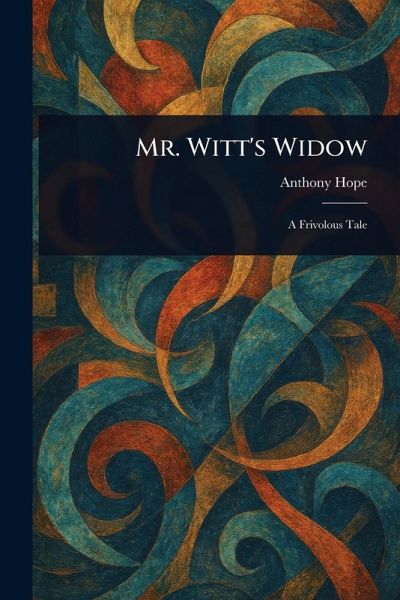
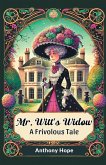
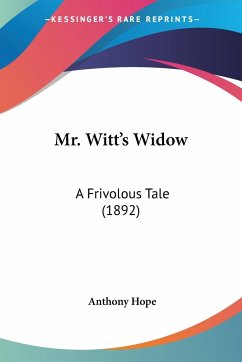
Experience the delightful intricacies of English society in Anthony Hope's "Mr. Witt's Widow: A Frivolous Tale." This engaging work of historical fiction offers a glimpse into the manners and customs of a bygone era, woven with threads of romance and sharp humor. Hope, a master of wit and social commentary, presents a story steeped in the nuances of social life and expectations. Explore the complexities of love, courtship, and reputation in a world governed by strict social codes. "Mr. Witt's Widow" is a testament to the enduring appeal of well-crafted storytelling, offering readers a chance…mehr
Experience the delightful intricacies of English society in Anthony Hope's "Mr. Witt's Widow: A Frivolous Tale." This engaging work of historical fiction offers a glimpse into the manners and customs of a bygone era, woven with threads of romance and sharp humor. Hope, a master of wit and social commentary, presents a story steeped in the nuances of social life and expectations. Explore the complexities of love, courtship, and reputation in a world governed by strict social codes. "Mr. Witt's Widow" is a testament to the enduring appeal of well-crafted storytelling, offering readers a chance to immerse themselves in a world where every word and gesture carries significant weight. This meticulously prepared print republication ensures the preservation of Hope's original work, allowing readers to savor the charm and wit of this classic tale. This work has been selected by scholars as being culturally important, and is part of the knowledge base of civilization as we know it. This work is in the public domain in the United States of America, and possibly other nations. Within the United States, you may freely copy and distribute this work, as no entity (individual or corporate) has a copyright on the body of the work. Scholars believe, and we concur, that this work is important enough to be preserved, reproduced, and made generally available to the public. We appreciate your support of the preservation process, and thank you for being an important part of keeping this knowledge alive and relevant.
Sir Anthony Hope Hawkins, as Anthony Hope (9 February 1863 - 8 July 1933), was a British novelist and playwright. He was a prolific writer, particularly of adventure stories, yet he is best known for only two works: The Prisoner of Zenda (1894) and its sequel Rupert of Hentzau (1898). These writings, considered "minor classics" of English literature, are set in the contemporaneous fictional kingdom of Ruritania and gave rise to the Ruritanian romance genre, which includes books set in fictional European places comparable to the novels. Zenda has inspired numerous adaptations, most notably the 1937 Hollywood film of the same name and the 1952 remake. Hope attended St John's School, Leatherhead, Marlborough College, and Balliol College, Oxford. In an intellectually distinguished career at Oxford, he earned first-class honours in Classical Moderations (Literis Graecis et Latinis) in 1882 and Literae Humaniores ('Greats') in 1885. Hope studied law and became a barrister in 1887, when the Middle Temple called him to the Bar. He studied under the future Liberal Prime Minister H. H. Asquith, who saw him as a potential barrister but was disillusioned by his decision to pursue a career in writing.
Es gelten unsere Allgemeinen Geschäftsbedingungen: www.buecher.de/agb
Impressum
www.buecher.de ist ein Internetauftritt der buecher.de internetstores GmbH
Geschäftsführung: Monica Sawhney | Roland Kölbl | Günter Hilger
Sitz der Gesellschaft: Batheyer Straße 115 - 117, 58099 Hagen
Postanschrift: Bürgermeister-Wegele-Str. 12, 86167 Augsburg
Amtsgericht Hagen HRB 13257
Steuernummer: 321/5800/1497
USt-IdNr: DE450055826