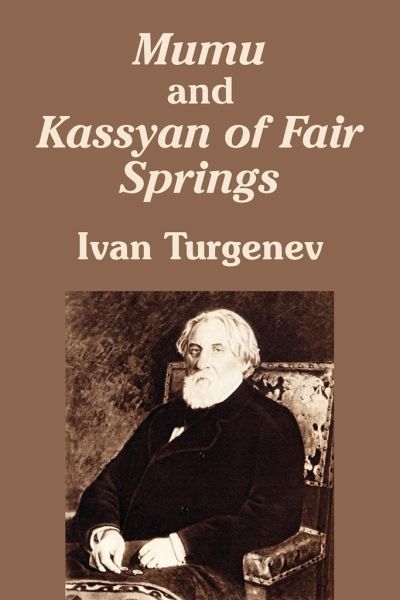
Turgenev is an author who no longer belongs to Russia only. During the last fifteen years of his life he won for himself the reading public, first in France, then in Germany and America, and finally in England. To one familiar with all Turgenev's works it is evident that he possessed the keys of all human emotions, all human feelings, the highest and the lowest, the novel as well as the base. But there was in him such a love of light, sunshine, and living human poetry, such an organic aversion for all that is ugly, or coarse and discordant, that he make himself almost exclusively the poet of…mehr
Turgenev is an author who no longer belongs to Russia only. During the last fifteen years of his life he won for himself the reading public, first in France, then in Germany and America, and finally in England. To one familiar with all Turgenev's works it is evident that he possessed the keys of all human emotions, all human feelings, the highest and the lowest, the novel as well as the base. But there was in him such a love of light, sunshine, and living human poetry, such an organic aversion for all that is ugly, or coarse and discordant, that he make himself almost exclusively the poet of the gentler side of human nature. We may say that the description of love is Turgenev's speciality.
Ivan Sergeevich Turgenev (1818-1883) was a prominent Russian novelist, short story writer, and playwright, widely regarded as one of the most significant figures in Russian literature. He is known for his lyrical prose, deep characterizations, and exploration of social and political issues. Turgenev initially began his literary career with poetry and short stories but gained widespread recognition with his 1852 collection "A Sportsman's Sketches" (also known as "Sketches from a Hunter's Album"). This work, which depicted the harsh realities of serfdom and the lives of Russian peasants, contributed significantly to the abolition of serfdom in 1861. Turgenev was also known for his play "A Month in the Country" (1855), a psychological exploration of unrequited love. He was part of the group of Russian writers who brought Russian literature to international attention in the 19th century. Though his works were less intense and philosophical than those of contemporaries like Dostoevsky and Tolstoy, Turgenev s elegance and realism made him widely admired. He died on September 3, 1883, in Bougival, near Paris, France, leaving behind a lasting legacy.
Es gelten unsere Allgemeinen Geschäftsbedingungen: www.buecher.de/agb
Impressum
www.buecher.de ist ein Internetauftritt der buecher.de internetstores GmbH
Geschäftsführung: Monica Sawhney | Roland Kölbl | Günter Hilger
Sitz der Gesellschaft: Batheyer Straße 115 - 117, 58099 Hagen
Postanschrift: Bürgermeister-Wegele-Str. 12, 86167 Augsburg
Amtsgericht Hagen HRB 13257
Steuernummer: 321/5800/1497
USt-IdNr: DE450055826