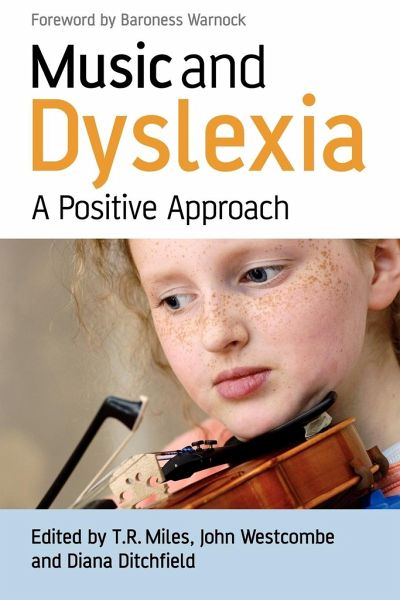
Published originally in 2001, the first edition of Music and Dyslexia shed light on the personal experiences of dyslexic musicians and music teachers who taught dyslexic students. The field has developed rapidly, particularly in the area of neuropsychology.
Published originally in 2001, the first edition of Music and Dyslexia shed light on the personal experiences of dyslexic musicians and music teachers who taught dyslexic students. The field has developed rapidly, particularly in the area of neuropsychology.
Tim Miles, OBE, MA, PhD, CPsychol., FBPS, was the first professor of Psychology at the University of Wales, Bangor, serving from 1963 to 1987, and is now professor Emeritus. He has published widely both on dyslexia and other topics. he is an amateur cellist. John Westcombe taught music in Inner London before taking advisory and music direction posts in three large LEAs. More recently, consultancy work has been done for Trinity college of Music and Youth Music. Current interests include concert reviewing and Chairing the British Dyslexia Association Music Committee. Heinemann published his careers in Music (1997). Diana Ditchfield Studied piano performance at the royal Irish Academy of Music, before taking degrees in Education and trading in secondary school in the United Kingdom. Her interest in dyslexia started in the 1980s. She teaches piano at the Municipal School of Music in Limerick and is a Learning Support Tutor in Disability Services at University Level.
Inhaltsangabe
Foreword. List of contributors. Preface. Section I. Tackling problems. 1. Dyslexia and Developmental differences (T. R. Miles). 2. Things that can go wrong (T.R. Miles). Section II. In and around the classroom.
3. In and around the classroom (Christine McRitchie Pratt). 4. Classroom rhythm games for literacy support (Katie Overy). 5. Early years: Deirdre starts to learn piano (Olivia McCarthy and Diana Ditchfield). 6. Winning over the reluctants (Christine McRitchie Pratt, Diana Ditchfield, Sheila Oglethorpe and John Westcombe). 7. Can music lessons help the dyslexic learner? (Sheila Oglethorpe). 8. Parallels between the teaching of musical and mathematical notation (Tim Miles). 9. The paperwork (Diana Ditchfield). 10. Sight-reading (Sheila Oglethorpe). 11. Sight-reading and memory (Michael Lea). 12. Ten top tips and thoughts (Nigel Clarke). 13. Can computers help? Matching the inner with the outer ear (Adam Apostoli). Section III. Strategies and successes. 14. Positive connections across the generations (Annemarie Sand and John Westcombe). 15. Similarities and differences in the dyslexic voice (Paula Bishop-Liebler). 16. Thirty-seven oboists (Carolyn King). 17. Suzuki benefits for children with dyslexia (Jenny Macmillan). 18. Dyslexia: no problem (Diana Ditchfield). Section IV. Science takes us forward. 19. Insights from brain imaging (Katie Overy). 20. Music reading: a cognitive neuroscience approach (Lauren Stewart). Index.
Foreword. List of contributors. Preface. Section I. Tackling problems. 1. Dyslexia and Developmental differences (T. R. Miles). 2. Things that can go wrong (T.R. Miles). Section II. In and around the classroom.
3. In and around the classroom (Christine McRitchie Pratt). 4. Classroom rhythm games for literacy support (Katie Overy). 5. Early years: Deirdre starts to learn piano (Olivia McCarthy and Diana Ditchfield). 6. Winning over the reluctants (Christine McRitchie Pratt, Diana Ditchfield, Sheila Oglethorpe and John Westcombe). 7. Can music lessons help the dyslexic learner? (Sheila Oglethorpe). 8. Parallels between the teaching of musical and mathematical notation (Tim Miles). 9. The paperwork (Diana Ditchfield). 10. Sight-reading (Sheila Oglethorpe). 11. Sight-reading and memory (Michael Lea). 12. Ten top tips and thoughts (Nigel Clarke). 13. Can computers help? Matching the inner with the outer ear (Adam Apostoli). Section III. Strategies and successes. 14. Positive connections across the generations (Annemarie Sand and John Westcombe). 15. Similarities and differences in the dyslexic voice (Paula Bishop-Liebler). 16. Thirty-seven oboists (Carolyn King). 17. Suzuki benefits for children with dyslexia (Jenny Macmillan). 18. Dyslexia: no problem (Diana Ditchfield). Section IV. Science takes us forward. 19. Insights from brain imaging (Katie Overy). 20. Music reading: a cognitive neuroscience approach (Lauren Stewart). Index.
Es gelten unsere Allgemeinen Geschäftsbedingungen: www.buecher.de/agb
Impressum
www.buecher.de ist ein Internetauftritt der buecher.de internetstores GmbH
Geschäftsführung: Monica Sawhney | Roland Kölbl | Günter Hilger
Sitz der Gesellschaft: Batheyer Straße 115 - 117, 58099 Hagen
Postanschrift: Bürgermeister-Wegele-Str. 12, 86167 Augsburg
Amtsgericht Hagen HRB 13257
Steuernummer: 321/5800/1497
USt-IdNr: DE450055826