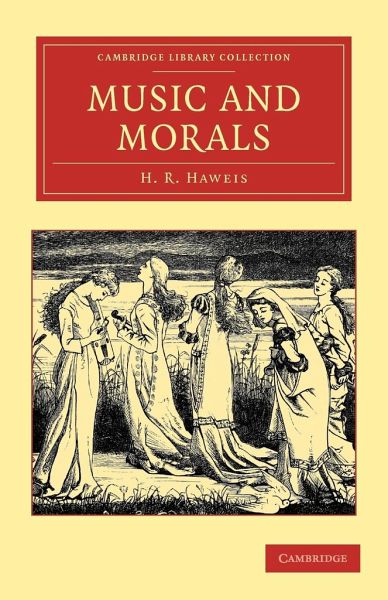
The English cleric and writer H. R. Haweis (1838-1901) considers the philosophical side of music and how it is connected with emotions and morals in this 1871 publication. Containing an interesting mixture of musical philosophy and facts, the book is divided into four sections - Philosophical, Biographical, Instrumental and Critical - each of which comprises a series of short entries or essays on a wide range of subjects. Haweis provides informative biographies of a number of great composers, including Handel, Schubert, Mozart, Beethoven and Mendelssohn, together with analysis of some of their…mehr
The English cleric and writer H. R. Haweis (1838-1901) considers the philosophical side of music and how it is connected with emotions and morals in this 1871 publication. Containing an interesting mixture of musical philosophy and facts, the book is divided into four sections - Philosophical, Biographical, Instrumental and Critical - each of which comprises a series of short entries or essays on a wide range of subjects. Haweis provides informative biographies of a number of great composers, including Handel, Schubert, Mozart, Beethoven and Mendelssohn, together with analysis of some of their best-known works. He takes an in-depth look at a selection of instruments, including violins and pianos, and concludes with a section of short essays on a wide range of topics including brass bands, musical tastes in England, conductors and opera. Quirky and engaging, the book contains a wealth of information and will appeal to any music-lover.
Mary Eliza Haweis, née Joy (1848-1898), was the daughter of the painter Thomas Musgrave Joy, and an artist in her own right, who first won fame with her exhibition at the Royal Academy under her maiden name Miss M. E. Joy. Her literary career started after she married Hugh Reginald Haweis, and after illustrating his books, started writing her own using the name "Mrs. H. R. Haweis." Chaucer for Children was her very first book, and catapulted her to instant fame. She followed this up with several other works centered around art, fashion, history, and literature, including The Art of Beauty (1878), The Art of Dress (1879), The Art of Decoration (1881), and The Art of Housekeeping (1889). From 1880 she wrote essays on artistic houses, first published in the magazine The Queen. Apart from her literary work, she is also remembered for her successful campaign to have museums opened on Sundays-revolutionary at the time, but now standard practice around the globe.
Inhaltsangabe
Book I. Philosophical: Music, Emotion, and Morals Book II. Biographical: From Ambrose to Handel Handel Gluck Haydn Schubert Chopin The letters of Mozart The letters of Beethoven Mendelssohn Book III. Instrumental: Violins Pianoforte Bells Book IV. Critical: Music in England Conclusion Appendix.
Book I. Philosophical: Music, Emotion, and Morals Book II. Biographical: From Ambrose to Handel Handel Gluck Haydn Schubert Chopin The letters of Mozart The letters of Beethoven Mendelssohn Book III. Instrumental: Violins Pianoforte Bells Book IV. Critical: Music in England Conclusion Appendix.
Es gelten unsere Allgemeinen Geschäftsbedingungen: www.buecher.de/agb
Impressum
www.buecher.de ist ein Internetauftritt der buecher.de internetstores GmbH
Geschäftsführung: Monica Sawhney | Roland Kölbl | Günter Hilger
Sitz der Gesellschaft: Batheyer Straße 115 - 117, 58099 Hagen
Postanschrift: Bürgermeister-Wegele-Str. 12, 86167 Augsburg
Amtsgericht Hagen HRB 13257
Steuernummer: 321/5800/1497
USt-IdNr: DE450055826