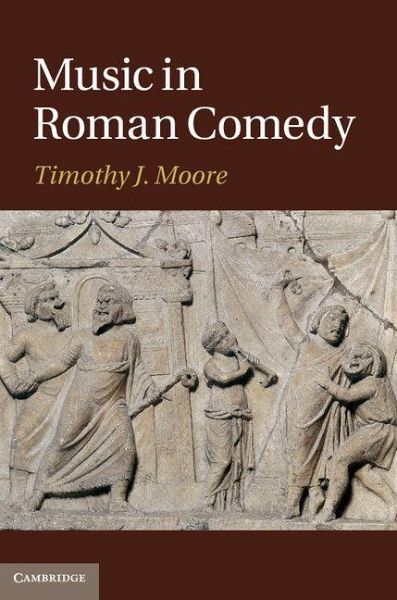
The plays of Plautus and Terence were profoundly musical: large portions of all the plays were sung to accompaniment, and variations in melody, rhythm and dance were essential elements in bringing both pleasure and meaning to their performance. This book explains the nature of Roman comedy's music: the accompanying tibia, the style of vocal performance, the importance of dance, characteristics of melody, the relationship between meter and rhythm, and the effects of different meters and of variations within individual verses. It provides musical analyses of songs, scenes and whole plays, and…mehr
The plays of Plautus and Terence were profoundly musical: large portions of all the plays were sung to accompaniment, and variations in melody, rhythm and dance were essential elements in bringing both pleasure and meaning to their performance. This book explains the nature of Roman comedy's music: the accompanying tibia, the style of vocal performance, the importance of dance, characteristics of melody, the relationship between meter and rhythm, and the effects of different meters and of variations within individual verses. It provides musical analyses of songs, scenes and whole plays, and draws analogies between Roman comedy's music and the music of modern opera, film and musical theatre. The book will change our understanding of the nature of Roman comedy and will be of interest to students of ancient theatre and Latin literature, scholars and students working on the history of music and theatre, and performers working with ancient plays.
Timothy J. Moore is John and Penelope Biggs Distinguished Professor of Classics at Washington University, St Louis. He is author of Artistry and Ideology: Livy's Vocabulary of Virtue (1989), The Theater of Plautus: Playing to the Audience (1998), a translation of Terence's Phormio and numerous articles on Livy, Tibullus, Roman comedy, Petronius, ancient music and Japanese kyogen comedy. He has produced a website in which he sings songs of Plautus in their original rhythms (http://uts.cc.utexas.edu/~timmoore/Recordings%20of%20Plautus/MoorePlautusRecordings.html). He has lectured widely in North America, Europe and China on topics including music archaeology, Western and Japanese comedy, Greek and Roman music, and analogies between Roman and American musical comedies. He also has extensive experience as a singer and as a performer in musical theatre. He has received fellowships from the Alexander von Humboldt Foundation, the American Academy in Rome and the Loeb Classical Library Foundation, and a Mellon Faculty Fellowship at Harvard University, Massachusetts.
Inhaltsangabe
Introduction 1. Tibiae and tibicines 2. Song 3. Dance 4. Melody and rhythm 5. Meters 6. Arrangement of verses and variation within the verse 7. Musical structure 8. Polymetry 9. Pseudolus 10. Adelphoe Conclusion Appendix I. The meters of Roman comedy Appendix II. Characters and meters Appendix III. Musical features by play Appendix IV. Exceptions to the ABC pattern Appendix V. Polymetric passages.
Introduction 1. Tibiae and tibicines 2. Song 3. Dance 4. Melody and rhythm 5. Meters 6. Arrangement of verses and variation within the verse 7. Musical structure 8. Polymetry 9. Pseudolus 10. Adelphoe Conclusion Appendix I. The meters of Roman comedy Appendix II. Characters and meters Appendix III. Musical features by play Appendix IV. Exceptions to the ABC pattern Appendix V. Polymetric passages.
Es gelten unsere Allgemeinen Geschäftsbedingungen: www.buecher.de/agb
Impressum
www.buecher.de ist ein Internetauftritt der buecher.de internetstores GmbH
Geschäftsführung: Monica Sawhney | Roland Kölbl | Günter Hilger
Sitz der Gesellschaft: Batheyer Straße 115 - 117, 58099 Hagen
Postanschrift: Bürgermeister-Wegele-Str. 12, 86167 Augsburg
Amtsgericht Hagen HRB 13257
Steuernummer: 321/5800/1497
USt-IdNr: DE450055826