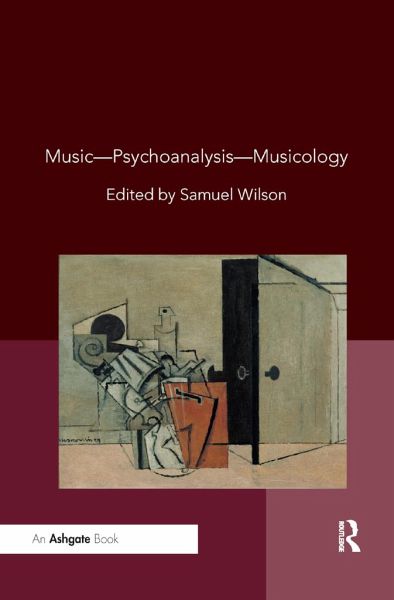
There is a growing interest in what psychoanalytic theory brings to studying and researching music. Bringing together established scholars within the field, as well as emerging voices, this collection outlines and advances psychoanalytic approaches to our understanding of a range of musics-from the romantic and the modernist to the contemporary popular. Drawing on the work of Freud, Lacan, Jung, ¿i¿ek, Barthes, and others, it demonstrates the efficacy of psychoanalytic theories in fields such as music analysis, music and culture, and musical improvisation. It engages debates about both the…mehr
There is a growing interest in what psychoanalytic theory brings to studying and researching music. Bringing together established scholars within the field, as well as emerging voices, this collection outlines and advances psychoanalytic approaches to our understanding of a range of musics-from the romantic and the modernist to the contemporary popular. Drawing on the work of Freud, Lacan, Jung, ¿i¿ek, Barthes, and others, it demonstrates the efficacy of psychoanalytic theories in fields such as music analysis, music and culture, and musical improvisation. It engages debates about both the methods through which music is understood and the situations in which it is experienced, including those of performance and listening. This collection is an invaluable resource for students, lecturers, researchers, and anyone else interested in the intersections between music, psychoanalysis, and musicology.
Samuel Wilson is Tutor in Music Philosophy and Aesthetics at Guildhall School of Music and Drama and Lecturer in Contextual Studies at London Contemporary Dance School. He completed his PhD in 2013 at Royal Holloway, University of London. His research explores music and subjectivity in the intellectual and material contexts of recent modernity. He has published on contemporary music and aesthetics, drawing on a range of theoretical perspectives-from psychoanalysis and Critical Theory to phenomenology and posthumanism.
Inhaltsangabe
Introduction Samuel Wilson Part I: Psychoanalysis, musical analysis, and method 1. Speaking of the voice in psychoanalysis and music David Bard-Schwarz 2. Parallels between Schoenberg and Freud Alexander Carpenter 3. The psychodynamics of neo-Riemannian theory Kenneth M. Smith 4. Schubert, music theory, and Lacanian fantasy Christopher Tarrant 5. Subjective and objective violence in Taylor Swift's 'I Knew You Were Trouble' Alexi Vellianitis Part II: Situating music and psychoanalysis 6. Does the psychoanalysis of music have a 'subject'? Samuel Wilson 7. Jung and the transcendent function in music therapy Rachel Darnley-Smith 8. Symbolic listening: the resistance of enjoyment and the enjoyment of resistance Jun Zubillaga-Pow 9. Masochism and sentimentality: Barthes's Schumann and Schumann's Chopin Stephen Downes
Es gelten unsere Allgemeinen Geschäftsbedingungen: www.buecher.de/agb
Impressum
www.buecher.de ist ein Internetauftritt der buecher.de internetstores GmbH
Geschäftsführung: Monica Sawhney | Roland Kölbl | Günter Hilger
Sitz der Gesellschaft: Batheyer Straße 115 - 117, 58099 Hagen
Postanschrift: Bürgermeister-Wegele-Str. 12, 86167 Augsburg
Amtsgericht Hagen HRB 13257
Steuernummer: 321/5800/1497
USt-IdNr: DE450055826