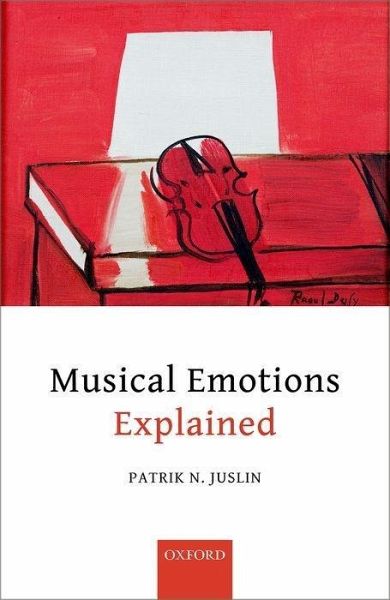
Can music really arouse emotions? If so, what emotions, and how? Why do listeners respond with different emotions to the same piece of music? Are emotions to music different from other emotions? Why do we respond to fictional events in art as if they were real, even though we know they're not? What is it that makes a performance of music emotionally expressive? Based on ground-breaking research, Musical Emotions Explained explores how music expresses and arouses emotions, and how it becomes an object of aesthetic judgments. Within the book, Juslin demonstrates how psychological mechanisms from…mehr
Can music really arouse emotions? If so, what emotions, and how? Why do listeners respond with different emotions to the same piece of music? Are emotions to music different from other emotions? Why do we respond to fictional events in art as if they were real, even though we know they're not? What is it that makes a performance of music emotionally expressive? Based on ground-breaking research, Musical Emotions Explained explores how music expresses and arouses emotions, and how it becomes an object of aesthetic judgments. Within the book, Juslin demonstrates how psychological mechanisms from our ancient past engage with meanings in music at multiple levels of the brain to evoke a broad variety of affective states - from startle responses to profound aesthetic emotions, and explores why these mechanisms respond to music? Written by one of the leading researchers in the field, the book is richly illustrated with music examples from everyday life, and explains with clarity and rigour the manifold ways in which music may engage our emotions, in a style sufficiently engaging for lay readers, yet comprehensive and novel enough for specialists.
Patrik N. Juslin is Professor of Psychology at Uppsala University in Sweden, where he directs their research and teaching in music psychology. His work focuses on the perception and experience of sound in music and speech, particularly in relation to emotion, also covering areas such as music education, health, music performance, and aesthetics. Juslin co-edited the Handbook of Music and Emotion (2010) together with John Sloboda, and has also previously worked semi-professionally as a guitar player.
Inhaltsangabe
Part I: Introduction 1: Setting the Stage: Overture in C Major 2: The Book's Composition: Aim and Structure 3: The Value of a Psychological Approach 4: Music, Experience, and Affect Part II: Expression and Perception of Emotion 5: What Is Meant by Emotional Expression? 6: Empirical Studies: What Have We Learned? 7: Music as Expression: Objections and Obstacles 8: Breaking the Code: The Musical Features 9: How Are Music and Emotion Links Studied? 10: Viewing Music Through a Brunswikian Lens 11: The Voice of Angels? Iconic Expression 12: Further Layers: Intrinsic and Associative Expression 13: Deviation From the Exact: The Role of the Performer Part III: Arousal of Emotion 14: Beyond Perception: When Music Moves Us 15: Does Music Arouse Emotions? How Do We Know? 16: The Prevalence of Emotional Reactions 17: How Does Music Arouse Emotions? 18: Jumping at Shadows: Brain Stem Reflex 19: Get Into the Groove: Rhythmic Entrainment 20: Mirroring the Expression: Contagion 21: Ring My Bell: Evaluative Conditioning 22: Blast From the Past: Episodic Memory 23: Seeing in the Mind's Eye: Visual Imagery 24: What Comes Next? Musical Expectancy 25: Predictions, Implications, Complications Part IV: Aesthetic Judgment 26: Aesthetics: The Hard Problem? 27: Traditional Approaches to Aesthetics 28: What's Special? Adopting the Aesthetic Attitude 29: Aesthetic Criteria: Meet the Usual Suspects! 30: A Novel Approach Towards Aesthetic Judgment 31: Aesthetics and Affect in Broader Perspective 32: The Last Chorus: Putting It All Together 33: Coda: Final Outlook Appendix: The Lens Model Equation
Es gelten unsere Allgemeinen Geschäftsbedingungen: www.buecher.de/agb
Impressum
www.buecher.de ist ein Internetauftritt der buecher.de internetstores GmbH
Geschäftsführung: Monica Sawhney | Roland Kölbl | Günter Hilger
Sitz der Gesellschaft: Batheyer Straße 115 - 117, 58099 Hagen
Postanschrift: Bürgermeister-Wegele-Str. 12, 86167 Augsburg
Amtsgericht Hagen HRB 13257
Steuernummer: 321/5800/1497
USt-IdNr: DE450055826