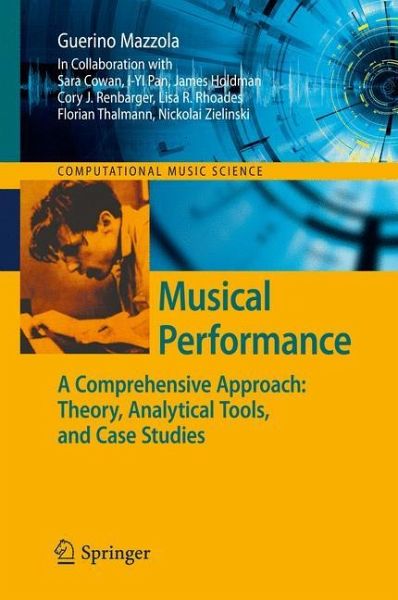
This book is a first sketch of what the overall field of performance could look like as a modern scientific field but not its stylistically differentiated practice, pedagogy, and history. Musical performance is the most complex field of music. It comprises the study of a composition's expression in terms of analysis, emotion, and gesture, and then its transformation into embodied reality, turning formulaic facts into dramatic movements of human cognition. Combining these components in a creative way is a sophisticated mix of knowledge and mastery, which more resembles the cooking of a delicate…mehr
This book is a first sketch of what the overall field of performance could look like as a modern scientific field but not its stylistically differentiated practice, pedagogy, and history. Musical performance is the most complex field of music. It comprises the study of a composition's expression in terms of analysis, emotion, and gesture, and then its transformation into embodied reality, turning formulaic facts into dramatic movements of human cognition. Combining these components in a creative way is a sophisticated mix of knowledge and mastery, which more resembles the cooking of a delicate recipe than a rational procedure.
This book is the first one aiming at such comprehensive coverage of the topic, and it does so also as a university text book. We include musicological and philosophical aspects as well as empirical performance research. Presenting analytical tools and case studies turns this project into a demanding enterprise in construction and experimental setups of performances, especially those generated by the music software Rubato.
We are happy that this book was written following a course for performance students at the School of Music of the University of Minnesota. Their education should not be restricted to the canonical practice. They must know the rationale for their performance. It is not sufficient to learn performance with the old-fashioned imitation model of the teacher's antetype, this cannot be an exclusive tool since it dramatically lacks the poetical precision asked for by Adorno's and Benjamin's micrologic. Without such alternatives to intuitive imitation, performance risks being disconnected from the audience.
Linshujie Zheng is a soprano. She has a master's degree with distinction at Cardiff University. Currently she pursues a doctoral degree in voice at the University of Minnesota. Zheng has received awards and scholarships in China, the UK, and the US. She has performed at the Royal Albert Hall, Wales Millennium centre, and St David's Hall. She also sung principal roles, including Zerlina in Don Giovanni, Genovieve in Suor Angelica, Susanna in Le nozze di Figaro. Zheng not only focuses on the performing arts, she also has a passion for Gesture and reception theory. Guerino Mazzola qualified as a professor in mathematics and in computational science at the University of Zürich. Visiting professor at the ENS in Paris in 2005. Since 2007 professor at the School of Music, University of Minnesota. He developed a Mathematical Music Theory and music software presto and Rubato. 2007-2021 he was the president of the Societyfor Mathematics and Computation in Music. He has published 33 books and 150 papers, 27 jazz CDs, two DVDs, and a classical sonata. His most important book is "The Topos of Music", about mathematical music, performance, and gesture theory.
Inhaltsangabe
Part I Introduction.- 1 Introduction and Overview.- 2 List of Symbols.- 3 Short History of Performance Theory.- 4 Oniontology.- Part II Structure Theory.- 5 What Is Structure Theory?- 6 Tempo Curves.- 7 Tuning, Intonation, and Dynamics.- 8 Combining Tempo, Tuning, and Dynamics.- 9 Articulation.- 10 General Performance Fields.- 11 The Category of Performance Cells and Hierarchies .- Part III Expressive Theory.- 12 What Is Expressive Theory?- 13 Emotional Expression.- 14 Gestural Expression.- 15 Analytical Expression.- 16 Analytical Weights.- 17 Shaping Operators.- 18 Two Generic Models and the Challenge of Improvisation.- 19 String Quartet Theory .- Part IV Rubato: Model and Software.- 20 Performance Scores.- 21 Stemma Theory.- 22 Case Studies.- 23 Statistics.- Part V Inverse Performance.- 24 What Is Inverse Performance Theory?- 25 The Technical Setup.- 26 Schumann's Träumerei: Argerich vs. Horowitz.- 27 Rethinking Music Critique.- Part VI Epilogue.- 28 Summary of Performance Theory.- 29 Future Developments.- Part VII Bibliographic References, Music Examples, and Index.- References Bibliography.- Music Examples.
Part I Introduction.- 1 Introduction and Overview.- 2 List of Symbols.- 3 Short History of Performance Theory.- 4 Oniontology.- Part II Structure Theory.- 5 What Is Structure Theory?- 6 Tempo Curves.- 7 Tuning, Intonation, and Dynamics.- 8 Combining Tempo, Tuning, and Dynamics.- 9 Articulation.- 10 General Performance Fields.- 11 The Category of Performance Cells and Hierarchies .- Part III Expressive Theory.- 12 What Is Expressive Theory?- 13 Emotional Expression.- 14 Gestural Expression.- 15 Analytical Expression.- 16 Analytical Weights.- 17 Shaping Operators.- 18 Two Generic Models and the Challenge of Improvisation.- 19 String Quartet Theory .- Part IV Rubato: Model and Software.- 20 Performance Scores.- 21 Stemma Theory.- 22 Case Studies.- 23 Statistics.- Part V Inverse Performance.- 24 What Is Inverse Performance Theory?- 25 The Technical Setup.- 26 Schumann's Träumerei: Argerich vs. Horowitz.- 27 Rethinking Music Critique.- Part VI Epilogue.- 28 Summary of Performance Theory.- 29 Future Developments.- Part VII Bibliographic References, Music Examples, and Index.- References Bibliography.- Music Examples.
Rezensionen
"[T]his book is an interesting look at a structured, theoretical investigation of artistic expression. One could question the need for such research, on the basis that traditional training works well. Whether this analysis could improve performance technique remains to be proven. On the other hand, we have much to learn about human consciousness and emotions. Work in this area could shed some light here, which would be welcome." (G.R. Mayforth, ACM Computing Reviews, May 2012)
Es gelten unsere Allgemeinen Geschäftsbedingungen: www.buecher.de/agb
Impressum
www.buecher.de ist ein Internetauftritt der buecher.de internetstores GmbH
Geschäftsführung: Monica Sawhney | Roland Kölbl | Günter Hilger
Sitz der Gesellschaft: Batheyer Straße 115 - 117, 58099 Hagen
Postanschrift: Bürgermeister-Wegele-Str. 12, 86167 Augsburg
Amtsgericht Hagen HRB 13257
Steuernummer: 321/5800/1497
USt-IdNr: DE450055826