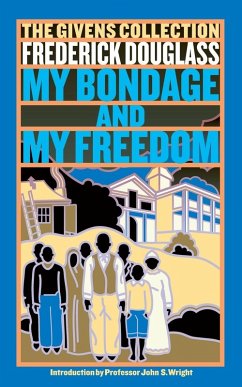
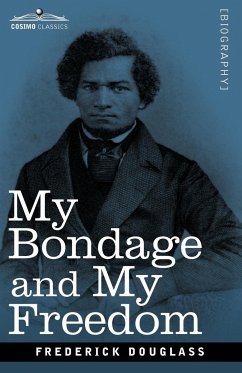
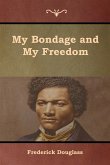
The second volume in Douglass's three great autobiographical narratives, My Bondage and My Freedom (1855) was written after he had established himself as a newspaper editor. In this book, Douglass expands upon his previous account of his years as a slave. With great psychological penetration, he probes the long-term and corrosive effects of slavery and comments upon his active resistance to the segregation he encounters in the North. Frederick Douglass was a renowned orator and the text of one of his most powerful speeches "What to the Slave is the Fourth of July?" can by found in My Bondage and My Freedom.…mehr
The second volume in Douglass's three great autobiographical narratives, My Bondage and My Freedom (1855) was written after he had established himself as a newspaper editor. In this book, Douglass expands upon his previous account of his years as a slave. With great psychological penetration, he probes the long-term and corrosive effects of slavery and comments upon his active resistance to the segregation he encounters in the North. Frederick Douglass was a renowned orator and the text of one of his most powerful speeches "What to the Slave is the Fourth of July?" can by found in My Bondage and My Freedom.
Frederick Douglass was an American social reformer, abolitionist, orator, writer, and statesman who lived from February 1817 or 1818 to February 20, 1895. After escaping slavery in Maryland, he rose to prominence as a national leader of the abolitionist movement in Massachusetts and New York, where he was known for his oratory and incisive antislavery writings. As a result, abolitionists at the time saw him as a living counterexample to enslavers' claims that enslaved persons had the intellectual aptitude to act as independent American citizens. Northerners at the time couldn't believe such a superb orator had been enslaved. Douglass released his initial biography as a reaction to his incredulity. Douglass produced a total of three autobiographies, one of which, The Story of the Life of Frederick Douglass, an American Slave (1845), got a bestseller and was influential in promoting the ideal of abolition, as was his second book, My Bondage and My Freedom (1855). Following the Civil War, Douglass was an outspoken advocate for the rights of freed slaves, and he published his final autobiography, Life and Times of Frederick Douglass.
Es gelten unsere Allgemeinen Geschäftsbedingungen: www.buecher.de/agb
Impressum
www.buecher.de ist ein Internetauftritt der buecher.de internetstores GmbH
Geschäftsführung: Monica Sawhney | Roland Kölbl | Günter Hilger
Sitz der Gesellschaft: Batheyer Straße 115 - 117, 58099 Hagen
Postanschrift: Bürgermeister-Wegele-Str. 12, 86167 Augsburg
Amtsgericht Hagen HRB 13257
Steuernummer: 321/5800/1497
USt-IdNr: DE450055826