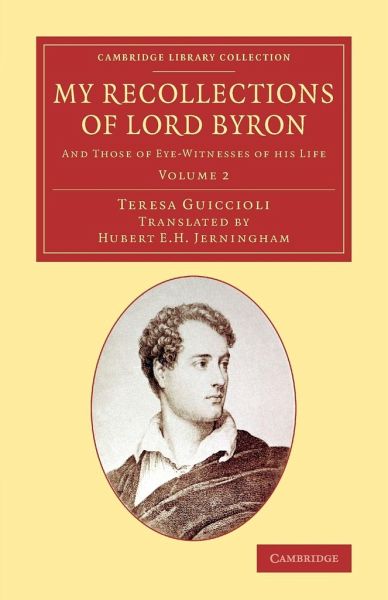
This two-volume work was originally published in French, and anonymously, in 1868. In 1869, Richard Bentley published an English translation by Hubert E. H. Jerningham, in which he stated that the work 'is the production of the celebrated Countess Guiccioli'. Teresa Guiccioli (1800-73) was nineteen, and married to a much older man, when she first met Byron in Venice. Their subsequent love affair lasted until Byron left for Greece, together with her brother Pietro Gamba, whose account of Byron's last days is also reissued in this series. Anxious to restore Byron's reputation, which she believed…mehr
This two-volume work was originally published in French, and anonymously, in 1868. In 1869, Richard Bentley published an English translation by Hubert E. H. Jerningham, in which he stated that the work 'is the production of the celebrated Countess Guiccioli'. Teresa Guiccioli (1800-73) was nineteen, and married to a much older man, when she first met Byron in Venice. Their subsequent love affair lasted until Byron left for Greece, together with her brother Pietro Gamba, whose account of Byron's last days is also reissued in this series. Anxious to restore Byron's reputation, which she believed to be tainted by a conflation in the public mind between the poet and his more notorious characters, she attempts to refute some of the more scandalous assertions about his life. Volume 2 continues to describe Byron's qualities: his generosity, courage and modesty, but also his faults, including vanity and misanthropy.
The Contessa Teresa Guiccioli, born Teresa Gamba on 1800 in Ravenna, Italy, remains an evocative figure in literary history, primarily for her intimate association with the illustrious poet, Lord George Gordon Byron. Her claim in the literary world is anchored by her memoir, 'My Recollections of Lord Byron', which details her passionate and tumultuous affair with Byron during his self-imposed exile in Italy. As a young and cultured noblewoman, she became Byron's last mistress and the muse who invigorated some of his most poignant work. Despite their age difference, Teresa and Byron shared a deep intellectual and emotional bond, which profoundly influenced Byron's literary output. Her recollections are not just a window into Byron's life and character but also an insightful reflection on the cultural and societal norms of early 19th-century Europe. The book remains a vital source for Byron scholars and enthusiasts, granting an intimate look at the man behind the myth. Teresa's narrative, while steeped in personal bias, is characterized by its candid and revealing portrayal of one of the most enigmatic poets of the Romantic era. Her style combines a mix of romanticized reminiscence with the attention to detail that befits her aristocratic background, offering scholars a fascinating glimpse into the daily life and personality of a literary giant.
Inhaltsangabe
1. Lord Byron's constancy 2. His courage and fortitude 3. His modesty 4. Virtues of his soul 5. His generosity elevated into heroism 6. His faults 7. His irritability 8. His mobility 9. His misanthropy and sociability 10. His pride 11. His vanity 12. Lord Byron's marriage and its consequences 13. His gaiety and melancholy 14. His melancholy 15. Conscience the chief quality of his soul Semi-biography of Byron in Mr Disraeli's Venetia.
1. Lord Byron's constancy 2. His courage and fortitude 3. His modesty 4. Virtues of his soul 5. His generosity elevated into heroism 6. His faults 7. His irritability 8. His mobility 9. His misanthropy and sociability 10. His pride 11. His vanity 12. Lord Byron's marriage and its consequences 13. His gaiety and melancholy 14. His melancholy 15. Conscience the chief quality of his soul Semi-biography of Byron in Mr Disraeli's Venetia.
Es gelten unsere Allgemeinen Geschäftsbedingungen: www.buecher.de/agb
Impressum
www.buecher.de ist ein Internetauftritt der buecher.de internetstores GmbH
Geschäftsführung: Monica Sawhney | Roland Kölbl | Günter Hilger
Sitz der Gesellschaft: Batheyer Straße 115 - 117, 58099 Hagen
Postanschrift: Bürgermeister-Wegele-Str. 12, 86167 Augsburg
Amtsgericht Hagen HRB 13257
Steuernummer: 321/5800/1497
USt-IdNr: DE450055826