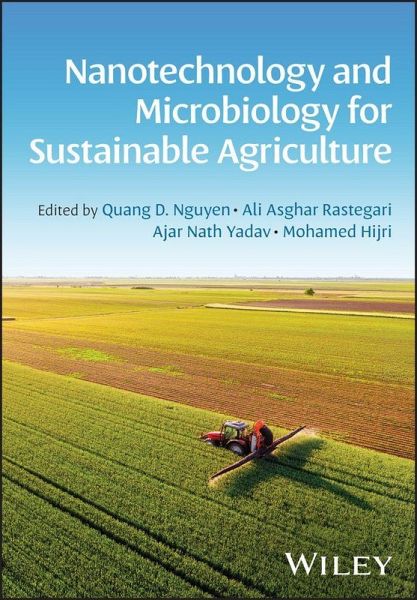
Comprehensive resource presenting benefits, opportunities, and challenges in the application of nanotechnology in farming Nanotechnology and Microbiology for Sustainable Agriculture provides a comprehensive overview of the diverse roles of nanotechnology and microbiology for sustainable agriculture, highlighting the potential synergistic applications of these two rapidly advancing scientific domains to address pressing challenges in the field. This book shows how these technologies can offer novel solutions for soil health management, enhanced nutrient delivery, pest control, stress tolerance,…mehr
Comprehensive resource presenting benefits, opportunities, and challenges in the application of nanotechnology in farming Nanotechnology and Microbiology for Sustainable Agriculture provides a comprehensive overview of the diverse roles of nanotechnology and microbiology for sustainable agriculture, highlighting the potential synergistic applications of these two rapidly advancing scientific domains to address pressing challenges in the field. This book shows how these technologies can offer novel solutions for soil health management, enhanced nutrient delivery, pest control, stress tolerance, and crop productivity. The chapters in this book are organized into several thematic sections. Topics explored include the synergistic effects of phosphorus-solubilizing microbes and nanoformulations to improve plant growth and soil fertility, the role of fungi in the production of bioactive compounds and nanomaterial development, the integration of plant and soil microbiomes with nano-interventions to support food safety, nutrient cycling, and agroecosystem resilience, the biosynthetic capabilities of actinomycetes in producing antimicrobial and growth-promoting nanomaterials, and the role of nanotechnology in enhancing GMO functionality, safety assessment, and public perception in food systems. Contributed to by international experts in their respective fields, Nanotechnology and Microbiology for Sustainable Agriculture includes information on: * Nano-biotechnological solutions for remediating pesticides, hydrocarbons, and heavy metals from soils and water bodies * Green-synthesized nanomaterials from biological sources with potential for managing plant pathogens in a sustainable manner * Advanced nanostructures for immobilizing beneficial microbes and enzymes to enhance their agricultural efficiency and stability * The formulation, mode of action, and environmental benefits of nanopesticides compared to conventional chemical pesticides * Nanobiosensor technologies for real-time monitoring of soil quality, pathogens, pollutants, and nutrient levels Nanotechnology and Microbiology for Sustainable Agriculture is an essential up-to-date resource for researchers, scientists, students, industry professionals, and government agencies interested in microbial biotechnology, bioprocess engineering, agriculture, pest control, and nano-fertilizer manufacturing.
Professor Quang D. Nguyen, Institute of Food Science and Technology, Hungarian University of Agriculture and Life Sciences, Budapest, Hungary. Dr. Ali Asghar Rastegari , Associate Professor, Department of Biochemistry, Fal.C., Islamic Azad University, Isfahan, Iran Dr. Ajar Nath Yadav, Associate Professor and Head, Department of Genetics, Plant Breeding and Biotechnology, Dr. Khem Singh Gill Akal College of Agriculture, Eternal University, Baru Sahib, Himachal Pradesh, India. Professor Mohamed Hijri, Department of Biological Sciences, Institut de recherche en biologie végétale, Universitéde Montréal, Montréal, Montréal, Canada.
Inhaltsangabe
Chapter 1. Nanotechnology and Microbiology for Sustainable Agriculture: An Introduction Chapter 2. Nanomaterials in Agriculture and Soil Revitalization: Applications, and Challenges Chapter 3. Phosphorus Solubilizing Microbes and Nanotechnologies for Plant Growth Promotion and Soil Health Chapter 4. Role of Fungi in the Production of Bioactive Compounds and Nanotechnology Chapter 5. Potential Applications of Cyanobacteria Nanoparticles in Agriculture Chapter 6. Role of Beneficial Microbes for Sustainable Agriculture and Environmental Nanotechnology Chapter 7. Microbiome Applications in the Food System and Nano- agricultural Chapter 8. Microbial Nanotechnology in Plant Growth Promotion and Crop Protection Chapter 9. Microbial Nanotechnology in Biocontrol of Insect Pest Chapter 10. Role of Actinomycetes in the Bioactive Synthesis of Nanoparticles Chapter 11. Nanotechnology for Genetically Modified Organisms in Food Production Chapter 12. Bioremediation of Contaminants using Microbial Nanotechnologies for Agricultural Sustainability Chapter 13. Nanoparticles for Bioremediation of Heavy Metal from Agricultural Fields Chapter 14. Biologically Synthesized Nanomaterials and Their Antimicrobial Potentials for Crop Protection Chapter 15. Nanostructures for Immobilization of Agricultural Used Cells and Enzymes Chapter 16. Nanopesticides and Their Potential Applications for Crop Protections Chapter 17. Nanobiosensors in Agricultural and Environmental Sustainability Chapter 18. Nanotechnology and Genetically Modified Organisms for Agricultural Sustainability Chapter 19. Global Nanotechnology Research for Agriculture Chapter 20. Regulatory Aspects of Nanotechnology in the Agriculture Sector Chapter 21.Functional Annotation of Microbes and Nanotechnology for Agricultural Productivity Chapter 22. Nanotechnology and Microbiology for Agricultural Sustainability: Current Research and Future Challenges
Chapter 1. Nanotechnology and Microbiology for Sustainable Agriculture: An Introduction Chapter 2. Nanomaterials in Agriculture and Soil Revitalization: Applications, and Challenges Chapter 3. Phosphorus Solubilizing Microbes and Nanotechnologies for Plant Growth Promotion and Soil Health Chapter 4. Role of Fungi in the Production of Bioactive Compounds and Nanotechnology Chapter 5. Potential Applications of Cyanobacteria Nanoparticles in Agriculture Chapter 6. Role of Beneficial Microbes for Sustainable Agriculture and Environmental Nanotechnology Chapter 7. Microbiome Applications in the Food System and Nano- agricultural Chapter 8. Microbial Nanotechnology in Plant Growth Promotion and Crop Protection Chapter 9. Microbial Nanotechnology in Biocontrol of Insect Pest Chapter 10. Role of Actinomycetes in the Bioactive Synthesis of Nanoparticles Chapter 11. Nanotechnology for Genetically Modified Organisms in Food Production Chapter 12. Bioremediation of Contaminants using Microbial Nanotechnologies for Agricultural Sustainability Chapter 13. Nanoparticles for Bioremediation of Heavy Metal from Agricultural Fields Chapter 14. Biologically Synthesized Nanomaterials and Their Antimicrobial Potentials for Crop Protection Chapter 15. Nanostructures for Immobilization of Agricultural Used Cells and Enzymes Chapter 16. Nanopesticides and Their Potential Applications for Crop Protections Chapter 17. Nanobiosensors in Agricultural and Environmental Sustainability Chapter 18. Nanotechnology and Genetically Modified Organisms for Agricultural Sustainability Chapter 19. Global Nanotechnology Research for Agriculture Chapter 20. Regulatory Aspects of Nanotechnology in the Agriculture Sector Chapter 21.Functional Annotation of Microbes and Nanotechnology for Agricultural Productivity Chapter 22. Nanotechnology and Microbiology for Agricultural Sustainability: Current Research and Future Challenges
Es gelten unsere Allgemeinen Geschäftsbedingungen: www.buecher.de/agb
Impressum
www.buecher.de ist ein Internetauftritt der buecher.de internetstores GmbH
Geschäftsführung: Monica Sawhney | Roland Kölbl | Günter Hilger
Sitz der Gesellschaft: Batheyer Straße 115 - 117, 58099 Hagen
Postanschrift: Bürgermeister-Wegele-Str. 12, 86167 Augsburg
Amtsgericht Hagen HRB 13257
Steuernummer: 321/5800/1497
USt-IdNr: DE450055826